
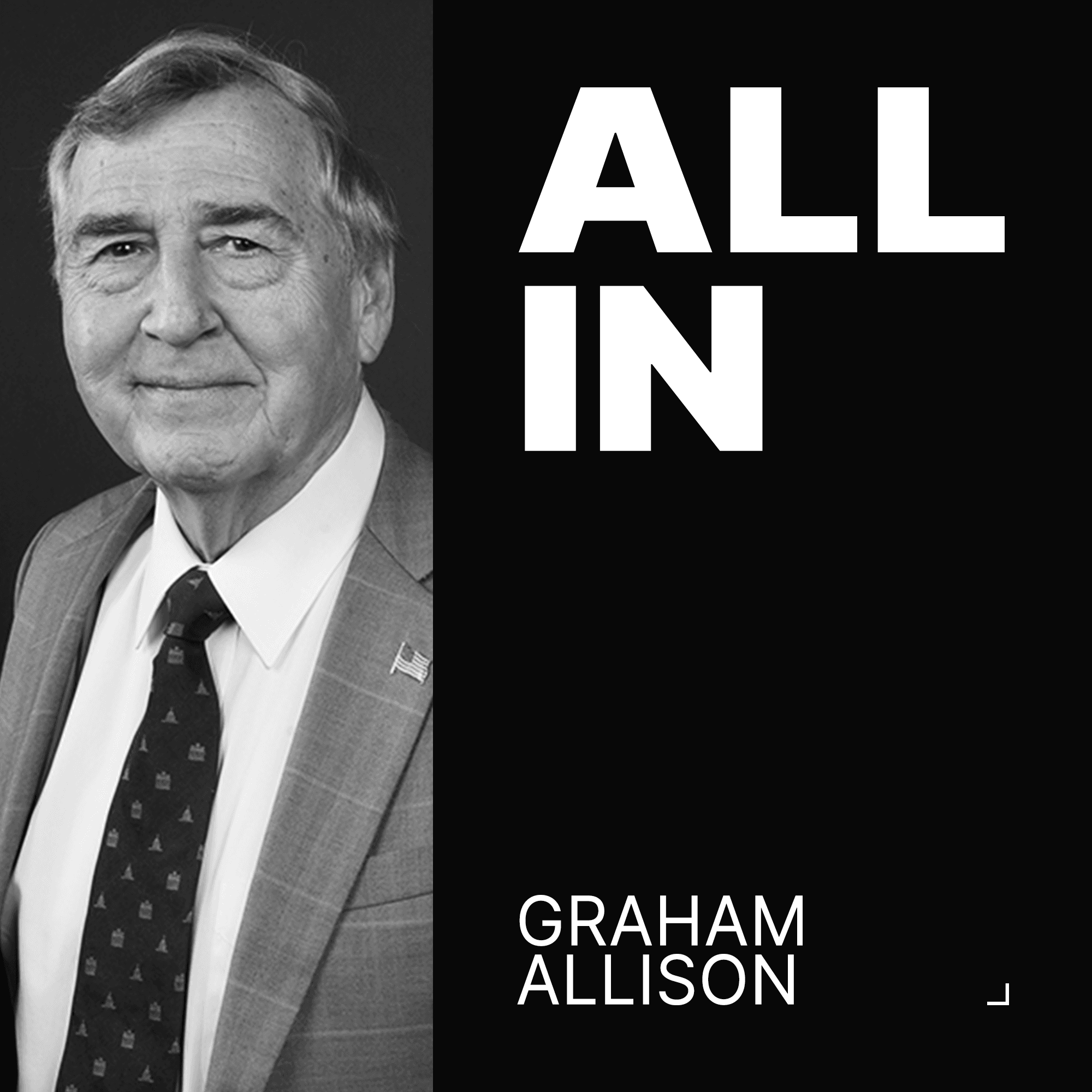
All-In Podcast: Graham Allison on the Global Realignment
Episode Date: March 9, 2026
Guests: Graham Allison, Harvard Professor
Hosts: Chamath Palihapitiya (A), Jason Calacanis (C), David Sacks, David Friedberg
Episode Overview
This episode features an in-depth, wide-ranging conversation with Professor Graham Allison, renowned for his expertise on international security and the US-China relationship. The panel explores the fast-moving geopolitical landscape, including the Iran conflict, American and Israeli motivations, impacts on global alliances, the likelihood of war involving China and Taiwan, the strategic significance of Greenland, nuclear proliferation, and domestic social unrest in the United States. Allison’s signature clarity and historical perspective underpin a discussion that’s both sobering and rich with insight.
Iran Crisis: American, Israeli, and Global Dimensions
[01:30 – 24:28]
Key Insights
-
Fog of War & Uncertainty
- All current analysis about the US and Israel’s escalation with Iran is fundamentally uncertain.
- Graham Allison:
"There's a huge level of uncertainty currently about what's happening and about what's likely to happen. … There's a fog of war that's actually increased because we got two big fog machines adding to the confusion, namely Trump and the administration on the one hand and Bibi on the other."
[01:32]
-
Demonstration of Power
- The recent operations in Iran and Venezuela reflect “supreme military and intelligence power” by the US and Israel, but create risk for hubris.
-
Regime Change Dangers
- Regime change rarely works long-term (see Afghanistan, Iraq). Destroying a regime leaves a vacuum often filled by chaos.
- Allison:
"Breaking something's a lot easier than building something."
[03:07]
-
Is This "Bibi's War"?
- Allison calls the escalation the result of Netanyahu’s 20-year obsession with Iran:
"I’m pro-Israel but anti-Bibi in this respect... I don't see evidence that Iran was about to attack the U.S. or get a nuclear weapon."
[04:36]
- Allison calls the escalation the result of Netanyahu’s 20-year obsession with Iran:
-
Trump’s Motivation
- No clear evidence of a grand strategy; Trump appears impulsive and susceptible to persuasion. The timing fits tactical opportunity (Iranian leadership exposed).
- As for China, Allison doubts the Iran escalation is purely leverage, but the demonstration of force may play into upcoming talks.
- Allison:
“Maybe he got excited by the upside, not quite careful enough about the risks or the downside.”
[08:29]
-
Civil War or Quagmire?
- Warns Iran could descend into "Syria plus," with possible civil war, fragmentation, or a hostile power vacuum.
Notable Quotes
-
Allison, on the unpredictability of war:
"In wars, very frequently it's easy to get in and it's quite difficult to get out."
[05:46] -
On potential US withdrawal:
"Trump is erratic, impulsive, but he has some coordinates... November 3rd is a big day for him... I can easily imagine in the next week... he’s left himself room to declare victory."
[18:51] -
On Israel and rising antisemitism:
"Bibi is not Israel. ... What Bibi’s doing to Israel’s democracy is really destroying it and the impact of that on Jewish kids in America ... that’s not the country I want to be proud of."
[22:05]
China, Taiwan, and the Global Power Balance
[24:28 – 39:50]
Key Insights
-
No Imminent Taiwan War
- Allison assigns only a ~5% chance China will attempt to invade Taiwan by 2028 unless provoked.
- Reasons: Preference for “peaceful reunification,” internal military purges weakening Chinese readiness, upcoming more China-friendly Taiwanese politics, Trump’s own accommodating stance.
- Allison:
"The likelihood of an attack on Taiwan this year or next year or even into 28... is very low. I put it at about where the prediction markets are, 5% or something low.”
[25:09]
-
Status Quo & Strategic Ambiguity
- Decades of delicate balancing—one China policy, strategic ambiguity—have preserved peace and Taiwan’s prosperity.
-
Taiwan’s Importance
- 96% of advanced semiconductor manufacturing centered on the small island; this concentration is a major global risk.
- The US faces enormous logistical and military challenges in defending Taiwan given its geography and China’s proximity.
-
China’s Rise and Dual Narratives
- China’s meteoric economic, technological, and geopolitical ascent fuels a narrative of inevitable US decline.
- Economic power is central to China’s strategy—domination in manufacturing, technology, and global supply chains.
Notable Quotes
-
"Never has a country risen so far so fast on so many different dimensions."
[33:43] -
On US–China rivalry:
"That dynamic, the shifting of the seesaw, is what gives you this Thucidity and dynamic ... [that] drags them into a war, after which they think, my God, how did this ever happen?"
[35:20] -
On advice to Taiwan:
"So I say to the Taiwanese friends, you know, basically, don’t screw it up."
[28:59]
China’s Domestic Challenges
[36:37 – 39:50]
- Population decline and youth unemployment are described as Xi Jinping’s largest internal threats.
- Rapid advances in robotics and AI are transforming manufacturing and could offset some demographic problems.
- Chinese society is, in many ways, more adaptive and technologically progressive than the US.
"More than half of the factory worker robots in the world are in China … If demographics is only a problem because of workers, we're going to have worker [robots]."
[37:27]
The Arctic and Greenland: The New Geopolitical Frontier
[39:50 – 48:57]
Key Insights
- Greenland is valued for its strategic location for missile defense and sea lanes as the Arctic melts.
- The US doesn’t need to invade or own Greenland to achieve its aims; long-term leases suffice.
- Rising socialism in Europe isn't seen as a direct risk of Chinese/foreign dominance, but allied relations are more important than ever as the power balance shifts.
"We, the US, can get everything we want from Greenland without invading it or owning it."
[40:27]
- Trump’s “Greenland drama” is characterized as a reality TV performance to create leverage—not a substantive territorial ambition.
Notable Quotes
- "I think Trump’s Greenland venture was more like for fun."
[42:45]
The 80-80-9 Framework: Modern Security Milestones
[48:57 – 56:20]
Key Insights
- Allison’s memorable framework:
- 80 years since a great power war
- 80 years since a nuclear bomb was used in conflict
- 9 nuclear-armed states worldwide
- These milestones are not “natural”; they’re the result of hard-won, fragile international architecture.
- Nuclear nonproliferation is eroding, with North Korean and Pakistani acquisition seen as major failures.
- Israel’s policy of “affirmative non-proliferation” (military action against potential nuclear states) is contrasted with US missteps in Korea.
"80 years. This is the longest peace in recorded history since Rome. This is not natural, this is very abnormal … The 80, the 80 and 9 we should not take for granted."
[49:47, 52:43]
Domestic Politics: Populism, Inequality, Socialism
[56:20 – 62:10]
- Rising economic inequality is sowing political instability and making the US fertile ground for populism or socialism.
- Allison cites alarming wealth imbalances and references minimal stock market participation for most Americans.
- Radical policy ideas—UBI, taxes on the wealthy, or greater wealth redistribution—may become serious, out of necessity, not ideology.
- There is an urgent need for those at the top to consider new forms of generosity or social action.
"If the top 10 or 20% are taking 80% or 70% of the pie, that's not stable and sustainable, I think, in a democracy ... it's an invitation for some more radical ideas."
[57:53]
Memorable Moments & Quotes
-
On war’s unpredictability:
"If we woke up tomorrow or today and a couple of ships have been sunk or a couple of hundred of Americans have been killed, this is going to have a very different. A different image."
[08:18] -
On American military hubris:
"You can do four or five different scenarios for how this might conceivably end. It could end up being an extended civil war in Iran among the various national groups, even some of them possibly seceding. So again, fairly chaotic. Look like Syria plus."
[17:44] -
On humility and wisdom:
"You can measure a man's knowledge and thoughtfulness by his humility ... you have extraordinary depth, and you've thought so deeply about so many of these issues." — Chamath [62:10]
Timestamps Index to Key Sections
- Iran and Global Realignment: [01:30 – 24:28]
- China and Taiwan: [24:28 – 39:50]
- The Arctic & Greenland: [39:50 – 48:57]
- Nuclear Proliferation (80-80-9): [48:57 – 56:20]
- US Populism & Inequality: [56:20 – 62:10]
Conclusion
Professor Graham Allison provides a clear-eyed, historically grounded analysis of a world in flux—from Iran’s upheaval to China’s steady rise and America’s own internal reckoning. He warns against overconfidence, highlights the limits of power, and stresses the fragility of the global order. The conversation ends on a note of humility—and urgent curiosity for the challenging years ahead.