
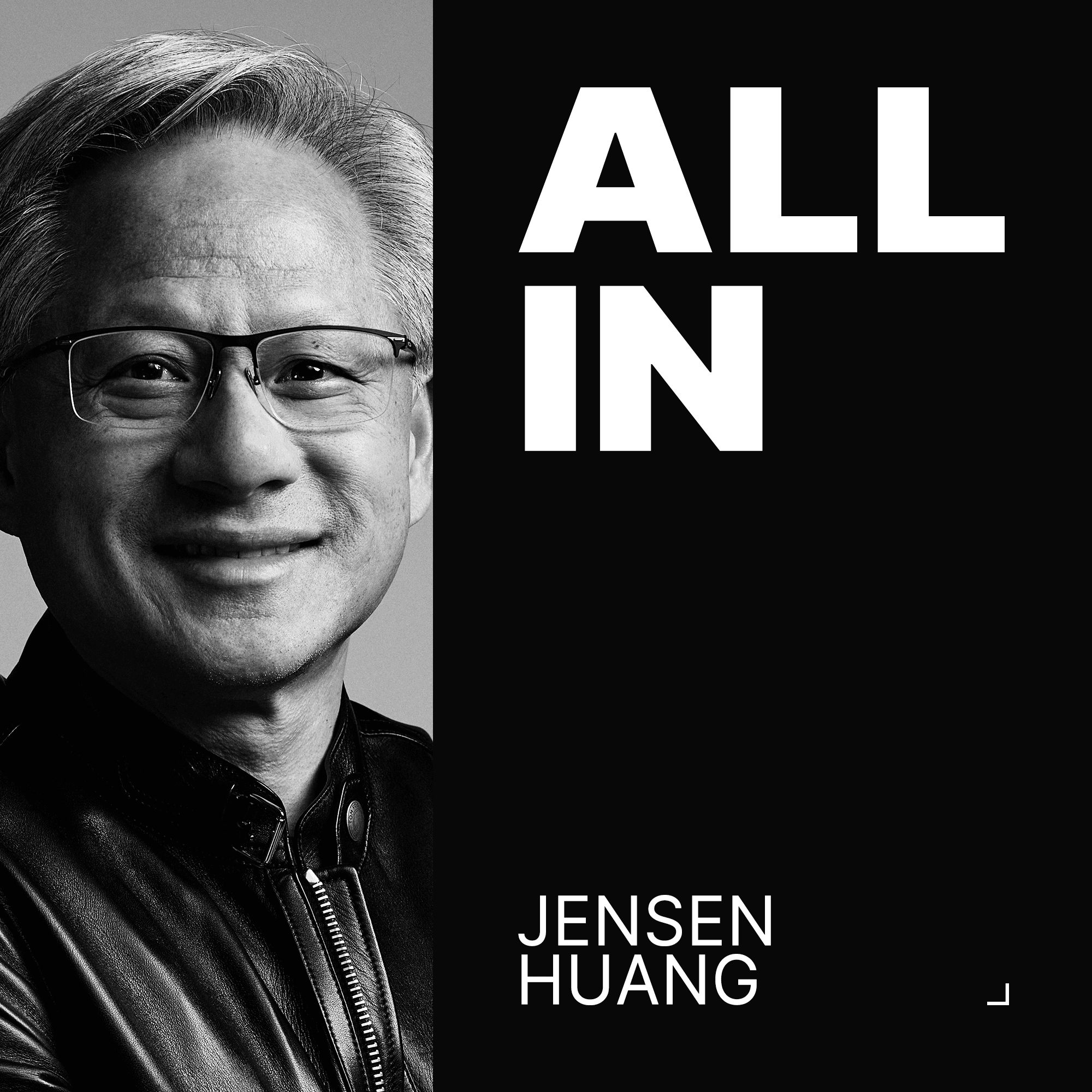
All-In Podcast: Jensen Huang LIVE — Nvidia's Future, Physical AI, Rise of the Agent, Inference Explosion, AI PR Crisis
Date: March 19, 2026
Guests: Jensen Huang (Nvidia CEO)
Hosts: Jason Calacanis, Chamath Palihapitiya, David Sacks, David Friedberg
Special Guests: Brad Gerstner, Dwarkesh Patel
Length: ~66 min (timestamps in MM:SS format)
Episode Overview
This episode features a rare and in-depth live interview with Nvidia CEO Jensen Huang, delving into the company’s evolving role as the epicenter of the artificial intelligence (AI) revolution. The panel discusses Nvidia's transition from a GPU to an "AI factory" company, the explosion of inference workloads, the rise of AI agents, the future of physical AI and robotics, U.S. AI policy, open vs. closed models, and the PR/legislative challenges facing the industry. Huang also shares candid strategic insights, reflections on the coming AI-driven economic transformation, and advice for the next generation.
Key Discussion Points & Insights
1. Nvidia’s AI Factory & Disaggregated Inference (01:20–04:30)
-
Dynamo: Announced as the “operating system of the AI factory,” akin to the dynamo of the industrial revolution.
-
Disaggregated inference: Moving from monolithic GPU solutions to heterogeneous computing — splitting inference workloads across specialized chips (GPUs, LPUs, CPUs, networking, storage).
- “We just really evolved from a GPU company to an AI factory company.” — Jensen Huang (03:15)
-
Nvidia’s TAM expansion: The company’s markets and racks in data centers have expanded massively, with new processors like Groq and Bluefield entering AI infrastructure.
2. From LLMs to Agents: Workloads of the Future (04:30–07:00)
-
Agentic processing: The rise of complex, multi-model systems (agents & sub-agents) requires diverse, flexible infrastructure.
-
Real-world applications from AI-augmented robots, cars, factories, even teddy bears. Edge and embedded AI require their own custom solutions.
-
“There are three basic computers … The one for training, one for simulation (Omniverse), one for the edge (robotics). All of them are going to be necessary.” — Jensen Huang (06:10)
3. The Inference Explosion & Economics of AI Factories (07:11–09:27)
- Inference > Training: The industry has shifted from a focus on model training to being “inference constrained.”
- Factory economics: Nvidia's “$50B AI factory” might have higher upfront cost than competitors' (ASICs, AMD), but much higher throughput and efficiency, ultimately producing the “lowest cost tokens.”
- “Even when the chips are free, it’s not cheap enough if you can’t keep up with the technology.” — Jensen Huang (09:16)
4. Enterprise Strategy, Decision-Making, and “Hard Things” (09:27–11:00)
-
Huang’s strategic lens: Focus on unsolved, “insanely hard” problems ripe for breakthrough, making the most of Nvidia’s “superpowers.”
-
Quote: “If it’s not hard to do, we should back away from it... And so if it’s super hard to do, nobody’s ever done it before, it’s very likely you’re going to have a lot of pain and suffering and so you better enjoy it.” — Jensen Huang (10:01)
5. Nvidia’s Long-Tail Bets: Physical AI, Digital Biology, and Space (11:00–12:40, 48:06–49:24)
-
Physical AI: A “$50 trillion opportunity” across robotics, manufacturing, and the physical world.
-
Digital Biology: Predicts a “ChatGPT moment” coming for biology with agentic AI modeling genes, proteins, and chemistry.
- “We’re about to understand how to represent genes, proteins, cells... digital biology is going to inflect.” — Jensen Huang (11:24)
-
Space AI: CUDA-enabled imaging on satellites; data centers in space are being explored (48:08–49:24).
6. Rise of AI Agents & Open Source: The Desktop Revolution (13:40–17:12; 29:46–34:12)
-
OpenClaw: Described as a revolution, making agentic computing accessible at the desktop and changing how people interact with computers.
-
The agentic paradigm: AI agents now have memory, resource management, IO, and can run skills — effectively, a “personal AI computer.”
- “What do we have? We have a personal artificial intelligence computer for the very first time. It’s open source, it runs everywhere.” — Jensen Huang (16:13–16:24)
-
Security & Governance: Nvidia contributing safety protocols to enable responsible agent deployment.
7. AI Policy, Regulatory Challenges & U.S. Tech Leadership (17:12–19:25; 34:12–37:22)
-
Huang stresses the need to educate policymakers and avoid letting “doomerism” dominate AI legislation.
- “It is not a biological being. It is not alien. It is not conscious. It is computer software.” — Jensen Huang (17:53)
-
National Security: If the U.S. slows adoption out of fear, it will lose its AI leadership to other nations.
-
U.S. export controls and geopolitics: Nvidia gave up a 95% share in China but is now regaining access (“President Trump wants us to get back in there...”).
8. AI’s Economic Flywheel: Inference Costs, Token Usage, and Agent Productivity (22:07–27:25)
- Economic model of AI: Inference workloads have gone “from zero to a million X” in two years; agentic systems create value by “doing work,” not just providing information.
- Tokens as productivity currency: “If that $500,000 engineer did not consume at least $250,000 worth of tokens, I am going to be deeply alarmed.” — Jensen Huang (25:26)
- The “superhuman” employee: AI vastly multiplies the effectiveness of knowledge workers, eliminating “this is too hard/too big” as limiting beliefs.
9. AI as a General Purpose Technology: Customization & Verticalization (31:24–34:12; 57:36–59:38)
-
Open source vs. proprietary models: Both are essential for future innovation; “Model is a technology, not a product.”
-
The next frontier is combining world-class general models with deeply specialized, vertical agents.
- “Deep specialization ... The sooner you connect your agent with customers, that flywheel is going to cause your agent to get hyper.” — Jensen Huang (58:12–58:49)
10. Global Diffusion, Geopolitics, and Supply Chain Resilience (37:22–40:17)
- Ensuring the U.S. AI tech stack (hardware to platforms) is used worldwide for national security.
- Importance of re-industrializing the U.S., diversifying supply chains, and maintaining strategic partnerships, especially with Taiwan.
11. Self-Driving, Robotics, and the End of Physical Labor Constraints (41:08–55:58)
- Robotics inflection approach: Humanoid and industrial robots to proliferate in 3–5 years thanks to enabling AI.
- “We just got tired of [robotics] ... about five years before the enabling technology appeared. But it’s here now.” — Jensen Huang (53:09)
- China’s leadership in components (motors, magnets) foundational to robotics.
- Robots will unlock massive new economic opportunity, “the greatest unlock for prosperity for more people ... than any technology before.” — Dwarkesh Patel (55:12)
12. Job Displacement, Upskilling, and the Changing Nature of Work (59:38–65:08)
- Paradigm shift: “You’re not going to lose your job to AI, you’re going to lose your job to someone using AI.” — as Jason Calacanis notes Huang predicted 3 years ago (59:38)
- Job displacement is inevitable (e.g., drivers), but jobs will transform, not disappear — e.g., chauffeurs as “mobility assistants.”
- Radiology example: Despite predictions, deep learning only increased the demand for radiologists by accelerating task throughput.
13. Advice to the Next Generation (62:41–65:25)
- Master AI tools, combine deep subject expertise (science, math, language), and understand that knowing how to guide, not just use, AI will be a key skill.
- “Language is the programming language of AI...the English major could be the most successful.” — Jensen Huang (63:16)
Notable Quotes & Memorable Moments
-
On Nvidia’s Evolution:
“We just really evolved from a GPU company to an AI factory company.” (Jensen Huang – 03:15) -
On Strategic Focus:
“If it’s not hard to do, we should back away from it...a lot of pain and suffering is going to go into it. You better enjoy it.” (Jensen Huang – 10:01) -
On Inference Economics:
“Even when the chips are free, it’s not cheap enough if you can’t keep up with the technology.” (Jensen Huang – 09:16) -
On Open Source Agents:
“We have a personal artificial intelligence computer for the very first time. It’s open source, it runs everywhere.” (Jensen Huang – 16:13–16:24) -
On AI Policy:
“It is not a biological being. It is not alien. It is not conscious. It is computer software.” (Jensen Huang – 17:53) -
On Token Budgets for Engineers:
“If that $500,000 engineer did not consume at least $250,000 worth of tokens, I am going to be deeply alarmed.” (Jensen Huang – 25:26) -
On Robotics & Prosperity:
“When everyone gets a robot, their robot can do a lot of work for them ... the robot is going to end up being the greatest unlock for prosperity for more people on Earth than we’ve ever seen with any technology before.” (Dwarkesh Patel – 55:12) -
On Job Transformation:
“You’re not going to lose your job to AI, you’re going to lose your job to somebody using AI.” (recalled by Jason Calacanis, referencing Jensen Huang – 59:38) -
On Radiology and AI:
“Ten years later, ... computer vision has been integrated into all of the radiology platforms ... the number of radiologists actually went up and the demand for radiologists is skyrocketed.” (Jensen Huang – 63:23)
Timestamps for Key Segments
| Segment | Timestamp | |------------------------------------------------------|------------| | Nvidia’s AI Factory, Disaggregated Inference | 01:20–04:30| | From LLMs to Agentic Workloads | 04:30–07:00| | Inference Explosion & Factory Economics | 07:11–09:27| | Jensen’s Strategy on “Hard Things” | 09:27–11:00| | Long-tail Bets: Physical AI, Digital Biology, Space | 11:00–12:40, 48:06–49:24| | Rise of AI Agents, Open Source Desktop Tools | 13:40–17:12, 29:46–34:12| | AI Policy, Regulation, & U.S. Leadership | 17:12–19:25, 34:12–37:22| | Economic Flywheel: Token Usage, Agent Productivity | 22:07–27:25| | AI as General Purpose Tech, Specialization | 31:24–34:12, 57:36–59:38| | Diffusion, Geopolitics, Supply Chain | 37:22–40:17| | Self-Driving, Robotics, End of Labor Constraints | 41:08–55:58| | Job Displacement, Upskilling, Nature of Work | 59:38–65:08| | Advice to Students/Next Generation | 62:41–65:25|
Final Takeaway
Jensen Huang articulates Nvidia’s central role in the new AI-driven industrial and economic revolution, emphasizing an open, agentic, and highly specialized future. The conversation strikes a balance between optimism about AI’s transformative power and sober recognition of both policy risks and the need for continuous upskilling. The team contends that, while massive productivity gains and new opportunities await, society must proactively guide the technology to amplify prosperity and wellbeing.
Recommended for:
– Tech and AI enthusiasts
– Entrepreneurs and investors
– Policy makers and educators
– Anyone interested in Nvidia, AI infrastructure, or the future of work
Listen to this episode for a front-row seat to the next decade of AI.