
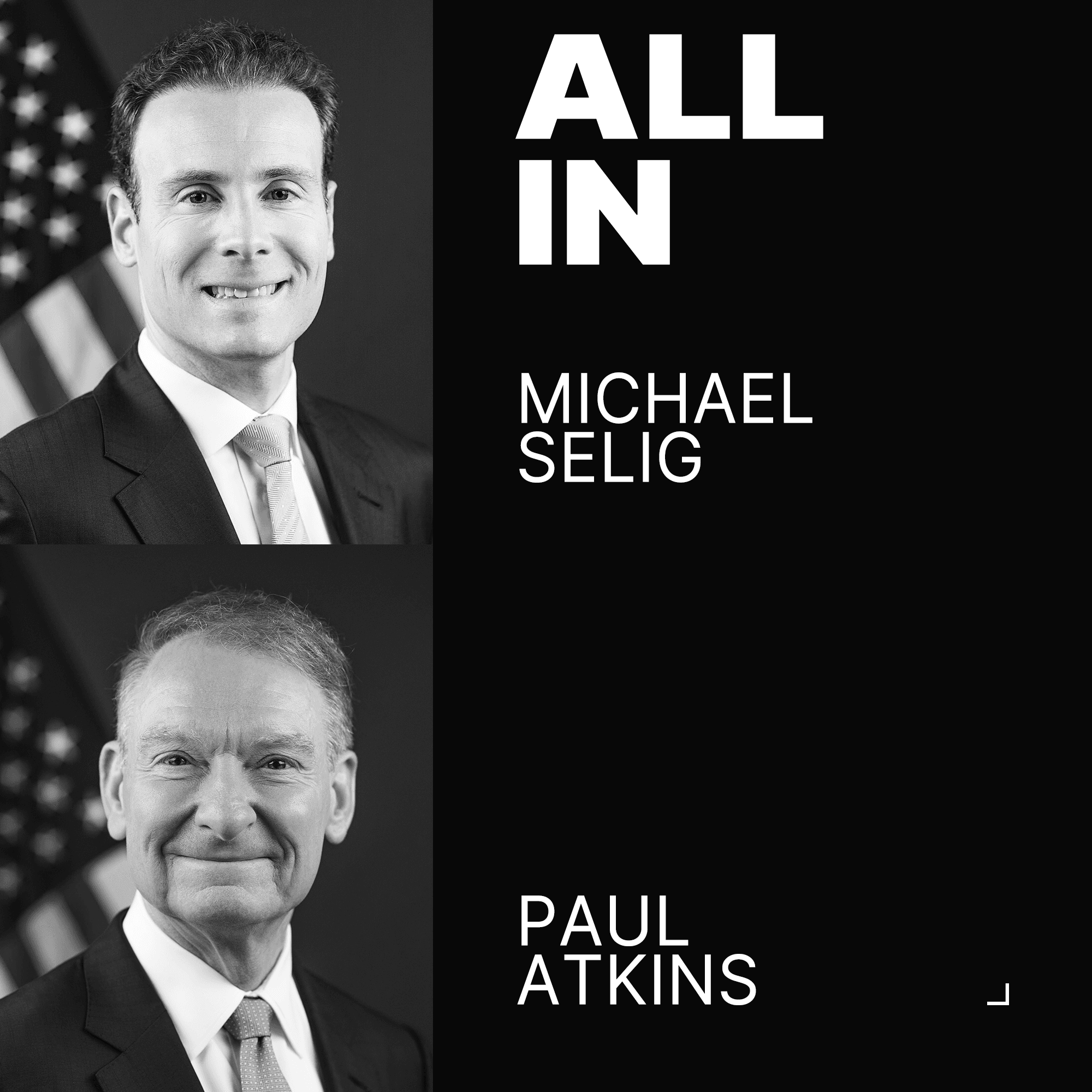
Episode Overview
Title: Rewriting the Rules: The SEC & CFTC on Crypto, IPOs & the Future of American Markets
Date: March 11, 2026
Hosts: Chamath Palihapitiya, Jason Calacanis, David Sacks & David Friedberg
Guests: SEC Chair Paul Atkins & CFTC Chair Michael Cielig
In this episode, the All-In crew sits down with SEC Chair Paul Atkins and CFTC Chair Michael Cielig to tackle the dynamic landscape of U.S. capital markets. They dig into critical subjects: the state and future of IPOs, the challenges of regulating crypto and prediction markets, the blending roles of SEC and CFTC, reform of accreditation rules, the impact of leverage, regulatory harmonization, and market participant education. The conversation dives deep into both practical reforms and the philosophical tension between investor protection and innovation.
Key Discussion Points & Insights
1. The Evolution and Current Health of U.S. Capital Markets
- Atkins' Industry Perspective
- "In the mid-80s… to be a startup and to build your products and do R&D you had to go public." (01:03)
- Compared to past decades, companies now stay private much longer; returns increasingly accrue to insiders, not the public.
- IPOs have shifted from a fundraising event to a liquidity event for founders and early investors.
- "Fully today half the number of public companies as we had 30 years ago, and it's completely reversed." (02:37)
- Regulatory Burdens
- Cost and complexity of compliance is a major deterrent for IPOs (proxy statements, quarterly reports).
- Litigation fears and annual general meeting complexity are other key inhibiters.
- Atkins: "We need a spring cleaning ... with a real focus on materiality." (05:11)
2. Modernizing Regulation: SEC & CFTC Agendas (Crypto & Tech Innovation)
- Cielig's Regulatory Philosophy
- Focused on shifting from "regulation by enforcement" to building "fit for purpose" rules for current technologies (crypto, AI).
- "A big piece of my agenda has been crypto ... purpose-fit rules and regulations for new innovative technologies." (06:34)
- Hopes for pending legislation giving clear CFTC authority over crypto spot markets; emphasizes anticipation and readiness regardless of legislative pace.
- Practical Rule Reformation
- Both agencies aim to replace outdated one-size-fits-all forms and processes with frameworks that make sense for digital assets and blockchain-native organizations.
- "We may even have to build in speed bumps to prevent fraud ... but there are challenges from the liquidity perspective." (10:40, Atkins)
3. Systemic Risks and Technology-Driven Market Changes
- Tokenization, 24/7 Trading, AI Hedge Funds
- Sacks raises the risks of always-on, automated, AI-based markets lacking "kill switches" or circuit breakers (08:16).
- Cielig: "We need to study them and ... set up guardrails ... we can't have these technologies built elsewhere." (09:23)
- The regulators want U.S. innovation, but are also focused on mechanisms for enforcing stability and preventing fraud/manipulation.
- Leverage in New Markets
- Discussion about the dangers and historical context of leverage, especially extreme cases in crypto (50x/100x Bitcoin trades).
- "Those things are constantly looked at ... now we need to look carefully at these new markets," says Atkins (14:02).
4. SEC & CFTC: Cooperation, Turf Wars, and the Path Forward
- Historic Friction — and Change
- Atkins: “I compare it to two fortresses with no Man's land in between. And ... the no man's land is littered with bodies of would-be products...” (15:57)
- Both chairs are now actively harmonizing frameworks, moving toward information sharing and cross-jurisdictional coordination.
- "We have a memorandum of understanding ... allow us to share information, coordinate on specific issues." (16:45, Cielig)
- Substituted Compliance and Super-App Vision
- Smoother paths for products overlapping the agencies’ domains, with a vision for a more integrated regulatory experience — possibly a future super-app approach.
5. Prediction Markets: Innovation, Manipulation, and Regulation
- Unique Issues of Prediction Markets
- Friedberg prompts discussion on the challenge of investor protections versus capital formation, especially as prediction markets grow (19:16–20:58).
- Cielig: Historical grounding from Iowa election markets to today’s more complex contracts; policing manipulation and insider trading.
- "The exchanges are the first line of defense ... the regulator ... is a cop on the beat." (22:23, Cielig)
- Real-world examples of enforcement (e.g., insider trading involving Mr. Beast’s YouTube channel on Kalshi).
- Gray areas abound (e.g., “streaker at the Super Bowl?”); need for clear guidance and education (23:39–25:56).
6. Public Company Reporting Requirements
- Quarterly vs. Semi-Annual/Annual Reporting
- Sacks highlights the burden of quarterly reporting, potential inhibition of IPOs, and push for change (26:57).
- Atkins: SEC to propose and seek comment on new reporting cadences, open to more flexibility (27:37).
- Historic context: U.S. only moved to quarterly reporting in the 1970s.
7. Updating Accreditation & Democratizing Access
- Accreditation Rules: Outdated, Exclusionary?
- Calacanis: Existing laws exclude 95% of Americans from private markets; suggests a "sophisticated investor" (knowledge-based) test (30:31).
- Atkins: SEC will propose changes; notes statutory provisions already include knowledge, not just wealth (32:37).
- Memorable quote: "Why does a finance professor who makes $100,000 and lives in an apartment ... not able to invest, whereas an heiress who just came into $10 million suddenly is?" (33:11, Atkins)
- Venture Fund Formation Barriers
- SEC acknowledges hard-coded statutory limits but aims to use exemptions and work with Treasury and Department of Labor to enable more individual involvement (41:56).
- Cielig supports greater public access: “Markets always find a way. Allowing for more access, decreasing some of the requirements ... will just allow for people to have some skin in the game.” (44:27)
8. Derivatives, High Frequency Trading & Systemic Risk Post-GFC
- Market Participants and Oversight
- Cielig identifies "hedgers, speculators, and market makers" as vital for liquidity (35:45).
- Emphasis on both exchange-based and over-the-counter swaps; swap data repositories post-Dodd Frank have improved transparency, though reporting burdensome for participants (37:38).
9. Cross-Agency Regulatory Tools & Future Policy Borrowing
- Streamlined Product Launches & Flexibility
- Atkins wants more SEC products to have “self-certification” mechanisms (39:13).
- Cielig admires the SEC’s alternative trading system as an “exchange light” model; would like to adapt for the CFTC (40:10–40:36).
10. U.S. vs. Global Capital Markets: The American Advantage
- Why America Dominates — and Must Continue
- Strong rule of law, contract enforceability, and risk appetite drive robust markets (46:21, Atkins).
- Other jurisdictions hamstrung by rigid, code-based regulation.
- Keeping innovation and products onshore is key for U.S. growth.
11. Crypto Regulation: Clarity, Protection, and Evolution
- SEC and CFTC on Defining Securities vs. Commodities
- Most confusion and risk comes down to legal definitions.
- Atkins: If a digital asset is a "tokenized security," SEC rules must apply. If it's a tool or collectible, it may fall under CFTC oversight (49:14).
- Cielig: Separate capital-raising from the selling/using of tokens on a network; consumer protection comes from clear rulebooks (51:06).
12. Innovation vs. Risk: The Chairs' Top Concerns
- Cielig (CFTC):
-
- Preventing innovation from moving offshore.
-
- Guarding against major collapses and maintaining market integrity—"We can't have another FTX" (53:08).
-
- Atkins (SEC):
-
- Enabling onshore innovation.
-
- Staying vigilant against new threats—AI-enabled fraud, for instance (54:27).
-
13. Balancing Market Access & Protecting Young or Vulnerable Participants
- Problem Gambling & Market Addiction
- U.S. youth: 45% of men aged 18–30 have reported betting problems; 10% meet addiction criteria (56:33).
- Calls for education at the platform, public, and parental levels (57:29, Cielig & Atkins).
- "Robinhood now, if you want to trade something complex … forces you to go through a little wizard to make sure you understand it…” (59:18, Calacanis)
Notable Quotes & Memorable Moments
- Atkins:
- "We need a spring cleaning [of our rulebook]. We need to clean out the attic, the basement and the garage." (05:11)
- "There are so many benefits to come from distributed ledger technology... we may even have to build in speed bumps." (10:40)
- "I compare it to two fortresses with no Man's land in between ... littered with bodies of would-be products." (15:57)
- "Why does a finance professor ... not able to invest, whereas an heiress ... suddenly is?" (33:11)
- Cielig:
- “They were faced with regulation by enforcement. They were faced with regulations that did not work for their business models.” (06:34)
- "We have to separate the capital raising activity ... from the actual thing that people are buying. The tokens themselves in many of these cases are just goods ... potentially neither of us regulate." (51:06)
- “Markets always find a way ... Allowing for more access, decreasing some of the requirements ... will just allow for people to have some skin in the game.” (44:27)
- Sacks:
- "Where's the kill switch or where's the circuit breaker, if you will?" (08:16)
- Calacanis:
- “Nature finds a way, right? Like ... don't allow people to participate. They start doing ICOs.” (45:11)
Timestamps for Key Segments
- 00:22–04:57: Atkins on the changing IPO landscape, returns, and market structure
- 06:30–08:16: Cielig’s CFTC priorities; crypto regulation, AI, on-chain modernization
- 08:16–13:04: Automation, AI hedge funds, tokenization, and regulatory “circuit breakers”
- 14:02–15:29: Leverage, systemic risk, and historical regulation context
- 15:29–18:35: SEC/CFTC collaboration, historical turf wars, and harmonization efforts
- 19:16–26:57: Prediction markets – investor protection, manipulation, regulatory standards
- 26:57–30:31: Quarterly/semi-annual reporting, short-termism, and IPO effects
- 30:31–34:56: Accreditation, democratization, “sophisticated investor” possibilities
- 35:45–39:00: Futures, derivatives, HFT, swaps, GFC lessons
- 39:00–40:36: Tools each agency wishes they had
- 41:56–46:21: Venture capital fund constraints, democratizing access
- 46:21–48:05: U.S. vs. global capital markets; why America leads
- 48:05–52:14: Crypto/NFT regulation complexity, consumer protection
- 52:14–54:27: The biggest risks: innovation flight and market integrity
- 56:33–59:18: Market participation risks for youth, education, and platform responsibilities
Final Thoughts
A wide-ranging, candid conversation: two of the most important U.S. financial regulators detail their push for modernization, regulatory clarity, and market access while acknowledging real risks—from global regulatory arbitrage to high-tech manipulation and youth gambling. The tone throughout is pragmatic, occasionally self-critical, and deeply committed to both innovation and investor protection.
Listener Takeaway:
If you care about America’s place in the future of finance, or want to understand how Wall Street and Main Street access may change, this is a must-listen episode for the next chapter of regulation, innovation, and consumer empowerment.