← The Curiosity Shop with Brené Brown and Adam Grant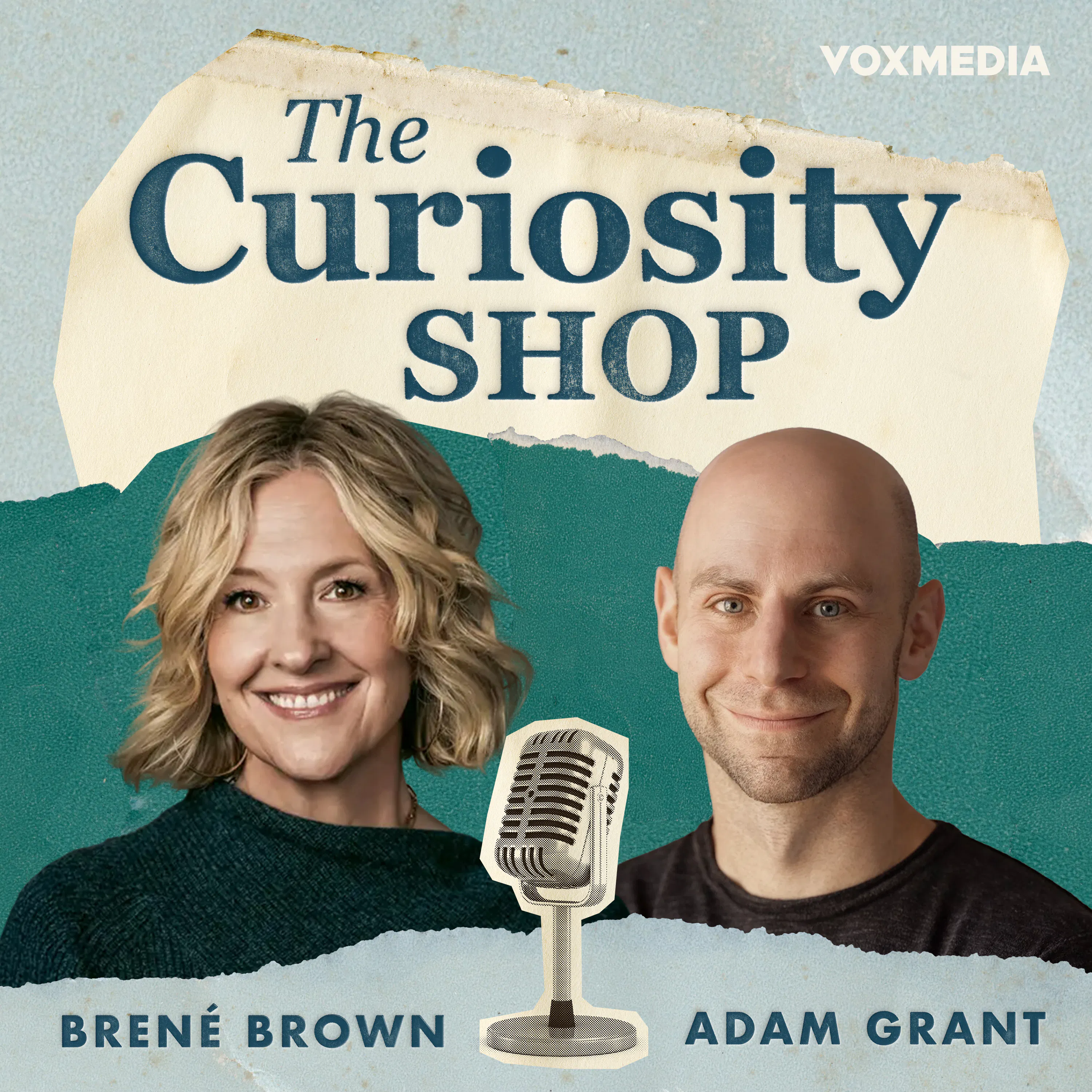
The Curiosity Shop with Brené Brown and Adam Grant
Sports as Leadership Theater and Recognizing Near Enemies
00:42:38
Loading summary
Transcript147 lines
- [00:00]
A
Hey, everyone, it's Adam Grant. While the Curiosity Shop is on summer hiatus, we're revisiting a few conversations that Brene and I really love, and we think you're going to enjoy them, too. On today's episode, we're sharing a conversation we originally recorded during Brene's Dare to Lead series. On Strong Ground, we explore the idea of far and near enemies, why sports can be one of our greatest leadership classrooms, and what both can teach us about leading with courage and clarity. Thanks for listening. And don't forget, new episodes of the Curiosity shop return on July 30th.
- [00:32]
B
Welcome to the Curiosity Shop, a show
- [00:34]
A
from the Vox Media Podcast network.
- [00:42]
B
Hi, everyone. I'm Brene Brown, and this is Dear to Lead. I am back for my second episode with the one and only Adam Grant, and we are digging into Strong Ground, my new book on leadership. And I'm excited to be here. And I'm always nervous to see what Adam's gonna ask me today. How are you, Adam?
- [01:05]
A
Nervous?
- [01:05]
B
Yeah, nervous.
- [01:08]
A
I dared to read. So I have so many new questions for you. I felt attention in the early parts of the book, and then I realized, oh, this is one of the paradoxes you're writing about that I'm supposed to get better at accepting and living with as opposed to wanting to solve. But there's. I feel there's a tension between adopting a set of routines to make sure that you have your strong ground and also being willing to break your routines so that you don't get trapped in the past. And I. I just wondered. I wondered, as I was. I was reading early on, how do you think about navigating that paradox?
- [01:55]
B
I think. Are you familiar with the Buddhist concept of near enemy?
- [02:04]
A
I've heard you talk about it, but I don't think I understand it well enough. So, like you, they're near and far enemies. I know that.
- [02:10]
B
Right. So you would say that, like, if compassion is the virtue, the far enemy is indifference. But the near enemy, the thing that kind of masquerades around like compassion but is actually dangerous would be pity. Right.
- [02:33]
A
So. Oh, that's good.
- [02:36]
B
Right. And so I would think that that's very good. Yeah. So pity. And I think the same could be true. The virtue might be empathy. The far enemy is not caring about someone at all. But the near enemy to empathy is sympathy, not feeling with someone, but feeling sorry for them, because that puts you in a place of superiority. Right. When you talk about this paradox that you're talking about, sometimes the near enemy, the Buddhist frame of near Enemy really helps me because I think the near enemy of discipline is rigidity.
- [03:22]
A
Yes. Yes. Nailed it.
- [03:26]
B
I think rigidity masquerades as discipline,
- [03:33]
A
but
- [03:33]
B
what you would find in the near enemy column is kind of ego protection stuff and discomfort protection. So I think discipline, when discipline fails to deliver agility and the capacity to reflect and change, it's no longer discipline.
- [04:00]
A
Oh, I love this. Okay, so this is, this is making sense out of. I have a colleague who's a very serious athlete, and I was, I don't know if I was appalled or just shell shocked to find out that he had a rule that there was no noise allowed at his house after 8pm I was like, that. That's, that's how you think you have to be in order to be an elite athlete. No. And he thought he was being disciplined. I think you've just reframed that as rigidity.
- [04:36]
B
Yeah, I think that's rigidity. And I think that's, I don't think that's discipline. Cause I think discipline would mean, especially if you've got kids in the house, I think discipline would be, I need to develop a practice that increases my focus or increases whatever I'm trying to do after 8 o' clock that allows the human beings around me to be human beings. That's discipline. Yeah. When you start to control the environment in order to protect yourself, that becomes rigidity.
- [05:14]
A
So, well put.
- [05:18]
B
Heat up your fourth of July at the Home Depot with our wide variety of grills under $300. And make every gathering one to remember. Give your outdoor space a glow up, whatever your budget is. With savings on seasonal plants starting at $5. With the grill fired up and your backyard set to perfection, you'll be able to invite friends and family over to kick off the party. Start celebrating. With low prices guaranteed at the Home Depot, prices may vary by store exclusions apply. See home depot.com pricematch for details.
- [05:48]
C
You want to get your backyard summer ready, but you don't want to break the bank. Wayfair gets it. Planning on dining al fresco or relaxing poolside? Wayfair has everything you need to prep your space. Shop now and save up to 70% off during Wayfair's 4th of July clearance score. Huge deals on outdoor furniture, area rugs and more. We're talking thousands of products for every style and budget, plus surprise flash deals. July 6th. Don't wait. Shop Wayfair's 4th of July clearance now through July 6th at Wayfair.com Wayfair Every style, every home.
- [06:18]
B
Hey, it's Ryan Reynolds here for Mint Mobile now. I was looking for fun ways to tell you that Mint's offer of unlimited
- [06:24]
A
Premium Wireless for $15 a month is back.
- [06:27]
B
So I thought it would be fun if we made $15 bills, but it turns out that's very illegal.
- [06:34]
A
So there goes my big idea for the commercial.
- [06:36]
B
Give it a try@mintmobile.com Switch upfront payment
- [06:40]
C
$45 for three months, $90 for six months or $180 for a 12 month plan. Required $15 per month equivalent taxes and fees. Extra initial plan term only greater than 50 gigabytes. Me slow when network is busy. See terms.
- [06:48]
B
I don't think we should underestimate the helpfulness of the near enemy, far enemy Buddhist concept when we think about our values. So like, what are the values that we really hold the most dearest? We're always clear on the opposite of those. The far enemy of those values that we hold most dear. But those near enemies, the ones that dress up and masquerade as the value, but also at the same time protect our ego and our kind of armor, those are the ones I think to really watch.
- [07:24]
A
I was just thinking about this. So if we take the value of generosity, is it fair to say that the far enemy is selfishness or greed, but the near enemy is actually self sacrifice?
- [07:40]
B
Oh my God, I'm disoriented. It's so weird that you said that because I had a word that came up when you were saying it, but I was like, I could never say that. But the word that came up for me was martyrdom.
- [08:04]
A
Same thing, same thing except yours adds the martyrdom adds an element of needing the recognition for having suffered for someone else's benefit, Which is, is maybe even worse.
- [08:25]
B
I'm like, I'm in a swirl of words, which is where you and I always end up. We always end up in this like weird swirl of like what do things, you know, what are constructs really mean? So the value or the virtue would be generosity. The far enemy would be selfishness. And the near enemy would be kind of a self sacrificing martyrdom. What I would be looking for in this equation, see if this checks out for you, is generosity. Just kind of like pulling way back to basic research. A capacity for generosity, I think would be measured by someone's ability to be other focused. Selfishness is self, completely self focused. So using the words other focused and self focused, what would the near enemy be? I think so.
- [09:46]
A
I think that would go ahead.
- [09:49]
B
To me, it's some kind of like, it's Some kind of fake other focus. That's really like, I could even see control going there
- [10:04]
A
is. Is it Anne Lamott who says that help is the sunny side of control?
- [10:08]
B
Yes. One of my favorite quotes of all time. Help is the sunny side of control. Yeah, that's what I think. That's. I mean, I, like, I literally have that on a post it note in my study at home because I can find myself doing that under the guise of generosity. And it's really. Let me help you with this. Let me help you with this because I want to control the outcome because it'll be better for me if the outcome is this. Oh, yeah, yeah. No, for me, sure. I. For sure I can do that.
- [10:39]
A
Oh, that's a, That's a different framing than the one I was imagining. Yeah, no, like, which is. No, go ahead, go ahead. No, I want to hear yours.
- [10:49]
B
No, I can just say I'll be glad to, you know, I'll be glad to hit some serves with you, but I need you to get your. I need you to speed up your serve. Dude, we're not winning in this mixed doubles, you know, like, you know, note
- [11:05]
A
to self, don't play doubles with Renee.
- [11:09]
B
Note to self. If you do work on serve. But I do think there is like, let me volunteer to help with the family dinner. Not because I want to help you, but because I want to control how it goes.
- [11:27]
A
You might be, you might be a little uncharitable to yourself there. Why do you want to control how it goes? You want everyone to have a good dinner experience, right?
- [11:38]
B
Probably. I mean. No, I want to. I want to control who sits where so I don't have to talk to certain people. So. No, that's nice. You might be being overly. But no, I think Anne Lamott, I mean, just I think because a lot of what informs Ann's thinking is her recovery. And so I think a lot of, for me, a lot of what I have to watch out about offering to help is really wanting to control. I mean, so I think that's where I go. But I do think this near enemy concept is super helpful when we're talking about values. Right?
- [12:17]
A
Yeah, I do too. And I think before we leave the generosity part of it behind, my framing of the near enemy of generosity being self sacrificing martyrdom was a little different, which is here I'm going to go above and beyond to do this thing for you so that I can feel like a good person. So I can feel like I'm not falling short of my values as opposed to thinking about what's actually best for you.
- [12:45]
B
Oh, yeah. Okay. I got it. Oh, shit. Yeah, I can do that. I can do that too.
- [12:53]
A
It's identity validating.
- [12:55]
B
Yeah.
- [12:55]
A
It's affirming as opposed to figuring out what's actually helpful here and sustainable for me to give.
- [13:02]
B
And it's actually not other focused.
- [13:06]
A
No. Now it's not. One, two, three. I'm standup comedian John Marco Cerese.
- [13:15]
B
And I'm actor penis model Russell Daniels.
- [13:18]
A
The downside is our podcast, where we bring on guests to talk about how miserable their lives are. Because, let's face it, things are not getting better. Every episode, we talk about what's wrong with our lives, Our guests lives, the
- [13:31]
B
world, but in a fun way.
- [13:33]
A
Bottom line is you're gonna walk away
- [13:34]
B
feeling better about your life.
- [13:37]
A
We've had so many cool guests. Caleb Huron. Busy Phillips. Stavros Halkias. Laverne Cox. Hassan Piker.
- [13:44]
B
Alana Glaser.
- [13:45]
A
I promise you're gonna have a good time. Now on the Vox Media podcast network, this is the downside.
- [13:54]
C
The average American spends $1,700 a year on clothes, and a lot of us are spending way more than that. But this week on Net worth and Chill, I'm breaking down exactly how to stop overpaying for your wardrobe with. Without sacrificing your style. Because between the tracking pixels following you around the Internet, the FOMO drops, and the influencer hauls, someone is always trying to get your money. I'm sharing my best kept secrets for scoring designer pieces for less. Why secondhand shopping is having its biggest moment ever. And the one rule I use before buying anything new. Plus, I'm answering your questions, including how to dress well when you have $0 to spend, how to upgrade your wardrobe for as little as possible, and what signs actually give away that someone is truly wealthy. Listen, wherever you get your podcasts or watch on YouTube.com YourRichBFF okay, so let's.
- [14:41]
A
Let's talk about this idea of. Of paradox. Because, you know, as. As I think about the. The relationship between a value and its near enemy, though those are. All of those pairings are paradoxical.
- [14:59]
B
Yes, for sure.
- [15:01]
A
We think of generosity and self sacrifice as, you know, as being cousins. Right? They're connected by a concern for others, and maybe one is a healthy expression of that and one is an unhealthy version that becomes self focused, but they're related. And I think that I have a bunch of questions for you about paradox, but I guess the first one is like, what. What is the the fundamental paradox of leadership that. That led you to say, okay, like, I need to. I need to make paradox the fundamental concept. Sorry, let me. Let me ask this differently. I have a better way to set up the question. So I'm reading Strong Ground, and I'm realizing there's a. There's a physical paradox in the book that you. That you unpack so nicely, which is you have to do a bunch of work that's going to take you a step backward to strengthen your core in order to then accomplish the goals that you want. And accepting that paradox is not easy. That I have to feel weaker in order to get stronger.
- [16:07]
B
No, it's terrible.
- [16:11]
A
So talk to me about how you become okay with that. As somebody who's always wanting to be moving forward.
- [16:24]
B
I. I'm not trying to, like, avoid the answer. I don't think I want your opinion on this. I'm gonna. I'm gonna answer your question with a question. I'm, like, looking in here like one of my favorite. I share four of my favorite writers on paradox. Two of them kind of more spiritual, and then two of them very business. You know, Jim Collins and James March. Like, let's just look at some of Jim Collins's paradoxes, which I think are great. So Jim talks a lot about the tyranny of the OR and the genius of the and. So in Jim's work, he talks about purpose and profit, freedom and responsibility, discipline and creativity, empirical analysis and decisive action, philosophical, visionary, futuristic thinking, and superb daily execution. So he talks about what leaders and teams risk if they don't get comfortable with the and. And the paradox, and they fall to the tyranny of the or. Which, reading. The same things I just read to you would be purpose or profit, freedom or responsibility, discipline or creativity. One of the things I'm very curious about, and I think I maybe unknowingly wrote from this belief. I don't think it's easy to resolve paradox if you don't understand the concept of paradox. I think if you're just faced with seemingly opposing ideas and you can't recognize the schematic of, oh, this is a paradox. And my job is to hold the tension of both until something better than either emerges, that our cognitive wiring for certainty and clarity overrides our ability to hold the tension. What do you think?
- [18:35]
A
Yes. Yeah. I have no further thoughts, you, Honor.
- [18:40]
B
No, but I really. I really.
- [18:42]
A
No, I think that. I think that's exactly right. I think that it's a little bit like. It's like one of the core Findings from emotion research that you write about, which is sometimes naming it is the best way to tame it.
- [18:55]
B
Yes.
- [18:57]
A
You have to be able to recognize and articulate that you're in the middle of one of these tensions in order to handle it effectively. And so often you're, it's like you're playing a, it's like you're, you're, you're in the middle of a tug of war and you don't realize, you don't realize that you're pulling against yourself.
- [19:17]
B
Yes. Oh my God, that's such a good visual. Yeah, I mean, I think I, I share in the chapter, my own real experience of this. And I'm still, I, I'm still struggling, struggling with it. I told my coach the other day that I wanted to change my value, that I wanted to change one of my values. And she said, you know, courage or faith. And I said, oh, maybe I'll just add a third. And she's like, I'd be very curious to hear what it's going to be before we go down that path. And I said, I value as highly as I value like faith, which is very high, and courage, unfindability. And she's like, what does that mean? I said, I do not wanna be findable. I don't want anyone to know where I am. I don't want anyone to be able to reach me, you know. And we immediately dropped back into this work that I've been doing over the past five years, which is discipline and freedom. I want freedom. I do not want my life to be defined in 30 minute scheduling blocks. Therefore I schedule shit. I don't schedule anything. And so my calendar looks amazing, but actually I have obligations, I just refuse to put them on the calendar. So I schedule over them, I double schedule. It's chaos, I cry. And so until just this last year, I've started to really understand the paradox that I'm in of. I need more freedom. And that's not going to be solved by unfindability, it's going to be solved by discipline. And I resent the out of that.
- [21:15]
A
Why?
- [21:23]
B
I, I'm not sure. I just. So I started scheduling like my hair appointments four, six weeks out. I started scheduling all of my games, you know, my pickleball games. I started scheduling my downtime. And what it's meant is I play six days a week. I don't have to call my hair salon crying and be like, oh my God, please get me in, I've got to do something. And you know, and it's Been good, but I'm still wrestling with. There's gotta be an easier way.
- [22:01]
A
Oh, okay. So the paradox in here that's jumping out for me is in order to gain freedom, you have to give up some control
- [22:12]
B
in order to gain freedom. Yes. I'm not built that way. I want freedom and control and no discipline. I think. You know what I think we're pushing up against, too? I think I've spent my whole life subscribing to the belief that the definition of freedom is no discipline.
- [22:42]
C
Mm.
- [22:45]
B
You know, and so now I want the freedom to Enjoy the last 20 or 30 years of my life in a very different way than what happened to my mom and my grandmother with dementia and frailty. And so I'm disciplined. I'm at the gym, I'm lifting weights, I'm working out, but I'm paying for my freedom with discipline. And I think there's a part of me that just
- [23:11]
A
rebels against that.
- [23:12]
B
Yes, that's the right word.
- [23:15]
A
It feels like an act of rebellion.
- [23:17]
B
Yes. But it's like, how many of us do things to be rebellious and we're the only one hurt by them? Do you know what I mean? It reminds me of that definition of resentment. That resentment is drinking poison and waiting for the other person to die.
- [23:44]
A
Oh, wow. Oh, I haven't heard that before. That's good.
- [23:48]
B
Yeah. So I do think the power of paradox is just like our conversation about rigidity and discipline. I think the power of paradox is it introduces a relationship between two concepts that we didn't understand existed. Does that make sense to you?
- [24:17]
A
It does. I think the part that I struggle with, and this is one of the ways that strongground really pushed me, is I just don't want to believe that the trade offs are inherent. Like, okay, what's. Like, what's the integrative solution? How do we get the best of both worlds? So let's take. Let's take a practical version of this in your life. So my solution to the paradox of, you know, I want. Basically, I want to. I want to control my time, but I also want to have flexibility and freedom is Paul Graham's idea of maker days versus manager days. So two days a week, I basically fail my calendar with all the things that need to be done, and then the other three days are pretty empty is the goal. It doesn't always work out that way, but that's. That's the template that I try to work from. And so what I feel like I'm doing is I'm trading two days of freedom for the rest of the week of freedom.
- [25:19]
B
But that seems to me to be discipline and freedom because this. Because Paul Graham's idea is a discipline practice.
- [25:29]
A
It is. You're right.
- [25:31]
B
I mean, that. I mean, I'm not sure there's a productivity. And I've looked at all of them because rather than doing shit, I actually just watch YouTube videos on productivity schemes. I mean, come on. If you haven't. We can't even be friends if you haven't wasted 30 minutes doing that. Like, come on.
- [25:47]
A
I've never watched a productivity video in my life.
- [25:49]
B
Oh, God. And you're so fricking productive. I know. It makes me crazy how productive you are sometimes. Um, but I do think Paul's idea of maker versus Manage. Maker versus manage. Right? Yeah.
- [26:05]
A
Maker versus manager. Yeah, yeah.
- [26:09]
B
Is a Disciplined is a discipline.
- [26:12]
A
You're right. It is.
- [26:13]
B
It's a practice.
- [26:15]
A
It is a practice. And I guess what it does is it makes the paradox more tolerable, but it doesn't make it go away.
- [26:22]
B
No. Because you're trading. When you say you're trading a couple days for more freedom. I still clearly see you in this heart of discipline versus freedom paradox. Discipline and freedom.
- [26:38]
A
Yeah, that's right. So you're just gonna have to accept it then.
- [26:42]
B
I cannot. I mean, I am, you know. Yeah. Because it's like I'm gonna have to get underneath.
- [26:47]
C
I love.
- [26:48]
B
I'm grateful that you use the word rebellion. Cause I'm going to. I'm going to do some investigating in my coaching work to understand what that's about. I think I need to do that, and I think that's help that'll be helpful for me. So thank you. I think the thing about strong ground, that the whole concept for me is a paradox in itself that I never thought about till after I finished the book, which is strong. Strong ground offers tethering connection and stability, but it's also the platform for explosive movement and change. You know, on the back of the book, I think we wrote something like, when people tell me. When people ask me, how far, fast or high do you think we can go as a team or as an organization? The first question I find myself asking now is, tell me about your relationship with the ground, then we can talk about that. And, I mean, I think that's why there's a chapter on the Tush Push. I think that's why I think about Simone Biles and the physics of what she can do is all about her relationship with the ground. I think about, you know, springboard diving, like how great could a diver be if they had no relationship with a board?
- [28:20]
A
It's the single hardest part of the sport.
- [28:22]
B
Oh, my God. Is it really?
- [28:23]
A
The flip, the flipping and twisting and the rip entries, like, all of that is far easier than timing and rhythm and balance on the board.
- [28:33]
B
So a diver, strong ground is the board.
- [28:36]
A
Absolutely. Or the platform.
- [28:37]
B
Yeah, the platform.
- [28:38]
A
If. Yeah, if you're on tower. But it's that. That was one of the things that. That jumped out at me when I was reading the book, is like. Yeah, even. Even these activities where, like, what we think is the defining strength is being up in the air. It's all about ground.
- [28:58]
B
It's all about ground. And I think that's true in organizations as well. I think I talk a lot about the physics of the Tush push and all of Newton's rules and how they applied to the Tush push and how if you've got someone that can execute against it. Well, if you've got a team. So for those of y' all listening that don't know what the Tush push is, it's in American football, you've got an offensive team and a defensive team. And in a situation where the offensive team is what we'd call a short yardage situation, they only need to move the ball about a yard. One of the ways they can do it, and it's kind of belongs in the tush push, belongs in a family of moves that are like a quarterback sneak collection of moves. But what they'll literally do is ground down into the turf and literally just use their massive muscles and ground force to push the ball forward a yard. And the physics of it is really about the fact that the offense has a split second advantage. They go first. So you're up against the law of physics there and their body weight. And what's really interesting is the minute any player becomes detached from the ground, they're no longer contributing to the tush push because they've lost their ground force. Right. And so I just thought, what would it mean for an organizational team to all be grounded not only in their values, but a clear understanding of the mission of their team or what they're trying to do and moving quickly? And, you know, that's Newtonian teamwork, you know,
- [30:46]
A
so we have to talk about sports metaphors a little bit more.
- [30:48]
B
Okay.
- [30:50]
A
Because I think you and I have both gotten a lot out of them, but also gotten pushback for using them. And I know sometimes when I use them, people say, well, wait, you're leaving out half the population. And it's led me to wonder, is it easier for a woman to bring sports metaphors to the table?
- [31:12]
B
When people say that you are leaving out half the population, are they talking about women?
- [31:17]
A
They're assuming it's feedback that often comes from women saying by default, women were less likely to grow up playing all the men's sports. They didn't grow up playing American football, for example. They're less likely to be super fans. And so you know the sport. Like they don't. They're not out golfing all the time, you know, so sometimes the metaphors don't translate for them.
- [31:41]
B
Yeah, yeah. I think, first of all, I think that's definitely becoming a very faulty assumption. Hashtag, everyone watches women's sports. I love that. And I think that if you're going to look, I use sports metaphors for a simple reason. I'm a big sports person and I think that sports is leadership theater. I think in a single play, certainly over the course of a quarter of a game or a half a game or a whole game, you can actually watch. It's like looking under the hood at strategy, discipline, operations. You can look at the whole line from idea to execution. You can watch it play out. It's literally leadership theater. So I think when you use sports metaphors, and not only do I use a lot of them, I have an entire chapter explaining why I use them and why I think they're valuable. I think you just have to pause to explain the sport. And I think when I use them, I usually will show videos or I'll walk people through and say there are two opposing teams. This team's trying to move the ball a yard. So they're using the physics of just, you know, five 300 pound guys just to literally push. So I think it's not using, it's not just using them that's problematic or can be problematic, it's how they use them. And what can feel, I think, not great for people, myself included, is making an assumption as a speaker that people know what you're talking about. But I don't think it's any different than when I've been in the audience and said, you know, hey, look, we've all read this book, right? We all are really familiar with, you know, so and so's work on Linda Hall's work on digital transformation. Like, excuse me, row four, seat J. No, don't know what you're talking about. That's just, that's just, that's just sloppy.
- [33:47]
A
Yep.
- [33:47]
B
A speaker could just take five seconds and say, listen, let me introduce you to Linda hall, for those of you not familiar with her work. This is what she studies at Harvard, this is what she's known for, and this is something that she taught. That's really changed my thinking. And then you've done a service. And so I'm gonna use sports metaphors. I'm gonna try to be more mindful about how I use them, but I think they are super helpful because you'd have to observe a team for a year and put together tiny snippets. You could never do it.
- [34:26]
A
I love the way that you characterize it. Sports are leadership theater. You're absolutely right. They're teamwork theater. We get more vivid observation and more visible examples than we do in any other world. And I think also we get the discipline of people trying to learn the skills.
- [34:49]
B
Yes.
- [34:50]
A
And, and, and practice them at an elite level as opposed to, I mean, talk about, talk about paradox. Like people spend easily 95% of their time as elite, elite athletes practicing for a performance that's a tiny fraction of their career.
- [35:09]
B
Right.
- [35:10]
A
Which is the exact opposite of what most leaders and team members do at work.
- [35:15]
B
Right. And I would say that they train for those that 5% and include in their training they build in obstacles. Like I remember when I think it was the Colorado's college football team in the U.S. colorado was training to play against Oregon, which has a notoriously loud stadium. So at practice, the coaches were all holding 5 foot high speakers blaring the organ song. You know, just to create leaders should be doing that. We should be training and skilling up and practicing that might look like role plays, that might look like pre mortems, that might look like red teams that, you know, we should be creating some, you know, environments to make sure our ideas and our strategies hold in environments and cultures and contexts that we can't control.
- [36:27]
A
So important and so rarely done.
- [36:30]
B
So rarely done. I mean, how long does a pre mortem take? I mean, you're the one that introduced me to the idea.
- [36:35]
A
Gary Klein is the one who put it on my radar.
- [36:37]
B
Okay, right. So Gary Klein's got it and we do them all the time. It's six months from now. This has gone to total shock. Shit. Why did it go to shit? What did we miss? And it has drastically changed how we think.
- [36:56]
A
It's amazing to me that these kinds of activities aren't more popular because I was with the leadership team recently and they had made what they all agreed was a disastrous strategic decision. And I was listening to them debrief it. And I said, well, how many major decisions did you simulate before you went into the real thing? And they said, none. Why did you expect to be good at this the first time you had to make a big choice together as a group?
- [37:27]
B
I mean, it's. Yeah, it's. And you're gonna, you know, I think one of the things you're gonna come to every chapter. You could talk about this in my book and think again. In all your books and all my books. The biggest unspoken resistance to intentionality is time.
- [37:48]
A
Always. We don't have time.
- [37:50]
B
We don't have time. You know, you think it's going to take time now? You think a 20 minute post mortem is going to be time cost, you know, cost you a lot. You wait, you know, a year from now when this has cost, you know, $27 million in six months.
- [38:10]
A
The, the way that people discount future time is beyond problematic. Like, yes, Invest. Invest the two hours this week to save yourself 200 hours over the next year, please.
- [38:23]
B
That's so, that's so interesting, the devaluation of future time. Do you think that's predicated on the overwhelming stress of current time?
- [38:36]
A
I mean, it's hard to imagine that that's not a major contributing factor. There's an economist you might know, David Labson, who studied this, he calls it hyperbolic discounting. And it's just the dramatic decrease in the amount of weight that people put on the time they have, even a week from now or a month from now, as opposed to now. And I've got to think that that intensifies under pressure and stress.
- [39:08]
B
Okay. To be continued. I love this conversation. We'll be back for episode.
- [39:14]
A
We have lots more to talk about.
- [39:15]
B
We have lots more to talk about. All right, thanks, Adam. I really appreciate it and I'm really. Let's just. Maybe it will be fun to do this. What's something you're taking away from this conversation?
- [39:25]
A
Oh, I mean, I have, I have multiple takeaways already. One is, I mean, just. I'll. I'll pick one from where we just were, which is instead of fighting against time, I want to reframe time invested now as time savings later. I'm, I'm always, I'm always kind of. I feel like chipping away and saying, no, no, you can squeeze more. You know, you could, you could add one meeting to the calendar or you could prioritize one hour a week to, you know, to devote to rethinking and unlearning things. And what this conversation is, is leading me to think is, no, let's take people into the future. Like you were saying, let's. Let's talk to them about how much time they're going to waste cleaning up the giant mess they're going to make if they don't carve out time now. Yeah, that's like, that's an investment, not a cost.
- [40:18]
B
It is a total investment and it's actually going back to the top of our conversation. Possibly an investment in your own freedom, which I can get behind. And I am going to think about this hyperbolic devaluation. I do not think about future time because in future, I'm even in better shape than I am now and I don't need as much time and my house is already clean. I've got some serious ass magical thinking on future time. Confession.
- [40:49]
A
Stay tuned. We're gonna dive into that in our next episode.
- [40:53]
B
Thanks, Adam.
- [40:54]
A
Thank you. We hope you're enjoying these conversations while we're on our summer hiatus. Again, just a reminder, we'll be back with brand new episodes of the Curiosity shop on July 30th. Thank you for listening.
- [41:08]
B
The Curiosity Shop is produced by Brene Brown Education and Research Group and granted production. You can subscribe to the Curiosity shop on YouTube or follow in your favorite podcast app.
- [41:18]
A
We're part of the Vox Media Podcast network. Discover more award winning shows@podcast.voxmedia.com Hear that? That's the sound of busy.
- [41:27]
B
To a restaurant, all that shouting and
- [41:29]
A
banging might as well be a symphony.
- [41:32]
B
It means the long days and longer nights are paying off.
- [41:36]
A
Sure, it's noisy, but there's a worse sound. This not busy.
- [41:42]
B
Busy means business. Which is why toast gives restaurants the tools and tech they need to help them perform under pressure.
- [41:50]
A
Sounds pretty good, right? Toast built for busy.