
Podcast
The AI Policy Podcast
Hosted by Center for Strategic and International Studies · EN
Join CSIS’s Aalok Mehta, Director of the Wadhwani AI Center, on a deep dive into the world of AI policy. Every two weeks, tune in for insightful discussions covering AI regulation, economic impacts, national security, geopolitics, and more. CSIS is a bipartisan think tank in Washington, D.C.
46episodes
Episodes
Newest firstAll episodes
Canada's Approach to AI Sovereignty with Sean Mullin
1w ago00:43:05Summary readyIn this episode, we're joined by Sean Mullin for a conversation on Canadian AI sovereignty. We discuss implications of the Trump Administration restricting foreign nationals' access to Fable (1:33); highlights from Canada's June 2026 National AI Strategy (13:05); the country's approach to AI regulation, including its AI and Data Act and (27:38); and more. Sean is a senior fellow at the Munk School of Global Affairs & Public Policy at the University of Toronto. He previously served as economic policy advisor to Prime Minister Justin Trudeau. You can read Sean's recent report on Canadian AI sovereignty strategy here.
SummaryIllinois Mandates Third-Party Audits of Frontier Labs and Trump Lifts Export Controls on Anthropic's Fable
2w ago00:38:54Summary readyIn this episode, we discuss the AI Safety Measures Act, or SB 315, Illinois' new frontier AI bill that mandates third-party audits for frontier AI labs (:51). We also cover the Trump administration's decision to lift export controls on Anthropic's Fable and Mythos models (7:34), Anthropic's claim that Alibaba extracted capabilities from Claude in a large-scale distillation attack (17:46), and OpenAI's proposal for the government to take a 5% stake in the company (26:12). Additional reading IL mandates third-party audits of frontier labs AI Safety Measures Act (SB 315) Lutnick's June 30 letter Anthropic's blog post "Redeploying Fable 5" OpenAI's blog post "Previewing GPT-5.6 Sol" "Anthropic Accuses Alibaba of 'Illicitly' Accessing AI Models" (Bloomberg) "OpenAI proposes handing Trump administration 5% stake" (Financial Times) Commerce lifts export controls on AnthropicAnthropic accuses Alibaba of adversarial distillationOpenAI proposes government take 5% stake
SummaryAdvancing AI Readiness with SeedAI's Austin Carson and Joshua New
3w ago00:39:33Summary readyIn this episode, we're joined by Austin Carson and Joshua New of SeedAI, a nonprofit focused on building AI readiness in the United States. We discuss their backgrounds (00:56), SeedAI's mission and projects (10:28), opportunities and risks from using AI to advance scientific discovery (14:15), and more.
SummaryWhite House Imposes Export Controls on Anthropic's Fable and Tech CEOs Join Heads of State at G7 Summit
4w ago00:30:04Summary readyIn this episode, we're joined by Kate Koren, deputy director of the Economics Program and Scholl Chair at CSIS, to discuss the Trump administration's recent move to impose export controls on Anthropic's Fable 5 and Mythos 5 models. We walk through the events leading up to the administration's decision (:47) and explore what authorities the Commerce Department has to restrict access to AI models (6:54). We also unpack the implications of AI industry executives joining world leaders at the G7 Summit in France last week (21:36).
SummaryTrump Signs Mythos-Inspired Executive Order After Delay and Reps. Obernolte and Trahan Release Draft Federal Framework for AI
Jun 1100:34:45Summary readyIn this episode, we unpack the Mythos-inspired executive order "Promoting Advanced Artificial Intelligence Innovation and Security," which the Trump administration issued on June 2 after an initial delay (2:10). We also cover the draft federal AI framework released by Reps. Jay Obernolte and Lori Trahan (14:53) and recent proposals for the U.S. government to acquire shares of American AI companies (24:55).
SummaryBridging the Public-Private Tech Talent Divide with Arun Gupta
Jun 400:40:06Summary readyIn this episode of the AI Policy Podcast, Wadhwani AI Center Director Aalok Mehta is joined by Arun Gupta, CEO of NobleReach Foundation and experienced venture capitalist, for a discussion on bridging the technology talent gap between the private and public sectors. They will cover the mission and accomplishments of NobleReach, the newly launched US Tech Force and its implications for AI adoption across the federal government, and how AI is reshaping opportunities for the next generation of workers. Arun Gupta is CEO of NobleReach Foundation, a nonprofit dedicated to empowering young technologists to move between the private and public sectors. He is the co-author of two books, Venture Meets Mission: Aligning People, Purpose, and Profit to Innovate and Transform Society and The Mission Generation: Reclaim Your Purpose, Rewrite Success, Rebuild Our Future. Arun is also a Lecturer at Stanford University and an Adjunct Entrepreneurship Professor and Senior Advisor to the Provost at Georgetown University. This event is made possible by general support to CSIS.
SummaryPope Leo Weighs in on AI and Trump Postpones Mythos-Inspired Executive Order
May 2800:31:03Summary readyIn this episode, Aalok Mehta makes his first appearance as the new host of the AI Policy Podcast. We briefly discuss what listeners can expect in this new chapter of the podcast before diving into Pope Leo XIV's recent encyclical on AI (1:45). We also cover President Trump's postponed executive order on AI and cybersecurity, including what the EO likely contained and why its signing ceremony was ultimately called off (18:09).
SummaryThe Next Chapter of the AI Policy Podcast
Apr 1600:08:01Summary readyIn this episode, founding host Gregory C. Allen announces his departure from CSIS and introduces Aalok Mehta, Director of the Wadhwani AI Center, as the new host of the AI Policy Podcast.
Summary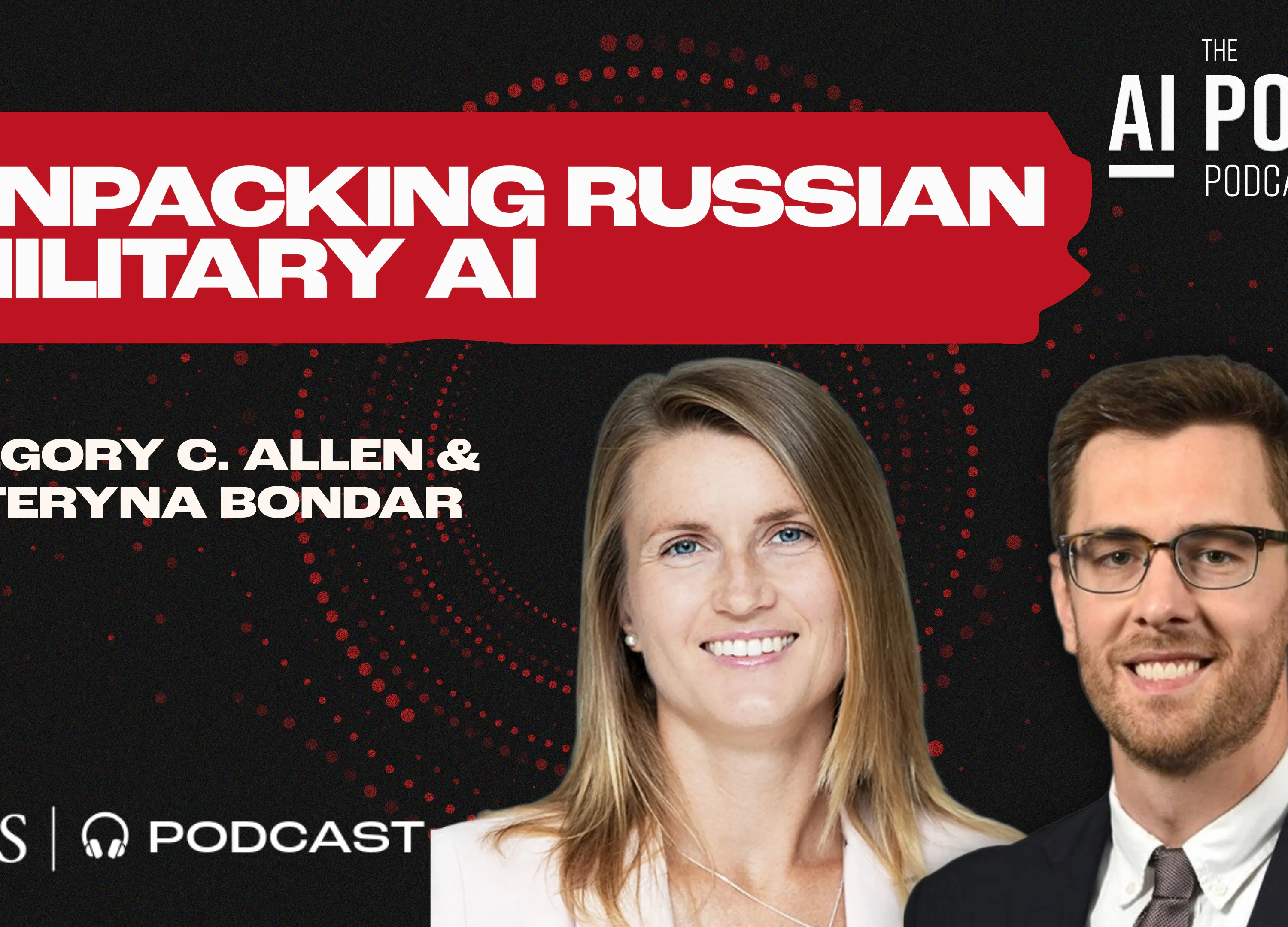
Unpacking Russian Military AI with Kateryna Bondar
Apr 1401:15:08Summary readyIn this episode, we are joined by Wadhwani AI Center fellow Kateryna Bondar to discuss her recent reports on Russia's military AI, "How Russia Is Building a Sovereign Drone Ecosystem for AI-Driven Autonomy" and "How Russia Is Reshaping Command and Control for AI-Enabled Warfare." We cover Kateryna's background (1:07) before doing a deep dive into the role technological innovation has played in the conflict in Ukraine (7:49). Kateryna then explains why AI capabilities in warfare "cannot be built, can only be grown" (22:24) and unpacks the report's claim that Russia has likely fielded a fully autonomous unmanned system in combat (53:02). Read Kateryna's report on Russia's AI-enabled C2 architecture here. Read her report on Russia's sovereign drone ecosystem here.
SummaryInside Project Maven and AI-Powered Warfare with Katrina Manson
Mar 2601:01:29Summary readyIn this special episode, we sit down with Katrina Manson, author of Project Maven: A Marine Colonel, His Team, and the Dawn of AI Warfare. We explore what drew Katrina to this story (2:31), trace the turbulent history of Project Maven and the obstacles it has overcome (8:03), examine how the U.S. leveraged Maven to support Ukraine against Russia (31:32), and discuss Katrina's latest reporting on Maven's role in the ongoing conflict with Iran (47:40). You can order a copy of Katrina's book here.
Summary