← The High Performance Podcast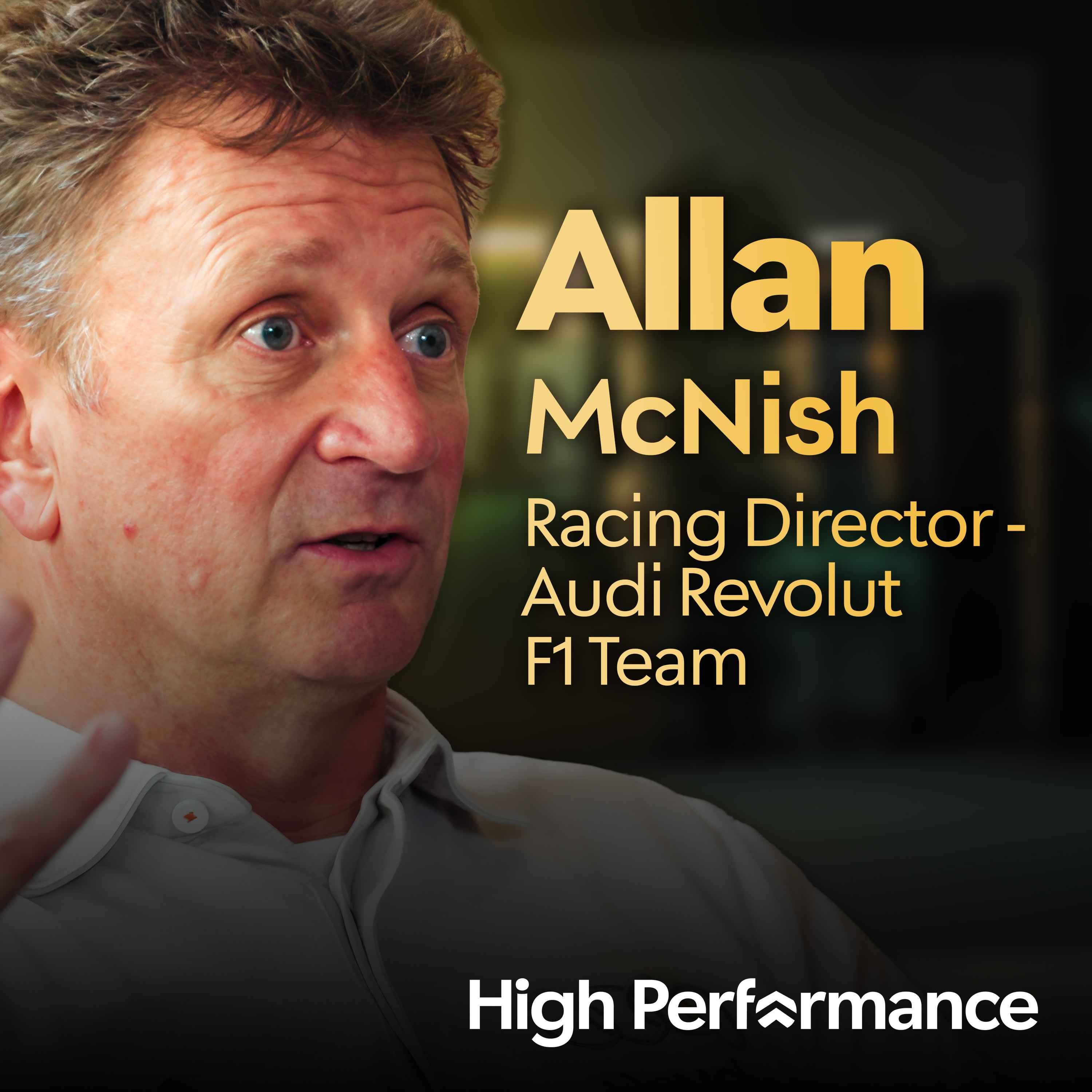
The High Performance Podcast
Why Audi Revolut F1 Team WILL Become F1 World Champions | Allan McNish (E423)
00:59:03
Loading summary
Transcript147 lines
- [00:00]
A
Welcome to the Audi Revolut Formula one team and thank you to Revolut business. We are not just at the team, we are in the heart of the building. This is the team, brand new to Formula one. And I'm about to sit down with a man who's central to what's been happening here. A man who used to race in Formula one, a man who's won Le Mans three times, a man who is now the racing director of this team, Alan McNish. I'm going to find out what makes him tick, what his hopes are for the team, and why he believes one day Audi revolut F1 team will be the world champions. I was with David Coulthard. I said, come on, what's Alan McNish like, really? And David said, hard as nails. You had times where you had to be lifted out of your car. Right.
- [00:39]
B
If it had been 10cm lower, it would have embedded itself. Goodness knows what had happened to me. That's McNish.
- [00:44]
A
That's Alan McNish.
- [00:47]
B
Taste of champagne gives you the energy back, doesn't it?
- [00:50]
A
Alan is okay.
- [00:51]
B
I remember the great Eddie Jordan telling me, audi's coming into Formula one. I said, well, I don't know about that, mate. Bringing the whole thing together with a power unit and also a chassis. We've got all of those things in place. There's absolute, absolutely no question we will be champions. Never fear a storm.
- [01:09]
A
Be ready to adapt. The skill is staying true to ourselves. Alan, thanks for having us at your headquarters.
- [01:19]
B
Thank you.
- [01:19]
A
So here we are, halfway through your first season as the Audi Formula one team. How would you describe the journey this year so far?
- [01:27]
B
Exciting. I would say it's overall, we always think about Melbourne, the first race being the first, but actually, this has been quite a few years in the planning. And so from that point of view, it was just the next sort of milestone, if you like, but the real milestone, because it's a racing team, you're going live, you're going to the circuit. All that build up is now coming to life to fruition. And as we get to coming up to the midpoint of the season, we look back on it with, I think, two sides, personally. One of them is the fact that we're here. We've achieved quite a lot, but what can we achieve going forward? Because we're always about what's next as opposed to what's behind us. And so right now, my eyes are sort of focused forward, but you've got to learn from what's behind you as well, though.
- [02:17]
A
So what have you Learned then from what's behind you as you.
- [02:19]
B
As you look forwards, it's a pinnacle, Formula one. It is difficult. It's a challenge in so many ways, not just because of the competition's been around for such a long period of time, but because, you know, you just go from race to race. There's not a time where you can take a breath, take stock and then start again. And the fact is, you're developing constantly, as well as racing constantly, as well as the fact that you're planning for not just next year 27, but 28, 29, and down the road. So, effectively, I would say it's everything, but flat out, it's full speed and it's one of the most exciting things about it. But right now, you know, for us as a team, we're a team with a lot of growth from what was the previous generation in 2025, but at the same time as well, bringing the whole thing together with a power unit and also a chassis, and bringing the name of Audi into Formula one, then that has been definitely one of the highlights. But it's also been. It's got a challenge and it's got a requirement deliver, and that's what we're. We're trying to do.
- [03:26]
A
I don't think we talk about emotion often enough, Right. In sport, particularly actually in Formula one. I'm interested in what, for you was the most emotional moment. Was it when you knew, like, this was happening, there was going to be an Audi F1 team. Was it the first race? Was it the first practice session, the qualifying session, the first points?
- [03:42]
B
There were different points because obviously this is a big time from Audi's perspective. There's been a lot of times in the past when there's been rumors. I remember with the great Eddie Jordan sitting there and he's telling me, audi's coming into Formula one. I said, well, I don't know about that, mate. And ultimately, it's happened this time. So when it was signed off by the board and when the regulations came out, Audi were the first power unit manufacturer to sign on the dotted line, then that was a moment, because that was live. We're real, it's done, it's moving forward, but that was preparation. We're a racing team. So for me personally, seeing the car rolling out of the pit lane, going to the grid in Melbourne was special. And then the next part about it, seeing Gabi getting points, was fantastic. But we are always, as I say, keep coming back to it. We always look forward, but those were without doubt special moments. But I think as well, from the wider side of things, when we pulled together some of the. Not operational on the circuit point of view, but all of the other things, like Revolut coming into it as our title partner, bringing a new brand into Formula one.
- [04:57]
A
And there was that cool moment in Miami with Lionel Messi.
- [05:00]
B
God.
- [05:00]
A
Yeah. I just think doing little things like that is so awesome.
- [05:05]
B
Well, when I heard about this, I thought, no, that can't be right. And the team kit arrived, Adidas drop came, and the coloration. And then to see Messi going out onto the field on the Saturday beforehand wearing that kit, and it was just absolutely sensational. And it was quite interesting because actually everybody at the airport flying to Miami for the race two days later, proud to wear the kit, pulled it on. They were sitting in there on the flights going across and proud to wear it all weekend. And it's one of the ones that, when I look around is still being worn around about. The factory people are still wearing it. It's not something that's one and done. It's actually something that's got, I would say, a touch point in our season.
- [05:44]
A
I like that because I think it's cool to see how elite people operate. Was there anything that you spotted from Lionel, for example, when he's around? Like, is he asking a lot of questions? Is he interested?
- [05:54]
B
Well, I think there's a few things that I've noticed, and we also had Djokovic in Barcelona with us at the weekend, is that they are, I would say, very precise in what they do, what they say, but also looking for the technical advantage. They're not just watching it and thinking this is fun and entertainment. They're looking at how you would gain a technical advantage, either for us in the sport, or alternatively, how they can use it in their own sport as well. And what do we do? What do we think about how are they doing it? And vice versa. And so they're always looking at, how do you gain that next step? And not just an acceptance that this is a fun weekend. Because, to be honest with you, in sport, if you're an elite sport, I don't think there's any weekend that's just a fun weekend. Every weekend's a school weekend, a learning weekend. And that was very clear for me with the guests that we've hosted through the course of the races so far. So I'm quite looking forward to the rest of the season because every single one of them I learn from as well. I watch how they're doing things, how they're interacting. And you can always pick up just little cues about it.
- [07:00]
A
You know that here at High Performance we're obsessed with marginal gains. And nowhere is that clearer than in Formula One, where performance comes down to visibility, precision and speed. Because when decisions need to happen fast, the teams performing at the highest level have to see everything clearly in real time. And honestly, managing a growing business, it isn't that different. When you're managing team spending across markets, travel suppliers and multiple currencies, small inefficiencies can really quickly add up. That's why High Performance is partnering with Revolut Business. Their spend and expense management tools give you real time visibility and control right across your business, from company cards and approvals to tracking team spending as it happens. So instead of getting buried in admin or outdated systems, you can stay focused on growing your business. And right now, High Performance listeners can get a £200 welcome bonus when you sign up through our link in the description and add money to your account by September 30, 2026. Subscription fees and Ts and Cs apply. It's interesting that you've gone from being behind the wheel to being behind the desk to be the, you know, the racing. Your official title is Racing director, right?
- [08:09]
B
That's correct.
- [08:10]
A
Now, as you know, I've been knocking around Formulon for a long time. Meanwhile, I don't think I've ever met another racing director. I mean, there's team managers and there's team principals and there's CEOs. How would you describe what you do
- [08:22]
B
so effectively at the circuit? I look after all of the racing activities, whether that be the strategy, whether it be the engineers, the driving, the operations of it. I also interact with the activation for the marketing and communications. And so it's when you're at the circuit, I kind of oversee everything there. And so hence the reason Racing director, because we are at a race and so in that side of it, it does bring in a lot of breadth. And you mentioned about when I was racing and funnily enough, I think a lot of the experience of when I was racing actually was very beneficial because as a driver you automatically are working with all of the different groups of people. As a driver you're working with your engineers, as a driver you're working with strategists. As a driver you're working with the media, with the marketing, with the partners, et cetera, but from a very different point of view, but you're actually having all of these touch points and it's bringing it together however, now I've also got to deal with the drivers. That was the one area that was new, is having to deal with Nico and Gabi.
- [09:31]
A
Let's talk then about how you manage drivers, because I think there's nothing quite like it where you've got two individuals racing for themselves, but also driving for a team. And the priority for the team is winning the team's championship or getting as many points as they can. As a team, the driver's only job is to beat his teammate and get the points for himself and make sure that he's shining a good light. I'm interested in where you fit into this and what you think makes a great driver in Formula One.
- [09:58]
B
Well, you need to hire absolutely ruthless, determined racing drivers, end of story. Because there's no wallflowers out there, and that's in all sport. Everybody's determined to win and succeed, and especially when you get to the 22 that are sitting in Formula One cars, even more so. It's something that I remember when I was racing, I never wanted to do because I never wanted to have to deal with people like me, because people that are just exacting, demanding, don't care if it's 10 o' clock at night, wanting to find, you know, a 10th here or a 10th there, and just pushing the absolute limits, because you're right, it's about the drive to be successful and there can only be one winner. And, you know, so I kind of came to the conclusion, dealing with people like me, there was better things and easier things to do in life. But you never say never. And it came to pass. And I learned a lot when I sat down for the first race in Formula E, because suddenly I had to look at two drivers. And so in some ways I'd spread bet on my success, if you like, because I had two there. But when they're fighting for that one victory and they're fighting for that one piece of tarmac and ultimately fighting for championships, then that's when it does make it spicy. That's when it becomes a case of trying to control probably the uncontrollable in a certain extent, because when they're in the car, you do have limited amount of control, but it's trying to set the boundary lines. This is how we go racing, this is what we do, this is the way we do it. And fundamentally, there are times when it spills over. We've seen it so many times, so many times in the sport, it just spills over and there's an incident. Then the important thing I Think is how do you recover from that? How do you then keep it controlled within your own team and not spilling out into the media frenzy that just amplifies the story. But that's easier said than done. That's not something you can learn in a script book, that's for sure.
- [12:02]
A
Have you had any of those moments this season where it's felt like it's going to spill over?
- [12:06]
B
No. This season, not at all. This season, actually, with Nico and Gabi, I think we've got a very good mix. And at the end, we're not in a position at the moment where we're fighting for those big, you know, victories, the podiums and wins and things. But I've had it in the past in Formula E. I've had it where we've had some very frank discussions after the race, actually, in our run to the championship in our first season. And it was a super hard start to the year. We got into a rhythm, started winning races just one after the other, pulled ourselves back into the team's title and we were leading one, two in New York. There's a double header. One on Saturday, one on Sunday. Leading one and two. And if we finished one and two, then we were in prime seat for Sunday. And the two drivers are 1 and 2, 7 seconds and the leading wheelbanging each other. And it was just the worst thing. Daniel Apt and Lucas Di Grassi and both of them wanted to win and we gave them the tools to do it. And there was part of me thinking, go on, get the job done. And there's part of me thinking, please, let's just not do the job that you're thinking you're gonna do. And we had to have a sit down ve honest, transparent discussion because I've been in their position, I've lived it. And frankly, when you are living it and you're looking through the narrow visor, you've got a very narrow view. If you stand back, like on gameplay mode, when you're playing online racing or whatever, you see a much bigger view of it. And that much bigger view is what I've got to look at, which is how do we as a team win as opposed to how do you as a driver win and your teammate doesn't? Because you've got to make sure that you come out of that one with two cars intact.
- [13:52]
A
And you've got two very different drivers. You've got an established, experienced driver in Hulkenberg, you've got a young guy trying to make his name and find his way in the sport in Gabriel Bortoletto. What is the thing that you've seen in each of them that has been the thing that you found most impressive?
- [14:08]
B
So very different things. You're right. Nico's got a wealth of experience and that comes to bear. And it was actually at the first test that he did in 2024, because he joined into Sauber as the precursor to come into the audio revolution.
- [14:25]
A
And he came because of the program, right, because he came because of what
- [14:29]
B
was coming, not what was there in 2025. And so did Gabi to a great extent. It was the calling of the future as opposed to what the car they had and what they knew at that time. And Nico jumped in in the morning, he ran morning and quick debrief at lunchtime, and then he jumped back in after lunch and as soon as he sat back in the car, he said, ah, yeah, but I thought we were going to do this, this. This boom, clear, concise, delivered information. And he was on it. So he was absolutely on every detail of what was going on. And that I thought, right, okay, now from the cockpit side of things, he is definitely aware and he's ready. And so that really did impress me with Nico, just how sharp he was. I'm not talking about his speed, I'm not talking about his racecraft. I'm not talking about his third position at Silverstone. It was just that moment I thought, right, we've got someone in the cockpit that can deliver that. And with Gabi, I watched him through his Formula 3 season, actually, and at the beginning, when I was looking at our driver development program that we're looking to build for the future, which we launched this year, he was actually one of the drivers that I looked at because of the fact he came out of a, I would say a program that wasn't quite as successful as it should have been, but there was something behind it. I didn't know then what, but there was definitely something there. And he won that championship, then won Formula 2 and followed him through. What I love about him, though, is just his enthusiasm. He's got speed, you know, he's got racecraft, but he's just enthusiastic work ethic. You know, we have to drag him out of the sim. We have to, you know, to actually pull him back from himself to some extent, because he's just got a really good work ethic there, but with an enthusiasm behind it, which is maybe youthful enthusiasm. Yeah.
- [16:21]
A
What about when he's had a couple of incidents? I'm thinking last season rather than this season. How is he in those moments, because from what I've seen, he looks like he's hard on himself, you know.
- [16:31]
B
No, he is, he is, because he's. He's young in his career and so he's establishing himself in his career and naturally you. You are hard on yourself. And there he goes away, reflects on it. He's quite honest, you know, if there's the mistake, he's honest about it, says it to the team, says it quite openly in the debriefs. Not necessarily shouts about it from the rooftops, but, you know, to the people that matter. And there, I think it's one of the traits that you sort of, or I do want to father a little bit, in a way, you know, arm round the shoulder type of thing, but with the knowledge. And this is what impressed me was after he shunned in Brazil last year, because that was a big shunt, that was a heavy, heavy hit. And then got back in. And when he got back to Qatar and then he was back on Song and he was right there because he had a difficult one in Vegas as well. So he had two back to backs. But the recovery was the important thing for me. And he did recover very well.
- [17:32]
A
And what did he do to get that recovery right, do you think?
- [17:35]
B
I think he basically did what good racing drivers do. They realise you can't change it, switch off, start again. But at the same time, he had the confidence that it wasn't like there was a hammer above his head. He had the confidence that the team were there supporting him and he just needed to sort of take a step back and then just go for it again. And he did that very, very well, though.
- [17:57]
A
And I'm really interested in Nico Hulkenberg as a character. I mean, he was driving in F1 back when I was hosting it, like a long time ago. Then he had this little sabbatical and now he's come back. What do you think the sabbatical did for him?
- [18:14]
B
I've got to be honest with you, Jake, when he took the sabbatical, I didn't think he was coming back into Formula one. I thought that was it done and dusted.
- [18:23]
A
I think once you see real life, and particularly have a child.
- [18:27]
B
Yep. But also he was looking at other things. He knew about racing at Le Mans. Cause he had gone there and he had won it. So that was an opportunity. He had other things being thrown around at him. And so, you know, there was maybe other areas outside, but to hang on with the reserve role that he had and picked up on the odd race under The COVID at the COVID time. Yeah. But to get in and then deliver straight away, I think was good. But I think that kept him sort of thinking, right, okay, I can. I can keep going here. It's not over. And I suppose There was probably 95% the paddock had thought that was maybe not going to be the case. I wasn't, as I said, sure he would get back into Formula One. But quite clear when he did get back in, he took it with both hands. There was nothing taken for granted. And I think that's probably the one thing, is you get a refresher, you can recharge the batteries a little bit, but you also know that nothing is for granted and you take it. And he's definitely taken the opportunity, this one as well. With us, he's taken that opportunity. Really.
- [19:34]
A
And why do you think it was so long that he didn't even manage a podium? It was one of the great conundrums of F1.
- [19:42]
B
I actually wonder. I think there's moments in time in driver's career. I can look back in my own and think, you know, if it had gone a different direction at that point, would it have taken you down a different road? May have done, but it may not have been a good road either. I think with Nico Brazil, I can't remember the year when he was leading.
- [20:03]
A
Yeah, long time ago.
- [20:04]
B
A long, long time ago. Right at the beginning. You're gonna have to check this one up, aren't you?
- [20:07]
A
Yeah. I hate not knowing stuff, don't you?
- [20:09]
B
I think if that had turned into a result, it would have maybe changed slightly the direction of his career. I don't know where it would have gone, but my point is that he deserved podiums. It's not due to his driving that he hasn't had a podium up till last year. It was other things in and around it. And so in that respect, you know, for me, it was always just wrong that he didn't have a podium, as opposed to there was something he was doing wrong, it was just wrong. It just didn't add up. But as well, you know, Silverston was a good example. I think Nico got this podium, it was him that won the podium. It wasn't necessarily the fact that we gave him a suddenly faster car or anything else. It was him that took the opportunity in the changing conditions and got that podium. And so that could have been probably 10 or 15 other times as well, but it just didn't work out in those ones.
- [21:09]
A
And what did or did you see any difference from him after that podium in Silverstone.
- [21:14]
B
Zero, absolutely. Trophy, a smile. You could see that there was a sort of element on the podium of the. Oh, cool. This is what it looks like. But actually afterwards, no difference. Which wasn't quite what I would say most people would expect, but he was super calm before, super calm afterwards, back into working. I'm sure there was a little bit of something off his shoulders, but I don't think he necessarily shows everything but, you know, a little bit of a monkey off your shoulder in that respect by getting that podium. However, you know, the first win is probably the thing that he's looking at now, and that's something that hopefully we'll be able to give him. But I was really surprised it didn't. It wasn't as if he suddenly went from being one person to the other. I didn't expect that, but, you know, he didn't. No change at all.
- [22:09]
A
So interesting. But I think you're probably right. The mentality of a racing driver, or probably a human being, is he's desperate for the podium. The minute he gets it, the only thing he wants is a win. The minute he gets a win, he'll be wondering whether one day he can be the world champion. Right. I think the brain just does that all the time.
- [22:23]
B
Yeah, you've got your own sort of steps. And I think it's when you go into a new category as well, or you do something new, a new job. I know from my point of view, with the evolution from being a driver to where I am today, there's an element, you go into it and you're thinking, right, okay, how do we deal with this? What do we do? And you use your experiences. But at the same time, once you get one step forward and you taste a bit of success, then you want the next part. And I think that's a competitive, driven edge, and that's the part that probably keeps us all together in the paddock. But certainly from a driver's perspective, first thing is get on the grid, get some points, get a podium, get a win, get a championship, and then after that, if you can, others, in championship terms, I mean, not many can do that, though.
- [23:15]
A
No, you can. How hard is it to keep them motivated when it has been a difficult season?
- [23:21]
B
Keeping motivated is not necessarily because we've had a couple of difficult races. No question about it this year. It's not unexpected being the start of a new program. And I think the thing that's been probably where we've worked on is actually making sure that people keep their Eye on the same prize. We're all going in the direction and these are not surprising situations that we've had, and we just have to deal with them one by one. It's part of the learning and growing as a team point. And we don't like it, we don't want it, but we can't get frustrated about it. And so it's been trying to just to make sure at times that we keep the focus on the right areas. And that's where also, again, coming back to the drivers, the drivers are very much flag bearers with that. They're very much the people that lead and set the tone of the team in terms of how they drive, how they go out there, how they give everything they've got, how they react, how they speak to the team on the radio and the wider side of things in debriefs, afters, what, when it hasn't been a good race, how do we deal with those things? And that's where I think the people that are those flag bearers are really, really important, especially in our sort of growing phase as a team.
- [24:41]
A
Do you want them knocking your door down, demanding a faster car, or do you want them understanding that there's a wider picture going on here and this is effectively a new team.
- [24:50]
B
We are in a phase where it's a new operation and we can't do everything overnight in the same way no other team can. And so therefore, buying into the vision of what we're doing with the knowledge that there will be races that are good races and races that are less good, and we'll all have problems at one point or another, but to focus on our own job. And so for me is to, yes, the drivers need to push, we need to push us as a team, need to keep pointing out the areas where we can work and where we can improve as a team at the same time as well, you know, making sure that they keep delivering every area that they can, whether it be, you know, on in laps, into the pit lane, breaking down the speed lane limit, whether it be, you know, just getting those last details right on the setup and working with a systems engineers to make sure that they get it right. Just going into, ideally, hopefully when we're fighting into Q3. And so, you know, everybody's got a part to play in it, but we need everybody within the team, not just the drivers, but everybody within the team to actually see the vision of where we're going. And that's something I think has been cultivating quite well over the last few months.
- [26:05]
A
And do you have to be careful saying to the drivers, like, well, when I won Le Mans or when I was driving in Formula One, do you know what I mean? Do you feel you have to be careful that you don't try and tell them what to do?
- [26:17]
B
Well, they don't need me telling them what to do at the end of the day.
- [26:23]
A
But you must use your experience, having won races and championships.
- [26:27]
B
No, I do. I use my experiences, but I use them in trying to work out what they need in advance, as opposed to reactive but proactive on it. And certainly there's times when you bring that experience across, but not necessarily saying, well, when I did this, because it's not that relevant nowadays. It is relevant in the whole scope of how you do it, but it's not relevant in the driving of it. Last time I drove a Formula One car was 2003 back in Suzuka, in a completely different era. And so last time I drove a racing car actually was 2013. So it was 13 years ago when I last raced. So there is a relevance of how you go racing and what you do and what you prioritize and focal points and everything else, but not necessarily to drive the car. But they don't need me to tell them that.
- [27:23]
A
Alan. Revolut business is now adding 30,000 businesses every single month. And that is despite competing against the institutions that have been around for years. And I liken the team to the team's partner. You know, Audi are trying to do the same thing here. They are trying to take on teams that for decades have been racing in Formula One. So what's the secret to doing things in a new and different way, like Revolutar, but at the same time not ignoring all the things that you can learn from those that have trodden the path before you, getting that balance?
- [27:55]
B
It's an opportunity, isn't it? It's always an opportunity. And when big institutions have been doing it for a long time, they sometimes become a little bit big and heavy. And then it's looking at, how do you exploit that? Certainly, that's what Revolut are doing. There is taking on the institutions with a different business model, a lighter, more agile business model, and one that's, I would say, right for the time, it's right for now. It's right for what the consumer is able to do with technology. And from us as a racing team point of view, we're coming in and looking at it in the same mentality, the same philosophy. Right. How do we set this up with all of the tools, all the requirements, with the technology that we have today, but without necessarily all of the baggage from before and try to do it a bit differently. And that can be technically, in terms of the way we design, develop the car, but it's also, how do we go to market? How do we look? What's our look and feel and image as well, and trying to be that little bit different.
- [28:57]
A
So back when you were racing and you were. And you remained one of the greats at Le Mans, did you always have in your head, one day I'm going to. After all this travel and all these wins, I'm going to make sure I'm still busy, still traveling, still away from my family, still finding the edge, still pushing the limits. Like, was this always for you, being a manager?
- [29:18]
B
I. When I retired, I remember specifically two points in my final year where I thought, right, the first one was, I'm not enjoying this as much as I was. And the second point was, that's it. I'm retiring at the end of the season.
- [29:38]
A
Can you tell us when you got the first one?
- [29:40]
B
Yep, it was Spa, which was the race always before Le Mans. We were on pole position, had a technical issue. We lost, basically. It was blown floors at the time, blown diffusers, and we just lost the efficiency off the floor. And the car was unstable, inconsistent, finished second or third, can't remember. But the next race was Le Mans, and Le Mans is the big one. That is the one. And so very focused on ensuring that I wanted to get all the answers before turning up at Le Mans because we hadn't quite sussed everything out with it at that point. And there was just a whole load of talk in and around it. And I just thought, right, okay, I'm running out of energy for all of this talk. But we won Le Mans. So that was something that was a big tick. And then my final race was in Kota, the circuit of the Americas, and we're on pole. Won that race really hard fight with Anthony Davidson, the Toyota, and we won by 10 seconds or something in the end. And I was doing actually a media drive with some journalists the next day, going to various places, going down to Houston from Austin, and I was about maybe 20 minutes in, and I just thought, right, that's it, end of the year. Nothing to do with the journalists, by the way. It was purely and simply to do with the fact I was putting so much energy in to continue to win that I didn't think I had that energy left to do it again. And I was enjoying less and less of it. So in that particular Kota weekend, I enjoyed the one lap of qualifying and I enjoyed the final stint to win the race. The rest of it was just work and that meant to me that I wasn't going to be in a position to be able to fight going forward because I wouldn't have the fight to do it. And so at the end of the season, won the world Championship and that was it. Came home, told Kelly, my wife, that that was it, no more racing. I was retiring and went to Audi and told them the same without necessarily having, which is your point, the plan to go after. I knew that the car industry, I've always been involved in the sport I love, and so I'd always got a feeling I would be involved in the sport in some way, but I didn't have a clear planning of what that was to be.
- [32:05]
A
How quick did you go from racing to managing?
- [32:11]
B
Probably if you asked me then, I would have said instant. If you asked me now, probably a couple of years, really, I would say that I still and, well, maybe clarify that. I remember the first race afterwards and I didn't have the same fire in my stomach that I had. I wasn't nervous. I used to pace around all the time, mainly to get away from people speaking to me so that I could have my own thoughts. But I was always just that nervousness and I didn't have that same feeling in my stomach. The first time I did have it back was my first race as Team Principal in Formula E. Then when Daniel and Lucas were diving into that first corner, I was watching the monitors exactly as if I was in the car and it was there. Heartbeat was up. Everything was going exactly as if I was still racing myself. So I suppose once you're a driver, you're always a driver. Just depends whether you wear the helmet or not. But certainly from my point of view, it's probably a couple of years before I really understood that transition and also understood that my job wasn't in the car any longer. It was actually outside of the car and it was ensuring that I prepared the situation for them to be able to deliver.
- [33:32]
A
The two jobs are so different. What do you bring into this role that you learned behind the wheel of a racing car?
- [33:39]
B
Racing, it's about the flag. It's about what you need to do to get to that point. It's about the fact that you can't be anything but looking to search to improve in every area all of the time. It's about the mentality of fighting every single day to be improving and that sort of racing feel, I suppose, because we can look at data and we can look at monitors and everything else, but at the end of the day, it's a live organism that's going on. When you're come off the line and go into that first corner, there's no dress rehearsal for that because everybody's doing something in and around it. So you can have your planned approach, but you've got to react to what everybody else is doing in the same way. We can have our planned approach as a team, but suddenly, if some of the competition come out with a new Scipod design or aero concept or something else, we have to look at it and react if it's better than what we've got. And so it's about the fact that you've got to be very clear in your planning. You've got a very good preparation, but you've also got to be adaptable, you've got to be agile, you've got to be like a racing car, really strong. Racing cars are robust. They give good feedback to the driver, but at the same time, they're agile on the nose, on the steering, but the driver always knows what they're going to do. And I think a good racing team's similar to that.
- [35:04]
A
The big change, of course, is when you're driving, it's all about you. When you're doing this job, it's all about everybody else. Yeah. Can you talk to us about the velvet gloves and the handshake?
- [35:13]
B
Yeah, this. You know, you've got to be very strong in terms of your principles, and you've got to deliver your vision over what you want out of it. And I think the sort of iron fist in a velvet glove was actually something Martin Brundle mentioned to me, and we had a team boss when I was driving at Toyota for Le Mans and Ove Anderson was a gruff Swede and he definitely was someone that had an iron fist with a velvet glove on it. And I think it was a very good analogy, actually, because you have to be strong, but you've got to do it in a subtle and delicate way. You've got to give the line, but you've also got to make sure that your people are on that journey with you. And. And so therefore, you need to have that sort of softness of touch. You need to have the awareness when they're having a bad day and to be able to support them in the right way. They need support. Some people need a kick up the backside, some people need a cuddle, but you need to Know which is which, and that's personality led. So you need to be able to try and lead them. But it comes back to it that some people do need the more iron side of it and some people need the velvet side of it.
- [36:29]
A
And how do you know when someone just simply isn't up to it and how do you deal with it then?
- [36:35]
B
That's the hard part, Honestly, that's the hard part, because then you've got to be transparent. I'm very much into transparency. You've got to sit down and try and support people to actually step up if they can step up, to give them the tools to do it. Some people just don't know the direction they need to go to do that. But ultimately there are times when you've got to make the hard call for the. The benefit of the team and to replace. It's not a case of that you want to. Because I don't think anybody actually enjoys those discussions or scenarios. But I think we're in a world here where it's an understood part that these things can happen and therefore it's a performance led environment and we all have to step up and we can't be also dragging the rest of the team down because actually it's to the negative of the whole team. But that is definitely, without doubt, the less fun side of the sport is that you've got to have sometimes these very clear discussions, and I'm sure you do have them.
- [37:40]
A
I remember when we first met a long time ago and I was with David Coulthard. After you left, I said, come on, what's Alan McNish like? Really? And David said, hard as nails. That was his description of you.
- [37:52]
B
That was very kind of him.
- [37:53]
A
Yeah, well, because I think you were. I mean, I'd love to talk about a couple of times in your career where you had to be hard as nails. I mean, you had times where you had to be lifted out of your car. Right. Because you had issues going on. Can you tell us about that?
- [38:06]
B
Are you talking about when the virus.
- [38:08]
A
Yeah, yeah.
- [38:09]
B
So that was a really strange thing. In 1990, I was test reserve driver at McLaren and one of the events we did was in Asia, and it was a. It was actually for Honda at the time. And I had a bowl of rice for lunch and something didn't feel right, so I stopped. And then I was ill for a couple of weeks, just stomach bug and everything else. And about a month later I woke up. My joints were swelling up, so my ankles, my hips, my right foot, the ball of my Right foot, couldn't put pressure onto it. And it was like a type of rheumatoid arthritis, type of effect in terms of the way the joints were seizing up. And I went to see Sid Watkins, who was the F1 medical delegate at the time, went to see Sid, and he sent me off to see some specialists. And then I went to see him and he went, don't worry, they're vets, those guys. We'll go and find some other ones. And ultimately had a virus that meant that I couldn't do any training. I couldn't really do anything. I was out of breath all the time. It was into my joints. And he said, it's going to take you probably six, nine months to clear out of your system. We're talking early 90s here. Talking at the point where my career was knocking on the door of Formula one, Talking at the point where I was winning in the category below, which was F3000. And just the momentum went straight out of my career, actually, from that. And so there was two parts to it. One is that physically I wasn't strong enough to drive. Raced in Barcelona and was absolutely wrecked. Raced in Hockenheim, finished second in Hockenheim. And that was the point of being lifted out of the car because I was actually trying to press the brake pedal with both feet on the in lap because of the pressure onto my right foot, where the ball of it was so sore. And that was definitely one that was mentally very tough because I had a spotlight in my junior career of going through. And it was a lot of positive talk about where I could get to. And then suddenly it's all going away from you and you're not really in control of it and you don't know how to deal with it. It's early 90s. It was quite a raw environment back in those days and that.
- [40:39]
A
What do you mean by that?
- [40:41]
B
Well, there was no support mechanisms, right? There was no sports psychologists. There was get in, do the job or don't get out. And so it was a. You know, there was. The support really was from your mom and your dad, and that was kind of it. And so it was definitely not an easy time. And one that I think, probably coming back to your point about Nico, when he got his opportunity afterwards, you grab a hold of it because, you know, it might not come around again. And so when the next season came around and I got the opportunity, then I didn't want to let go of it. But it was more of a mental battle. And once a physical battle was done, and it had gone through my system. Nothing since once, the mental battle of just trying to keep fighting, get in the seat, you know, send 150 different faxes out, because we're still in the fax eater here, you know, just to say, you know, give me a job, I can do that. And so that was. That was a hard time, I've got to be honest with you.
- [41:45]
A
And do you think it cost you an earlier opportunity in Formula one?
- [41:51]
B
It definitely didn't help.
- [41:53]
A
Yeah.
- [41:54]
B
I think there's probably. There's one other thing which was a decision that was made that I instinctively thought was the wrong one, but didn't voice my opinion about.
- [42:05]
A
What was that?
- [42:06]
B
In about 1990, the team that I was going to join and I was led down a route and I just instinctively wanted to go to another team, the other team won the championship and the team I was with didn't. And that was a big learning point in my career, to follow the instincts, to follow what's actually inside of you and voice it up, don't be shy, don't be frightened about it. Which maybe comes back to DC's hard as nails point, but you learn these things through time and you learn them and it's not repeating the mistakes and it's making sure that you actually put them to good use.
- [42:46]
A
The period where you were ill and there wasn't much support, because there wasn't in those days, what was the impact on your mental health?
- [42:54]
B
Well, there wasn't really mental health discussions, so I never really thought of it like that. It wasn't a case of thinking, it was a case of, right, how do I deal with this and how do I. And I suppose I've got quite a boxed mind, so I put things in little boxes, kind of deal with it. Yes or no? Is it something that I can worry about? Is it something that I can fix and just try to rationalize it as much as possible. It's like, you know, if I've. If you go off when you're driving a car, if you make a mistake and you have an accident, you know, why did you have the accident? Was it a driver error? Yes or no? If it wasn't, well, then, could you have done anything about it, yes or no? If you couldn't do anything about it, don't worry about it, just get back in there and give it one. If it's a driver error, can you change what you do? Yes or no? If it's a no, then fine, just get back in there and do it. If you can what do you need to change so you don't do it again? So I'm very much rationalizing things. And so in that respect, I think, and it's a long time ago now, but I think I just rationalized it as much as possible.
- [44:03]
A
And then the Le Mans mindset, this is very interesting because I think one of the things that you were able to do, you were fast all the time, but you have to lock into Le Mans. I mean, this is a 24 hour, grueling race. Grueling mentally. Grueling physically. The season peaks at that moment. Then you have this weird thing where the season carries on straight afterwards. Would you sort of talk us through what a Le Mans weekend was like for you and why you think you managed to find your a game season after season at Le Mans?
- [44:32]
B
The Le Mans mindset for me is, and it's something I had to learn a little bit, was controlling the energy, controlling things through. So that when I did get to Sunday afternoon, I still had something left in the tank. But I suppose the thing that I realized, and it was from winning it in 98, it's a huge event. It is a career changing race. And so from that perspective, the global impact of it is big from a driver's perspective. And so it's important. Like we were speaking about before, when you taste the champagne, you want to taste it again. And definitely I wanted to race that again. But to do that, you have got to be on it because it's a sprint and you are sprinting effectively through the course of the race. We've won it by less than 20 seconds before. So, you know, the difference between winning and losing is so marginal in all areas. That's like a tenth and a half per lap, give or take, for the course of the race would be the difference between winning and losing. It's just nuts in reality. And so I think for me, the determination was probably the single thing that got me through it. Just that I wanted to win that blooming race every single year. And the determination to do it, which then meant when you had a difficult stint, if you're on the wrong tyre, you're on a day tire medium, and you needed the soft because it was getting cooler at night. You were able to sort of fight through it. If you had a technical issue and you had to come back from that, you just didn't sort of fall over and give up, but you just fought all the way to the chequered flag because ultimately, as we've seen at Le Mans, cars stop on the last Lap.
- [46:16]
A
Yeah.
- [46:17]
B
So it's never over till it's over.
- [46:19]
A
Sometimes cars stop mid race as well. I know. Can we talk about 2011?
- [46:24]
B
Well, that wasn't even mid race. Come on, Jake. I didn't even get to mid race. Are you joking? 2011. Now, 2011 was the cruel mistress side of Le Mans. She can be a beautiful place, I tell you, it can be one of the most glorious places in France on a Sunday afternoon, standing on the podium, but I tell you, it can be absolutely cruel as well. And 11 was one of those years. Thankfully. I've had a few times on the podium, but that definitely was a counterbalance to it. So do you want the story? Okay. We didn't have a very good qualifying. We struggled a little bit, can't remember too much why, to be honest with you, about the car balance. But in the race it was actually pretty good. Hot sunny day. And I caught up into second and caught my teammate actually who was leading and he made a mistake at the Dunlop chicane and ran wide on exit. And there was a big stretch of Astroturf and he couldn't go at the power down because he was on the Astroturf. And I sailed round the right hand side of him, down the S's, the left and into the right. And just as I turned into the right, I collided with something and was going off backwards. That's all I knew was going off backwards. I knew it was going to be a big shunt. Cars rolled over, it's full 360 and landed upside down. And I'm on the radio trying to restart the thing, not quite realizing the car's upside down at this point, honestly. And the radio had been, you know, it's disconnected. So the pits couldn't hear me, I couldn't hear them. And then sort of looked around and thought, okay, this is not ideal. Can they put the car back? Not realizing there was. I don't think there was any wheels on it.
- [48:08]
A
Well, you didn't realize how big that
- [48:09]
B
I had no clue. So I got out the car, I was definitely winded and concussed. Went to the hospital and had scans and everything else. They said that I had some concussion and went back to the hotel and woke up the next morning. And as I walked downstairs I saw l' Equipe French newspaper. And on the front page of l' Equipe was a picture of this car vertical above a barrier, doing a pirouette. And I thought, bloody hell, one of our sister cars. What a shunt's that crikey they're so lucky to get at that. Not realizing at all that was our car. That was my car. Because the crash I had was quite a long crash. Yeah. There was dust and bits and pieces flying around, but it wasn't anywhere near as spectacular as what I then saw on YouTube when I ran upstairs and had a look at this thing, because for me, it was a shunt, big shunt out of the race. But it wasn't anything like that. And when I saw it, it was actually made me step back a little bit because it was a pretty ferocious accident, by all ways. You could look at it.
- [49:18]
A
I remember seeing it live.
- [49:19]
B
Oh, so did I. Yeah.
- [49:21]
A
And I'm thinking at the time, how did the car even stop? You know how it hit the barrier, pirouetted and stopped on the top?
- [49:27]
B
It's.
- [49:28]
A
But it could have gone over.
- [49:29]
B
I mean, it could have gone any direction. It could have gone any direction. It flew when it hit the gravel trap, because of the way the gravel was. It flew up in the air. So it just caught the top of the barrier.
- [49:41]
A
Yeah.
- [49:42]
B
And then from catching the top of the barrier, then it started pirouetting around. If it had been 10cm higher, it would have been one thing, because it would have gone over and into the wall. If it had been 10cm lower, it would have embedded itself into the barrier. And goodness knows what had happened to me because of the energy of impact that that would have had.
- [49:59]
A
What did your wife say afterwards?
- [50:01]
B
Well, she hurt her Achilles run into the medical center, and so she wasn't very happy about that. But, no, I was very fortunate all through my career that never any question, never one question about safety or thoughts or anything else, not once.
- [50:19]
A
That's amazing because this is the foot. This is the TV footage that I was watching at the time of the crash. And if you look at the way that they showed it on the telly, it cuts to the car, obviously having already crashed. And I can't believe that you're in a shunt that huge with no concept. How did you think you weren't upside down?
- [50:40]
B
Well, I just.
- [50:41]
A
Was it. You were knocked out and had no concept?
- [50:43]
B
No. Automatically. Well, at this point, I've got my foot in the brake, I can guarantee you that. And trying to recover the situation, which clearly is not recoverable. And the first thing you do is automatically go onto the starter button, get the clutch, get it in gear, and try and go again. And that's just an automatic reaction. I think that's just your way of doing things. And it was in the hospital that I realized that I'd touched the Ferrari. I had no clue of that at all. I didn't know it was even there because the vision out of those cars at the time was very, very limited. So anything on your left hand side you couldn't see. And he turned in.
- [51:20]
A
That touch there.
- [51:20]
B
Yeah, that touch there. So he turned in not being able to see me, and I turned in not knowing he was there at all. And that was the end result.
- [51:30]
A
And it lasts. When you watch it like a second and a half, does it feel like a lifetime when you're in a car?
- [51:35]
B
It felt longer than a second and a half. But remember, your brain is running at 200 miles per hour.
- [51:43]
A
Yeah.
- [51:44]
B
So every second your brain's doing 90 meters in distance at that speed, because you do 90 meters roughly at 200 miles an hour in one second. So from that perspective, it does last a second and a half, but you process it so, so quick that actually it slows it down. Certainly my experience of these things, it was actually quite a slow and also quite a calm accident. Wasn't anywhere near as volatile as it turned out to be.
- [52:11]
A
I'll tell you, other people that were lucky that day were all of the photographers and the marshals. The other side of the. I mean, wow.
- [52:18]
B
And one I know very, very well. And she wasn't aware because she was walking away from it. She had a little hearing aid. She wasn't aware. And I saw her afterwards and I had to give her a big hug. And every time I see her, Anne's her name, and every time I see her, I have to give her a big hug because, you know, you never know how these things are gonna end up. When the car and two cars collide, then it is a little bit in the lap of the gods. But certainly we were very lucky. And I say everybody was very lucky that day, but especially me.
- [52:49]
A
And what are your thoughts on luck? Because you have an incredible career, do you not?
- [52:54]
B
I don't. I don't believe in luck. No. I think it's a very easy excuse. And I suppose that's been drilled into me from my father. Dad was very much a case of proper preparation. Do all of the work at home, and when you go to a race, it's execution, it's delivery, and if you've done all the work at home, then chances are you're going to be able to deliver at the circuit. And so when people say, ah, it's bad luck, I really struggle with that concept. I do find it difficult And I find also I have to bite my tongue sometimes just not to say. But there are definitely from my perspective, in my whole career, whatever it was, except school, because that was clearly bad luck with those exams. But it was a case of if I did the job right, then actually I put myself in the position where the good luck came to me in terms of that actually I was probably on the better side of judging the risks as well. Better side of the judging the opportunities and taking them. And so I'm not sure that's luck. I think that's just judgment and hard work.
- [54:08]
A
So if it's judgment and hard work and preparation and mindset and behaviors, do you believe that The Audi Revolut F1 team win a Grand Prix and one day win a World Championship?
- [54:23]
B
Absolutely no questions in my mind. If we have got the mindset, if we deliver in the preparation, if we have got the focus and together focus and understand that there'll be some bumps in the road and work together, support each other, support the ones that need supported and to just understand that this is a journey that has got a direction. And I take this from our Lamond projects. We remember the 13 wins out of 18 starts at Le Mans, see the trophies on the wall in Neuburg, we remember the DTM titles and all of the other different bits and pieces. But not everybody remembers the work that went into it. Not everybody remembers the times when actually you came home scratching your head, how were you going to solve that problem? Or I should have done it this way or that way. And so from that perspective, that's the mindset that we just keep to go focus on. But for me there's absolutely no question if we've got all of those things in place, we will have the car and we will have the delivery of it and we will be champions at one point.
- [55:31]
A
So after all your incredible experiences, huge success, what do you believe high performance is?
- [55:38]
B
I think you've got personal. High performance is doing the absolute best job you can do today and then beating it tomorrow. Never ever resting on your laurels. Constant improvement and it's self reflection, a lot of it.
- [55:54]
A
Is that not exhausting.
- [55:58]
B
Taste of champagne gives you the energy back, doesn't it?
- [56:02]
A
I love that. We've got a few quick fire questions before we finish. As racing director at the Audi Revolut F1 team, what are the three most important behaviors for success?
- [56:15]
B
Respect. Got to respect our team support. I think we need to support our ones that needed at the time and that's what a team's about. Actually. And the third one, Responsibility. Take our responsibilities and if we've got the support behind it, then people will take the responsibility as well.
- [56:46]
A
Love that. What's the greatest advice you've ever been given?
- [56:52]
B
Playing pool with my dad in about 1982 and he beat me on the last ball and he said, they count the winners at the finish, son. They count the winners at the finish. That has steady. It's held me in good stead in my career.
- [57:06]
A
Yeah, I bet. What is your greatest strength?
- [57:10]
B
I would say my determination is my greatest strength.
- [57:15]
A
Your biggest weakness?
- [57:17]
B
Probably my passion.
- [57:19]
A
Your oh, your passion's your biggest weakness?
- [57:22]
B
Yeah, yep.
- [57:24]
A
Why is that?
- [57:26]
B
Because at times, if you don't control your passion, it become a weakness. And certainly from a racing point of view, there was times when I was maybe a little bit too passionate. Well, you maybe showed me a video of that. But yeah, I think that's probably my weakness. But it also means that passionate that I will just do whatever I can to actually achieve what I want to achieve.
- [57:51]
A
What advice would you give to a young Alan just starting out?
- [57:54]
B
Young Alan, in starting out as a
- [57:56]
A
driver, in life as a little kid, 10 years old?
- [58:00]
B
Enjoy it. If you don't enjoy it, you won't deliver your best. So you've got to keep in mind to enjoy it. But you've got to go for it. And you go for it flat out. There's nothing else about it.
- [58:13]
A
And after all your years of experience, the final thing, you're one golden rule, if you like, for a high performance life, the thing you'd like to leave people pondering about or thinking about.
- [58:23]
B
My golden rule. Performance is not always found in the obvious areas with the obvious people. Sometimes you've got to think laterally to get your performance. There's no one rule of how you achieve it, but there is one winner and they've achieved it.
- [58:53]
A
Really interesting. Thank you so much.
- [58:55]
B
Thank you very much.
- [58:55]
A
Top man.