← The Media Odyssey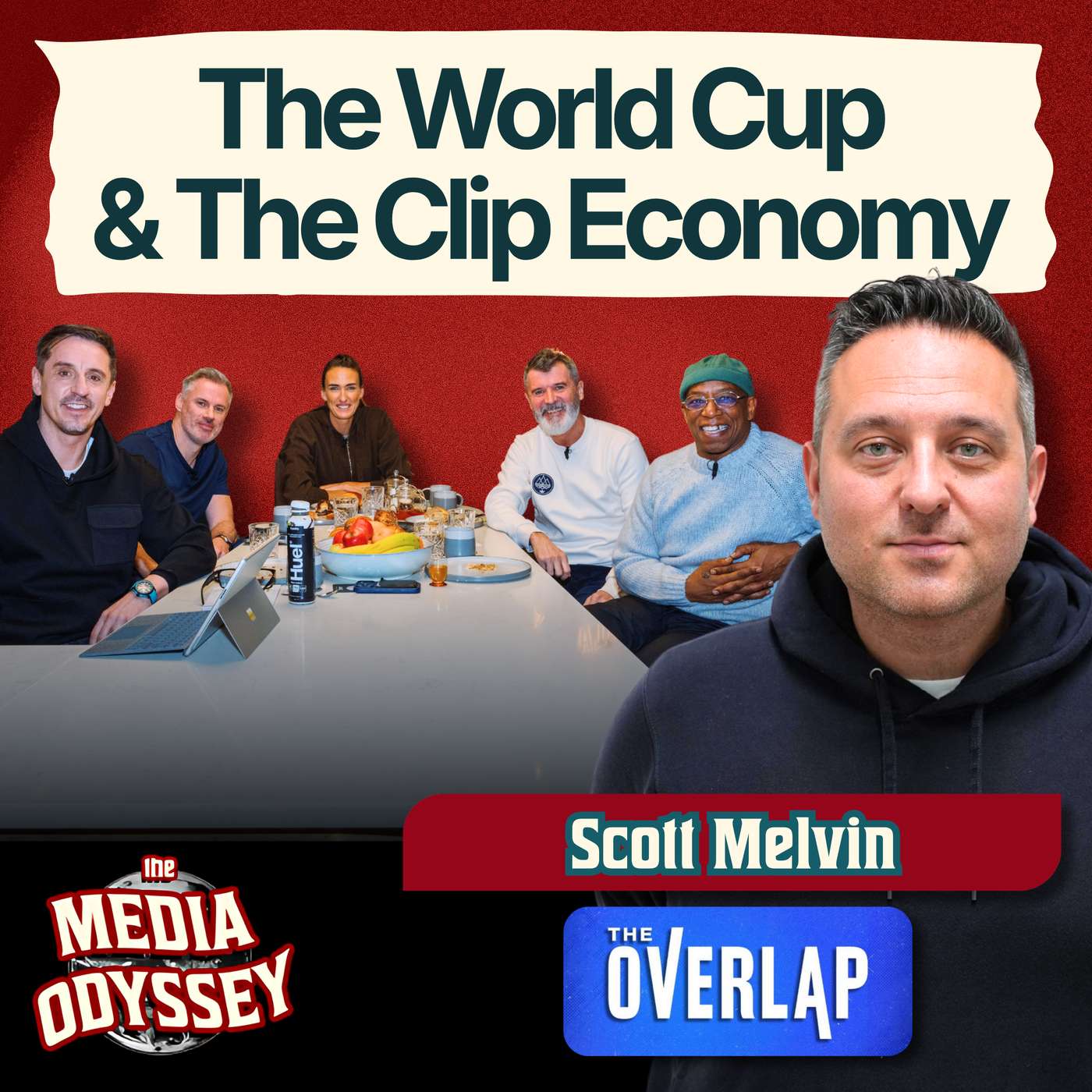
Loading summary
Transcript134 lines
- [00:00]
A
Welcome to the Media Odyssey podcast.
- [00:02]
B
That is Evan Shapiro and that is Marion Renshett.
- [00:06]
A
So it's the first day of the World cup and I want to know, Evan, you know, do you get, are you getting some, you know, soccer fever?
- [00:14]
B
What's the World Cup? I am a little bit more concerned about the invasion of New York, but it's actually kind of interesting. New York has World cup fever. Without question. Everybody's working, walking around with merch. Last night, I rode on a subway car that was entirely. And actually the whole train was branded for the World Cup. People are very, very excited. And you can see this massive influx of people from around the world who are coming here to watch their team play or just who are football fans in general. So I wore my football shirt today. Philadelphia eagles.
- [01:05]
A
Nice.
- [01:05]
B
Fuck. A.J. brown.
- [01:09]
A
Well, of course we're super excited. I have to say we're dubious as well, but for different reasons. We'll get into that because the guests that we have with us today, I'm super excited to welcome. Scott Melvin is the executive director of the overlap. Hey, Scott.
- [01:26]
C
Hi, guys. How are you?
- [01:28]
A
Super good. Awesome having you here. So you're at the World Cup. You're super lucky you're in New York already. Tell us a bit more about yourself, the origin story behind the overlap.
- [01:40]
C
So the overlap started off as a bit of a side hustle. About four and a half years ago, Gary Neville, who obviously was still a prominent pundit for Sky Sports, had a bit of an itch to scratch around doing long form conversation. Obviously, a lot of the, the broadcasters now throughout the live game broadcast have kind of moved away from, from longer form conversation pieces. And he felt Gary likes to talk and he felt there was a gap to do much longer form pieces. So the overlap started really as a bit of an experiment. Gary wanted to interview sports people for an hour and a half or however long it took. You don't get that privilege on, on broadcast television, on linear television. And it really just started as, like I say, an experiment. We were very fortunate. We're able to speak to some pretty high profile people in the first six months. People like Harry Kane, Anthony Joshua, Tyson Fury. And it all just kind of bubbled along. It wasn't a business. We didn't think of it as a business. And it wasn't really until September 23rd we launched a show called Stick to Football, which is our, our premium show. And it kind of just exploded. It was a very revolutionary idea of getting five people in a room to talk about football. But actually, what, what was Good for it was that all the guys we had have all come from a broadcast background. And it's very difficult in a TV show, particularly around live sport, to have time, you know, in a, in a half hour build up or, or one hour buildup of a show, you've only really got 15, 20 minutes of conversation time. Around halftime, you're lucky to get two, three minutes. So actually by putting these people in this room and saying, right, you got an hour and a half, talk about whatever you want. They all just kind of found it quite liberating. And actually what works best often is the content isn't really about football because you feel like you're listening in on friends conversations. So there was an example last year when Ian Wright came in and said, oh, I went to the cinema yesterday. They then spent 15 minutes talking about Toy Story 3 and the best animated films of all time. But it was brilliant because that's just how the show starts. We have a very cold open whereby as soon as they walk in the studio, we just start rolling and it can be 10 minutes, it can be 15 minutes and it's just, they come in and they sit down, they get ready, the team come in, the floor managers come in, the makeup comes in and we just put it all out because it feels really authentic. And it is authentic. It's never scripted, it's never, there's no, there's no running order for that first part of the show. And people just really took to it because you didn't see these guys in that situation whereby, you know, in broadcast it's very polished and obviously that's right and there's a place for it. But we just thought, let's just be completely raw with this. And people seem to take to it. And that was a real big moment for us. That was, you know, nearly three years ago now. And yeah, it just kind of exploded into from the side hustle into a real business and a real, a real show in particular for stick to football that people seem to love. I wouldn't say it was lucky, but we didn't necessarily plan it that way, if that makes sense.
- [05:04]
B
What's interesting is you. So There are other YouTubers like Kaze or Mark Goldbridge who will go out and get the rights for these leagues or for these games and they'll do deals with FIFA or whomever and they're building those channels on commentary while the game's happening during, before and after. But that's not the way you went. You went for a rights free strategy here. And the content around the game as opposed to the content in the game itself. As you were just mentioning. Why was that your strategy and why you think that works so well?
- [05:39]
C
It's less of a strategy more than it's prohibitive to try and buy rights. So as you know the rights for. Let's look at F1 as an example. I mean I think Apple paid $750 million for the latest F1 rights. I think sky paying 200 million a year, something like that. You know, Netflix pay 10 to 20 million dollars for a series of Drive to Survive. So the rights is really prohibitive. You either do it all in or you can't do it. It's very hard to dip your toe into live rights. But on the Netflix example, Netflix for a tenth of the cost of the live rights. If you ask people to name a talk about an F1 show, they'll talk about Drive to Survive. So it's not really about the business model for the network is obviously it's live rights. It, it drives everything. Live sport is the only thing keeping television afloat in some cases because you don't watch the super bowl box set in two months time, you watch it live similar to a Premier League game. So for us, and I think for most podcasts and Netflix obviously have the same model, hence they're moving into podcasts. If you can't own the rights on the conversation. And we think that owning the conversation around the sport is as powerful as owning the sport, depending on the level. So again, it wasn't a strategy, it was more that you were never going to buy live rights. Live rights are off the scale in terms of the cost, but you can piggyback that and be the shoulder content to that. And like I said around the time that we have to talk about the issues and talk about the games, we can talk about a game for three and a half hours. That luxury is not afforded to people on tv. So it was very much a. I think we all benefit from that. And again, when it comes to football particularly the appetite for it is 24 7. It's, it's non stop. People want it all the time. So there's room for everyone in this space. But yeah, the live rights was a, is a particular. I'd say it's a challenging market and will continue to be a challenging market. Obviously we did, we have a deal with the Bundesliga from last season which was a, a surprise to us. It came to us like a week before the season started. And I think to be fair to the Bundesliga, it was a really Bold move. You know, partnering with US as a YouTube channel and mark Goldbridge as a creator was, was really brave because they got quite a lot of stick for it. They surprised a lot of people. But I think when you look at the way that the, the rights market's heading, domestic rights will always be ring fenced and protected and the German market is particularly, you know, they do really well at domestic rights. The international rights is a challenge. The Premier League's a freak. The Premier League I think is probably the only league in the world in any sport where the international rights outstrip the domestic rights. Compare that to like the NFL. I think the NFL is maybe 10 times domestic versus international. So to try and get exposure for your league in overseas countries. Like I said, the money's been spent on the domestic rights so it's very hard to try and get any sort of serious income for your rights. So the idea of saying let's make it free in the UK, partner with YouTube channels, partner with creators, was, was brave. And I think we'll see more of it. I think it'll, I think it'll keep happening. This happened in France with. I know M6 are doing a partnership with Michoud on, on the World cup stuff. So that, that cross pollination is only going to increase over the next few years, I'm sure.
- [09:24]
A
And on the Bundesliga, what type of rights do you have? Are you actually showcasing a couple of games a week or is it highlights?
- [09:32]
C
So we have, we have Friday night live matches. I think we did 20 of them last year just in the UK. So geo blocked on our channel for the UK market. Same with Mark. But again, the challenge with that is that it's very hard to get people to watch something for 90 minutes even if it's domestic.
- [09:51]
B
So especially when it's a 00 tie at the end of it. But that's, that's my own personal.
- [09:57]
A
Look at him.
- [09:58]
C
It's all about jeopardy.
- [09:59]
A
Look at him. Fishing at football.
- [10:02]
C
One word for you, mate. Relegation. It's all very exciting.
- [10:05]
B
Okay, all right, fair enough.
- [10:06]
C
But yes, it's difficult but we obviously the part of the reason we thought the partnership worked for them was obviously our social reach is quite significant. So as well as streaming the live games, able to release live goal clips and previews and highlights. And to be frank, the social clips on the games outstripped the Life by about 20x. So but from an exposure point of view it makes perfect sense for them if someone was going to come in and offer them multi million pounds for the rights. Great you know, that's, that's exactly what they should be trying to do. But I think as an experiment, it's been very interesting. I think it has worked for, for them, but I think we'll see more and more of it.
- [10:49]
B
It's interesting. I mean, the clip culture thing. So this week There was the A.J. brown trade from the Philly to New England. And the amount of clip culture that's going on around that controversy is massive. It's my entire feed right now. What do you think the clip culture does to sport? You're right. The clips are really outpacing the games and the commenters, the online commenters are really becoming superstars unto themselves. What do you think clip culture does to the business of sport?
- [11:22]
C
Well, obviously it's the new marketing, right? It's simple. It's the only way or the best way to get people in front of your product. I don't think. Think back to 25 years ago. For football in particular, the free marketing was newspapers and the evening news and in the UK match of the day. And that sort of show, it's now so prominent that it's, it's a positive in the sense of it drives awareness and traffic. But it does skew the conversation slightly. So I was listening to, I was a talk last year with and it's Don Garber, see the MLS commissioner, and he was talking about the overall views of the MLS which were big in the hole. But when you look at if Lo Mess scores a hat trick for into Miami, it's going to get a billion views.
- [12:23]
B
Yeah, of course.
- [12:24]
C
How many of those billion people will sit and watch 90 minutes of Seattle vs Portland? It's very hard to find that middle ground of look at all the eyeballs we've got versus how many people are actually watching the games on tv. The tendencies will be good because sporting in live is always better than on TV in any sport. But it does kind of skew the narrative slightly. That's not to say it's a negative. It does help drive awareness, but I think it can, it can distort the, the messaging slightly.
- [12:58]
A
We, we had a few, a few months back, the producers of the format, Drag Race and we love this quote, what he was saying. The show is the clip and the clip is the show. But ultimately when you talk to a lot of players within the ecosystem, they're saying it's very hard to build bridges between those watching clips and those going to your own and operated to watch the full thing and talking about clips. When we were prepping for this. You view this World cup as a bit of a test, right? At scale of a bit of that make it or break it. Because again, there's like many more games than we've ever seen many more teams. It's not time zone friendly for us in Europe at least, where a lot of the. I think the expected viewing is going to be. And so it's going to be fascinating to see and I'd be curious to see how you see this. Will people be watching live games or they will just settle for, you know, the highlights and the conversation around it. And we're seeing Netflix, right. They don't have rights and they're going to have. The rest is football the entire time. There's going to be this daily show for X days, 40 days, et cetera. So do you think that this is kind of the moment where maybe it's going to, you know, tip over and highlights could actually become more valuable than full game Live rights?
- [14:25]
C
I'm not sure about valuable in terms of the value of them to a broadcaster. I think valuable to the consumer. Yes. I think, I think we're already there. I think we've already hit that point, the challenge with the World cup now. And it's similar to the domestic football here, hence my point around the Bundesliga. It's hard to get people to watch things for 90 minutes. There's so much football on TV now. It's very hard to. To dedicate that much time. There's a game of football every single night of the week in the uk
- [14:54]
B
and the rights are spread out. Right. They're not on the same spread out. So.
- [14:58]
C
So spread out.
- [14:58]
B
That's the big complaint fans have right now is that I can't find my game there. It's like there are Tik toks and Instagram posts that are just about. Like, where can I find. There was a great one the other day says, like this game is only on Delta.
- [15:12]
C
Yeah.
- [15:12]
B
You have to buy a ticket to a. To on a Delta flight and watch it on their seat backs. That's the only way to watch this game. It's a joke, obviously, but that's where people feel like it's going.
- [15:21]
C
Do you know what? There's an argument saying that monopolies and sports rights maybe isn't a bad thing. It's. It's quite clear in people's heads.
- [15:26]
B
At least I'll know where to watch.
- [15:27]
C
At least I know where it is. As long as they're not being priced out. If you have to pay 35, 50 pounds a month for Sky Sports, but they've got everything. I know where I'm going, Sky, tnt, Amazon, etc, if you're playing paying multiple subscriptions, hence why I said if you're going to go in, you've got to go all in. Having one Saturday morning game or one Friday night game isn't maybe enough. So I think the clips on the, on the, on your point, Marin. I think we're already there on the tipping point. If I want to watch a game of football, I'm booking it in two weeks at a time with, with compliance, AKA the wife and family. And I built my weekend around it. Whereas the games I'm half interested in, I'll watch the highlights later. People haven't got the time to watch wall to wall sport, but I think for the World cup in particular, you're right, the time zone's an issue for the Western viewer. I would also say, look, it's the biggest World cup of all time. They've added a lot more teams. They haven't necessarily added a lot more good teams. Yeah, there's only one Brazil, there's only one Argentina, so the volume could become a problem. Will we stay up till 2 o' clock in the morning and watch Uzbekistan versus Colombia? No, but if there's a great goal, I'll watch the clips.
- [16:45]
B
You'll stay up till two to watch the semifinals or the finals.
- [16:49]
C
As soon as we get through the group stages and we're into the knockouts, then it gets interesting. It's very hard to not qualify from the group stage of this World cup and I'm saying that with a caveat of I am Scottish and we will find a way to not do it. However, it's almost, it's almost harder to not qualify than qualify. So yeah, when we get to the knockout stages and it's, and you say the jeopardy is there's a, there's a result, someone's going out, then I think it'll get serious and you will stay up till 2 o' clock in the morning. But the majority of the games in the tournament are the group stages so the clips will be more important than ever. Hence FIFA's deal with tick tock. That's clearly a strategy around eyeballs getting driving awareness of, of some of the lesser known teams. But it'll be very interesting to see what the, what the, the linear numbers come out as post tournament globally. My feeling is it will be low but again there's more games, so cumulative might be more. But Qatar was great for time zones. For us it was middle of the day for us, it was early morning. I think it was ideal. So it'll be interesting to see how things play out post tournament on the. On the. On the live. The live numbers.
- [18:01]
A
Yes. Because my point is kind of, you know, if less. Despite the fact that broadcasters rely heavily on live. If live draws less viewers every four years, but we still see the value, the price point, you know, keep growing. There's a bit of a mismatch. So I was wondering whether there would be some sort of, you know, new balance coming into play. But I guess to the point you were making at the top, because live and sports are really helping traditional tv, you know, stay. Stay together. It's. It's likely they'll keep investing. Just the fear of seeing it go to a Netflix or. Or anyone else.
- [18:42]
C
Yeah.
- [18:42]
A
If we go back to the overlap. So you've done stick to football. We haven't spoken to it, but clearly you were saying, you know, you were trying to do something that wasn't possible on traditional TV, on broadcast TV, therefore, you went to YouTube and social. So this is where you know, the overlap and the programming is hosted. Could you tell us a bit more about that channel in terms of a couple of KPIs and how do you see it growing? Because you've made some recent moves in clearly what looks like a bit of a YouTube channel network approach.
- [19:19]
C
Yeah, we did a deal a few months ago for the Mark Goldbridge and the United stand. That's football channels. This sort of stemmed from about a year ago. We were thinking about what do we do next? The overlap was going well. The business was still in its infancy as a. As a proper business, having had a couple of years of trial and error. And there was a decision to be made of do we just keep doing what we're doing and enjoying it and the business will make money and it's all good, or do we actually try and grow relatively aggressively? And Gary Neville being Gary Neville, said, let's be aggressive. So we decided to be aggressive. And the only way for us to do that, really, was to try and find a partner that would help us do that. And we had a process and we ended up doing a deal with Global, who came in in January. And for us, it was about finding a strategic partner around commercial distribution, advertising, that whole Global infrastructure, which is very powerful, particularly in the uk. And then looking at who do you want to partner with from a channel creator point of view, obviously the Man United heritage in the group, Gary Roy, myself, being a Man United fan. Man United was the club we knew is probably the biggest club in the world in terms of audience globally. So how do we attract that Man United audience? It's very easy for us to say, let's just start a Man United channel, which we could have started from, from, from scratch. But growing YouTube channels is very difficult from scratch. I mean, it's taken us four and a half years to get to 1.7 million subs. So you could start a channel tomorrow, spend five years getting to a million, and it's a battle. Mark spent 10 years building his channel up to 2.2 million subs. So we thought, let's partner with him. We have an audience that we know are engaged in the club, engaged in his content. And what we've done is we've just shortcut five to seven years of building that audience, which Mark's done a fantastic job of building. So that was the first one, really. And the second channel of marks was called that's Football. We're looking to reshape from the start of next season to more of a kind of always on football. I don't want to say news and use always sounds a bit straight, but always on conversation. And I think for us that was quite important because we record stick to football once a fortnight. We do one topical show in the morning and then an evergreen guest episode in the afternoon. So it's very hard for us to react to a story. The Manchester United manager was sacked in a Monday morning. We didn't talk about it for 10 days. So how can you own the conversation of football when the biggest club in the world sat their manager and you're not talking about it for 10 days? So that was a light bulb for us that we need to be able to get on, get on air, get out ASAP. And again, the channel might belt, has, you know, 1.3 million subscribers, does fantastic views. So the little bit of a reshaping, we could be on air in 10 minutes reacting to news stories and the biggest stories in football. So strategically for us, that was very important. You can't be a credible football content business and not be able to react to, to, to big stories. Not in the same way that a talk Sport or a 5 Live Would or Sky Sports News would. We don't see ourselves as a news organization. I don't think we ever will. But we need to be able to react to these stories and do it in our own style. So that's the first of hopefully a few more partnerships looking to do the next 12, 18 months. And yeah, the appetite for football Content is like I say it's 24 7, it's 365, it's non stop. So there's a lot of clubs to
- [23:23]
B
try and service and Global is a, I mean very traditional, traditional media company. You know, this is a radio, remember radio and outdoor, they do outdoor as well. But they seem to be really getting heavily into creator world now. They back to the news agents which is basically the political version of what you do. And so I'm curious, what do you, what do you think they give you that you couldn't have necessarily done on your own?
- [23:51]
C
So they've recently just launched Global Studios which is their, effectively their, their video production business. I think whilst you say they may be traditional, I think they are quite forward thinking and they have been forward thinking with us. Incredibly ambitious. Obviously before us they did a deal with the podcast group the Fellas Studios. So we were kind of second through the door. Growth in the video space is obviously a massive part of their, of their plan going forward. They've recently announced a deal to, they've got their own YouTube sales rights deal now. So they're looking to branch out and partner with other creators in video sales. I think for us, other than the fact that obviously there's capital to deploy and to help to grow the business, it's always about the people really. There are lots of people we spoke to throughout a process who you will know but I think with them it was very much a personal thing. I couldn't possibly. I'll text you later.
- [24:53]
B
Come on. No one's listening. You could just talk amongst ourselves.
- [24:56]
C
No one's listening. That's not a great promo, is it? No one's listening. No, look, for us it was, for us it was alignment. We may have been four and a half years old but we were still relatively startup. We haven't got huge infrastructure in terms of finance, hr, legal, all those things. We were making content and we were quite simple in our, in our methods. You know, we're a bunch of guys who've made TV shows who started making this, this YouTube show. So it was a bit of support really in that sense.
- [25:27]
B
But I think they're also really good at, they're, they're really good at monetization. They have this massive digital ad exchange. Is, is that part of the equation as well? They're helping you monetize your channels 100.
- [25:37]
C
Yeah, yeah. We had, we, we, we told them what our ambitions were and they said we can help you do it. And we, and we believe them and we bought into it. And it's been a, it's been a great partnership so far. I like to see lots more, hopefully lots more to come from it.
- [25:53]
A
And let's talk about the audience for a minute. Right, so Gary Neville, how old is he? 50 or so.
- [26:01]
C
Just turn 51.
- [26:02]
A
Most of the. Yeah, most of the hosts are 50. Who, who's watching?
- [26:08]
C
So, yeah, you're right. The average age of our panel is 50. Our biggest demographic, if you combine is 18 to 34. I think there'll be a lot of YouTube strategists who will tell you that demographic would not work on YouTube. I think that's obviously not the case. We have the data to prove it. I think what's interesting is that I think the platform is what brings the younger demographic to it, not necessarily the talent. YouTube is a young platform, it attracts younger people. The talent, whatever age they are, will keep them there. But the platform itself has to feel young. I mean, I always use the example of Instagram. Three or four years ago, the man who broke the record for the fastest to a million followers on Instagram in four hours was David Attenborough, who was 94.
- [27:04]
B
That's right. No, he still has a massive, he's
- [27:07]
C
not an influencer, but he put him on the right platform and give people good content on that platform, people will come to it. So the age of the, of the talent or the hosts or the creators isn't a thing for me. I don't believe it is a thing. I think it transcends that. The platforms give you access to that younger audience and if you give them something good, they will come to you. I don't think it's rocket science. I think finding the right platform and giving them good content, that's, that's the playbook. It's, it's not complicated. You need the right people to front the shows and the right talent. Of course you do. And those who aren't high profile talent, like we were lucky, we launched with five high profile football names in the uk. But that doesn't mean one, that it will succeed because lots of these things haven't succeeded. But at the same time, you don't have to have a profile to launch on these platforms. You can build your own profile. So there are no rules here, There is no set playback of how these things have to work.
- [28:18]
B
And that's part of the fun of it, is that there are no, there's no clock. You can do whatever you want. It's part of what makes this, frankly, more fun to do than traditional television.
- [28:28]
C
Look, you self commission, you self regulate. If you don't, if, if you don't abide by common decency rules, you will fall over and you will, you will not be on the platform for much longer. But ultimately, if you're sensible and you play within your own rules that you've set, you'll, you'll succeed. But it, a lot of, it's patience, right, A lot of these channels now, I mean, like Mark, Mark's been like say 2.2 million plus 1.3 million over 10 years. It's taken 10 years to build up. I think what we've done in a way has shown that you can come in late with the right talent and the right marketing and the right social strategy. It's very hard now, I think for some of the original creators on YouTube, if they were to launch today, I'm not sure they'd get to that million, 2 million, 3 million point because there's so much else there and some of it is high profile talent so that the competition on the platform is a lot harder. But again, that's not to say it won't happen. Of course it will happen again. It will happen regularly.
- [29:37]
A
To your point, again, it could still happen, maybe not as often as what we've seen these last few years because to your point, there's a lot of competition, but with the right talent, the right formats, the right content, you know, something that again, you know, catches the, the audience, any, anything is possible. YouTube loves to say that it's never too late. But to launch on YouTube, I think that's a good pitch. But yeah, I agree with you.
- [30:01]
B
I want to take this moment to point out that one of us wore our club shirt on the, on the show here today. I have an eagle shirt on. Marian is not wearing a Paris Saint Germain shirt. I'm an actual fan and I'm very surprised. Yeah, I'm disappointed, actually.
- [30:17]
A
I know. So can I explain? There's a few.
- [30:20]
B
They are the league leaders right now. Right. And the league champions, aren't they?
- [30:23]
A
Yeah, but it's, you know, it's in here. Scott knows, you know, what happened about that. So I don't have a club shirt. Even if I wanted. Let me explain. I don't have a club shirt. Yeah, no, no, no, no. Nothing, nothing, nothing like that. But that's, that's, that's.
- [30:42]
C
I would ask you to prove it.
- [30:43]
A
Yeah. No, please, no, you know, let's not do that. No. But there's a few. So number one, I'm wearing a Radiohead T shirt. So I'm wearing my fandom, one of my fandoms. I'd love to have a Paris Saint Germain shirt, but I don't know if, you know, but when they won on Saturday, people. So the game ended quite early. Then some people partied, and some people, you know, also messed it up for. For others. But let's put that aside. Some people started queuing from 3am in the morning on the Champs Elysees in front outside of the Paris Saint Germain shop, because they were making a special shirt that was saying, you had the two stars. And in the back, it was saying back to back, because we've won, you know, two years in a row anyway, and it was worth €150. And I'm sure now it's selling on ebay for, you know, 10 times that. So that's the explanation behind that.
- [31:41]
B
But, you know, listeners, clearly Marian needs a Paris Saint Germain.
- [31:47]
A
Well, yeah, send one my way. I would love for.
- [31:50]
B
Let's see how avid our listeners are.
- [31:52]
C
The media odyssey Secret Santa has just become a lot more boring.
- [31:57]
B
I'd love that.
- [31:58]
A
You know, I'd love.
- [31:59]
B
We know what she's getting.
- [32:00]
A
Yes.
- [32:01]
B
So, Scott, I'm curious, what's your plan for covering World cup without any rights? I'm really curious as to what your strategy is and what your rollout plan is.
- [32:10]
C
Well, the strategy for us doesn't change because of the fact that it's an international tournament versus a Premier League or a Champions League season. It's still conversations around the tournament. I think what's important for us, particularly for the first two, three weeks, is just try not to chase it. There's four games every single day. If you record your show previewing the evening's games, your show's dead in three, three hours or four hours. So unless you're doing something every single day, which a lot will do and a lot will have, we'll have a very successful tournament. For us, it's like, how do we just try and capture the feeling of the tournament? What's going on in New York, what's going on around the grounds? My earlier reference to Toy Story, that will. We'll spend a lot of our time talking about the guys, you know, where have you been for dinner? Where have you been for a walk? Who did you bump into? Stories around it, obviously, as it gets further down, and England progress and Scotland progress and whoever else progresses, they will become the big topics. France, of course. Yes. But I think for us, if you try and chase it every single day, I think we'll just fall Over. So those previews to an evening game, if we get that episode out by 6 o' clock at night and the game kicks off at 8, our show's dead in two hours. So we're always trying to look three or four days ahead and just try and capture a bit of the feeling of the place rather than constant. We don't really do. We try to avoid like big tactical insights on the show. There's lots of places for that and that feels more relevant to a live broadcaster who has got rights and can show clips. We like to think we'll be doing more around the feeling of the place and the big stories. Obviously, if there's a big story around, I know Messi gets injured and he's out for the tournament, of course that's a big topic. But previewing every group game doesn't seem sensible to us because we'll, we'll never have that longevity on YouTube once we launch changes. When you get to the knockouts, every game's important, Every game's huge. I think for the first two weeks, just find our feet and get the lay of the land. In terms of how the tournament's going
- [34:18]
B
and how are you physically producing? What are you, are you, are you building a studio in each town?
- [34:23]
C
We have a studio in Brooklyn. Gary, Roy and Ian are all working for ITV during the tournament. So we've got a studio next to, if not in their hotel that we can access kind of 24 7. So it makes it nice and easy for getting the guys in, getting the guys out. It's a consistent space for the duration of the tournament, so we don't have to worry about rigging and de. Rigging as we did in Berlin when we, we did it for the Euros. So yeah, so we're in Brooklyn for six weeks, production team around the corner, talent in the hotel, makes it nice and simple.
- [35:00]
A
And so because you could go live non stop, some do that, right? We're seeing a lot more, you know, streamers on Twitch, on YouTube going live. We, we've had an example that is not football related, but this network TPBN, that was bought by OpenAI and these guys initially, just to your point, they were saying, you know, they're covering tech and business and they wanted to do this as a weekly podcast and then figured, you know, we might may as well just go live every day and it turned into a three hour daily livestream. Well, I guess, you know, if Gary and others have, you know, to work for ITV as well, it's not possible. But this could have Been something you guys could have done, or perhaps something you'll do two years, four years from now, possibly.
- [35:52]
C
I think my view would be that you could have too much of a good thing.
- [35:56]
A
Yeah.
- [35:57]
C
I think the beauty of our show is the fact that we. We only record once a week, once a fortnight, and we're doing two shows a week throughout the World Cup. I think that's plenty. There's. It's going to be very congested. It's a very congested space. And I think we like to think that by popping up twice a week, it feels a little bit more special and it's slightly different to the others. We're not always chasing the, you know, the daily stories. Look, plenty will be doing live streams throughout the whole tournament. I think people will be getting very blurry eyes by the end of it, particularly due to the times. Yeah, it's not something we've done much of. We've done. We did one live watch along in our past, which was Arsenal be Man United a couple of Novembers ago, which was great fun. But no, it's not something we do for the World cup this time. Maybe. Maybe for the. The next Euros. We'd think about it. It's slightly more friendly, given it's in the uk, but there's definitely a place for that. And I think the one thing that the. The live streamers have and have to have is an awful lot of energy and that it takes a lot out of you that.
- [37:06]
B
Are you going to be covering the Women's World cup in Brazil next year as well?
- [37:10]
C
We've done. Yeah, probably, but we haven't got that far. This has taken up a lot of head space over the last 12 months, as you can imagine. If you want to, I'm happy to go on a reconnaissance mission to Brazil for a few weeks to schedule.
- [37:23]
B
I'm gonna go in the fall. Yeah, yeah, it's wonderful.
- [37:25]
C
Yeah. So we'd love to. And I'm sure we'll be doing something, hopefully.
- [37:30]
B
On behalf of women's sports fans everywhere. I hope you do, because for Americans, the Women's World cup will be much more exciting than the men's.
- [37:39]
A
It's coming to an end. And I do have to ask you one more question, which is, who do you think is gonna win? You know, I don't think we can live that episode without.
- [37:48]
B
I think, let's make that the question of the week. Let's each make our predictions and then we'll come back afterwards and see who is right.
- [37:53]
A
Sounds good.
- [37:54]
C
I think. I think I know what you're going to say, Marian,
- [37:59]
A
so. No, I will say I hope it's France, but I think it's going to be Portugal.
- [38:06]
B
Wow. That was what I was going to say. I'm going to go with Portugal as well.
- [38:10]
C
Well, I hope it's Scotland, but let's not be. Let's not be stupid. I hope we win a game and get out of the group. I think Portugal or I think Argentina could potentially do it again. I don't know. There's so. There's so much of this tournament is going to be down to conditions more so than ever, but I think South American teams could do very, very well. He's going to be hot. It's going to be hot. I mean, the sad thing is for Scotland, our last game of the group is against Brazil in Miami. So if we need to get something out of that, we are in serious trouble.
- [38:49]
B
Yeah, it's going to be hot there and it's going to be. It's going to be a home game probably for Brazil. To a certain.
- [38:55]
C
The one team that keeps getting tipped is as a surprise package, not a winner is Ecuador.
- [39:00]
A
And I actually read about the Netherlands, which I live in the Netherlands, but I do not buy it. But apparently this guy is part economist, part football fan and he predicted. Right. The last few one and he says that the final is Netherland, Portugal.
- [39:18]
C
Yes.
- [39:18]
A
And Netherland wins, which really would. Would make my day.
- [39:23]
B
But has that Netherlands ever won? Has a Netherlands, everyone. Neither of them have ever won, right?
- [39:29]
C
No, no, Portugal won the Euros. The Euros. Yeah. But Netherlands have been tipped for every World cup since 1970. So let's not get too carried away. Do you know, the only thing I think as a caveat, I think it'd be very interesting to see this is not one for now, Evan, but the. The landscape of soccer in the US Post this tournament will be very interesting.
- [39:52]
B
Yeah, it's going to change. Yeah.
- [39:53]
C
Because the last eight years, particularly since Qatar World cup finish, has all been about this World cup and how it will change the attitude to soccer in America. I think when we get to the 21st of July, I'll be fascinated to see how the mentality has shifted, if at all. Or do we have a repeat of what happened in 94 where there was a huge boom and then two months later.
- [40:22]
B
Yeah, I think the big difference between 94 and now is the Internet is the kind of how the world has gotten so much smaller since then. So I do think. And Also, you know, 94, you talk about millennials very different generation. You've got Generation A here now. And I just think they're much more global in their perspective. So I do think this will be a transformational year with regards to America's relationship to football. Your football, not my football. And I do think having the Women's World cup coming right after it the next year where the US women have another good shot, I think that one, two punch will really be transformational. That's my.
- [41:03]
C
Do you think, do you think the men's game has suffered because of the success of the women's game? As in the perception is it's more of a female sport than a male sport?
- [41:13]
B
I think it's because, I mean America's, we love our winners and so we're so focused on the women's team. And by the way, I mean you can see what's happening in women's basketball as well, where Caitlin Clark is now arguably the biggest basketball star in America right now. So I just, I do think it'll be interesting. I think the men will, the US men will go a lot further than people are anticipating. And this always happens. The home team always goes further than they would normally go. The team, they're on their own clock. They're in oftentimes in their hometowns. And so I do think the combination of the US men going further, I don't think they'll win by any stretch imagination. But them going further in the rounds and it being here and these happening in stadiums all around, I do think you're going to see a major uptick in interest especially amongst Gen Z and Gen A.
- [42:07]
C
Good. Well, let's hope so. For your sake.
- [42:09]
B
Yeah, for your sake, for everyone's sake.
- [42:13]
A
Scott, it was amazing having you on. We met a while back, but I wanted to have you on for a long, long time. I mean it's amazing what you guys have done, you know, within. Within just three years. So kudos and let's circle back in a few weeks time and see who's a winner. I don't know, maybe. Maybe we. Someone buys drinks, you know, somewhere next.
- [42:36]
B
We all picked Portugal, so. So no, indeed.
- [42:39]
C
I'll go Argentina. I'll go Argentina. Okay.
- [42:42]
B
Okay. All right. Okay.
- [42:43]
A
Yeah. You just, you just copied me even. Cause I don't even. How come you picked Portugal anyway? Let's. Let's go.
- [42:49]
B
Because I was just in Portugal and everyone there was telling me we're going to win the World cup up so.
- [42:54]
A
Yeah, but that's my.
- [42:56]
C
I could see it in his eyes as soon as he said Portugal. He thought, I'll go with that. Yeah. You had nowhere to go.
- [43:01]
A
Yeah. He was like, oh, I was there. I know where it is on a map.
- [43:05]
B
Right, right, exactly. It's the one country I can identify.
- [43:10]
A
Awesome. Well, Scott, again, thank you so, so much.
- [43:13]
C
Thank you, guys.
- [43:14]
A
Great to see you today. Yeah. He's so lucky. I'm so jealous. I'd love to be there. I've never. Oh, actually, well, I did the Euro two years ago, and we've had the World cup in 2018. No, when was it? 1998, when I turned 18. I was doing the baccalaureate. I was supposed to study, and we had the World cup in France, and out of the blue, like, we just, like, we were so bad at the top, but out of the blue, we won. That was amazing. And then 20 years later, I was about to move to Amsterdam, and on the day of the final, I was doing my farewell party, which turned into a World cup party because it was us in the finals and we won. I cried my eyes out. And so I'd love to be there with them.
- [44:04]
B
Well, you have a place to stay? I'm here in New York. We have an extra room.
- [44:08]
A
I know, but it's a long time to stay. It's the money, my friend. There's so much.
- [44:12]
B
Well, you won't have to pay for a hotel. I know. Yeah. And by the way, you can't get tickets. It is impossible to get tickets.
- [44:19]
A
You.
- [44:19]
B
You can't.
- [44:20]
C
It's.
- [44:20]
B
You have to go. You literally have to buy scalpers at this point, there are no tickets.
- [44:25]
A
I don't like it that much. Well, to that point, to spend so much money. And plus, I have a lot of, you know, stuff to do with you over the next few weeks.
- [44:33]
B
That's right.
- [44:34]
A
So I'm gonna have to. In fact, yeah, Cannes. I'm going to London. There's a lot going on. My. My husband counted, and I'm going to be traveling in June. 16 days out of 30. Wow, that's a lot.
- [44:49]
B
Yeah, but you have small children. My kids don't give a shit when I travel.
- [44:52]
A
Yeah, but maybe your wife does, you
- [44:54]
B
know, I don't know. She seems to be having a good time.
- [45:01]
A
Well.
- [45:01]
B
Well, it was great. It was great to have you on. At next week's episode, we have a co host because you're on vacation. And I'm really thrilled. We've got one of my childhood crushes, Valerie Bertinelli, from One Day at a Time on the podcast as my special co host. So listen to. Thank you for listening to this podcast or watching this podcast, regardless of where you are. And tune in next week for a very special episode. This has been the Media Odyssey Podcast. That is Paris Saint Germain superfan Marianne Ranchette.
- [45:35]
A
And that is Eagle superfan Evan Chaparro.
- [45:39]
B
Go birds. Thanks for listening.