← The Naval Aviation Ready Room Podcast with Legends and Leaders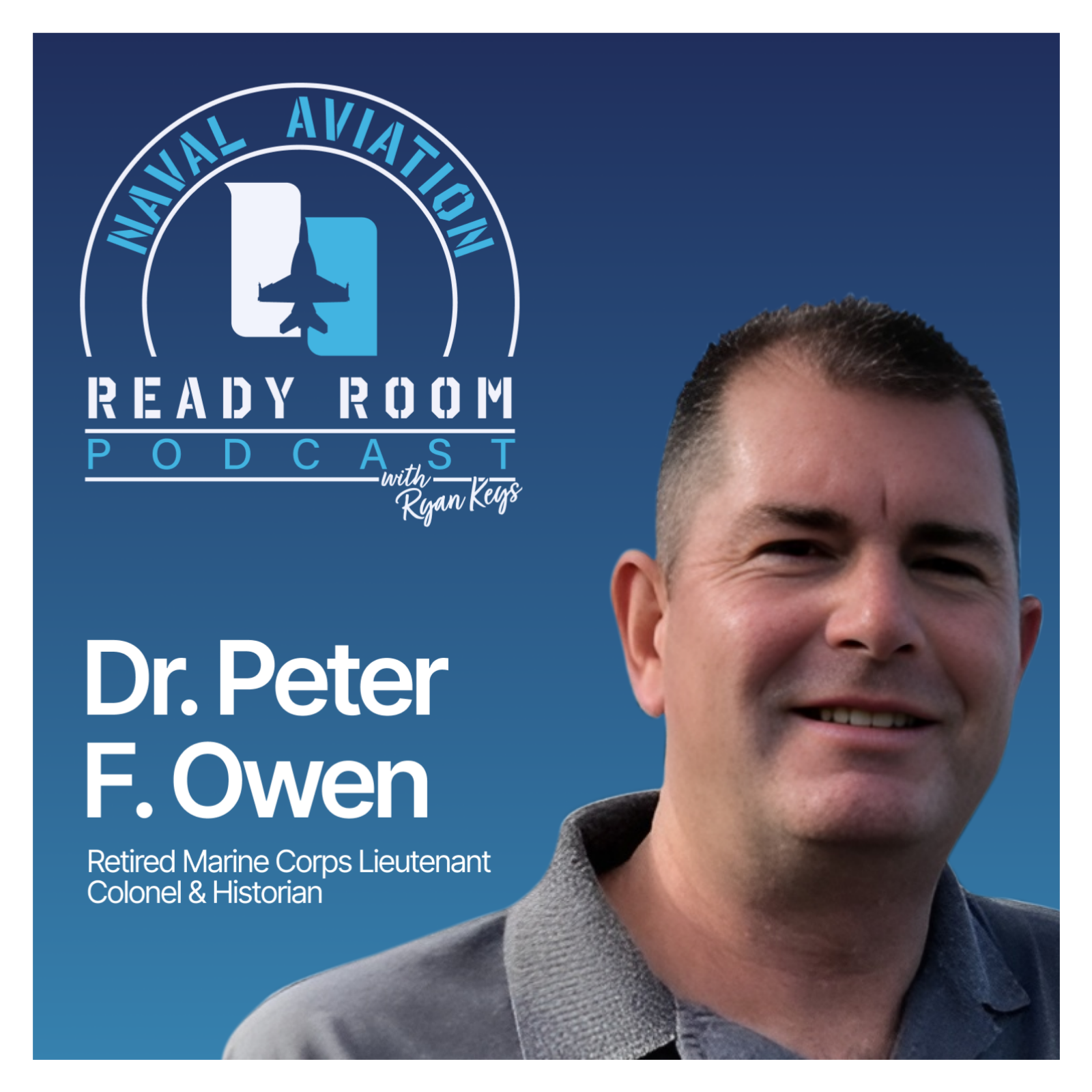
The Naval Aviation Ready Room Podcast with Legends and Leaders
Marine Aviation in WWII: The Real Story of VMF-221
00:53:14
Loading summary
Transcript104 lines
- [00:00]
Dr. Peter F. Owen
Our history, which is one of the reasons we celebrate our history, is that Marines are capable of a lot of really, really amazing stuff. So when you really understand what Marines went through in the Pacific War, what Marines went through in the Frozen chosen, what Marines went through in Vietnam like your dad did, you know, it's like when you're sniveling and cold at Quantico.
- [00:25]
Ryan Keyes
Welcome to the Naval Aviation Ready Room podcast, where the stories, leadership and leading edge technology of Naval aviation come al. Hosted by retired Navy Captain Ryan Keyes, this podcast takes you beyond mere museum artifacts as he delves into the personal stories, pivotal decisions, and state of the art hardware that define the world's most prolific aviation force. Our guest today is a retired Marine Corps officer and adjunct faculty member with the Marine Corps University and a federal civil servant. His remarks today are entirely his own and do not represent the views of the United States government. Today's episode takes us into the intersection of military history, Marine Corps leadership, and the evolution of Naval aviation during one of the most consequential conflicts of the 20th century. Joining us in the radar is Dr. Peter F. Owen, a retired Marine Corps lieutenant colonel, historian and educator whose research focuses on Marine Corps operations and aviation during the World Wars. Peter served more than two decades in Marine Corps, primarily in infantry and reconnaissance roles. During Operation provide comfort in 1991, he led a reconnaissance platoon in Northern Iraq. And during the 2003 invasion of Iraq, he served as executive officer of the 1st Marine Regiment after retiring from active duty, earned a Ph.D. in war studies and has continued to shape the next generation of military leaders as an adjunct professor with Marine Corps University. His latest book, Fighting Falcons the campaigns of VMF 221 in the Pacific, takes readers inside Marine Fighting Squadron 221 and examines how Marine aviation adapted during World War II from the devastating lessons of Midway to the maturation of Marine air power later in the Pacific war. Pete, welcome to the Ready Room.
- [02:02]
Dr. Peter F. Owen
Hey, thanks, Ryan. I'm thrilled to be here. This is great.
- [02:04]
Ryan Keyes
Great. Yeah. So glad to have you. Definitely, I want to say a one off necessarily. Our first Marine infantry officer here in the Ready Room. So you can put that on your list of accomplishments. But really we were connected through the United States Naval Institute, which is a fantastic organization based in Annapolis. I think it's actually still on the yard, I believe. Right on the grounds of the academy.
- [02:27]
Dr. Peter F. Owen
Yep. Over on hospital floor.
- [02:28]
Ryan Keyes
Yeah, there you go. Yeah, that's right. A brand new building there and we were connected there. I actually met the head of the Naval Institute out of Tailhook last year as well. And so then, anyway, we got connected because Pete wrote this book, like I said, called Fighting Falcons. And, you know, here at the Naval Aviation National Naval Aviation Museum, it's all about the history of Naval aviation. And to bring in one of the, I would say, premier historians from that age, I think was something that we definitely couldn't pass up for sure. So, like I said, so great to have you here with us. So let's kind of jump right into it. So one of the things I thought was interesting, though, was, so you were actually an enlisted Marine first, and then you got acceptance into the Naval Academy after that, class of 86. How did you go about that? Where'd you grow up? Why'd you enlist in the Marine Corps and then choose kind of the service academy route?
- [03:18]
Dr. Peter F. Owen
Sure. Well, my dad was a Naval aviator. In fact, he flew a 6s, did three tours in the Vietnam War, and. And I was actually born there in Pensacola at the Naval hospital. And while I was growing up, my dad got stationed at Whidbey Island. He was the XO and later the CEO of VA52 at the Naval Air Station there. And I went to Culver Valley Elementary School, which folks had been stationed there might be familiar with. What. It was kind of cool because we were right next to the Naval Air station. Like, you know, we. The landing pattern had the jets coming right over our playground, and you could hear the jets winding up while you were at recess. And sometimes, even when the wind was right, you could smell JP5.
- [03:56]
Ryan Keyes
That's a great, great way to grow up, man. That is awesome.
- [03:59]
Dr. Peter F. Owen
Yeah, I know. And the school library had this great section on naval history and the Pacific War and stuff like that. And I would just tear into those books. I was always reading them on the bus, at home, at night, you know, whatever, Reading all these books about the Pacific War because I was fascinated. My dad was kind of my hero, and I'm really into naval aviation. I was reading these books by this young adult author of novels. The guy's name was Rob White. He was a Naval Academy grad, served in World War II. But he wrote all these young adult novels where the protagonist was always a young naval officer or a young guy in the Navy. But I noticed that the characters there always had this sort of reverence and fascination for Marines. So I asked my dad, what's this Marine Corps thing, dad, what do you know about the Marine Corps? He said, oh, the Marines are great. You know, I have the utmost respect for Marines. I just don't want to be one. I'm like, okay. So I started to get fascinated by Marines and read a lot of books about the history and. And while I was through high school, I was either going to be a Naval aviator or a Marine. And by the time I graduated, I was going to be a Marine. I didn't get into the Naval Academy, which I think was great. Right out of high school. I had some other options to go to college, but I just wasn't ready or interested. So I enlisted as an infantryman and then I got assigned on guard duty at Naval Weapons Station in Yorktown. So reapplied to the Naval Academy, got in and that was great. Great opportunity.
- [05:20]
Ryan Keyes
Yeah, we actually kind of have some parallels. We're kind of talking about it on our pre call. So my dad was a infantry Marine enlisted guy in Vietnam as well. 1st Battalion, 9th Marines, the Walking Dead. And that impressed a lot upon me as well in my choice to enter the Naval service. I too did not get into the service Naval Academy right out of high school. I went to college for a year locally around my house and then got in after that, actually wanting to be a Marine aviator because of the influence of my dad. And I would go to his reunions, his 1st Battalion, 9th Marines reunions that they would have. Yeah, it was pretty incredible. Their CEO at the time there got the Navy Cross. So when he was there in country was, like I said, heroes. Right, Heroes from that timeframe. So I totally understand what you're leading up to. But you ultimately, though, like I said, wanted to serve, to become an officer and possibly a pilot after that, and then chose Marine Infantry. So tell me a little bit about kind of what of your time frame doing the infantry gig.
- [06:15]
Dr. Peter F. Owen
Sure. It was great opportunity. I was singularly fortunate. So I went down the 2nd Marine Division after the basic school in the infantry officer course. Had a weapons platoon for my first deployment, which is a little bit uncommon for a second lieutenant. We did a Mediterranean deployment, came back, did a Norway deployment. I was a company XO by now. And then we did another deployment to the Mediterranean. I was in the rubber boat company for that one, which is a whole lot of fun. And I was having so much fun right when it was time to go to like Parris island or recruiting duty or something like that, I went over to recon battalion. So I got to stay in the division a little bit a couple more years and I was a recon platoon commander there. And that's when Desert Storm was happening. So I was on my third med float now in this one tour and right after Desert Storm, we went into northern Iraq to protect the Kurds. Really interesting deployment. Really good experience for me. And then I did the usual cats and dogs tours along the way. Went on security forces in Charleston. I commanded a company in Hawaii, which was great. Went to Okinawa. I did joint duty in Hawaii at U.S. pacific Command. Commanded a recruiting station, which I did not love, but I loved my recruiters and I got pretty good at it.
- [07:29]
Ryan Keyes
I feel like that's everyone's experience when they do recruiting duties. The people I've spoken to, sure.
- [07:33]
Dr. Peter F. Owen
Well, if you don't get fired, you get your choice of duty station. So I chose Camp Pendleton, 1st Marine Division, and I was very fortunate to be the XO for the 1st Marine Regiment. We unvetted Iraqs, which was a very interesting time, of course. And then I did my twilight tour running the Marine Corps down there, EWTG packs. Got a. Basically an amphibious raid. And back then the Amphibious Reconnaissance school was there and also the Water Survival Instructor School. So I was in charge of those three courses. It was great. All I had to do was stand on the beach with my hands on my hips and admire the job my instructors were doing. It was easiest job I ever had. Yeah.
- [08:08]
Ryan Keyes
Look out, the Pacific Ocean. I mean, not a bad life. I know this is a rabbit hole, but real quick. So that command is the emblem for that command, the one where essentially it's like a diver who's horizontal and he's swimming, but has like a flame or a torch or something like that on it.
- [08:24]
Dr. Peter F. Owen
That's generally the Amphibious Reconnaissance logo. I don't think it's an official thing anywhere.
- [08:30]
Ryan Keyes
Got it. Yeah, I just remember saying that all the time. I just thought that was probably one of the coolest emblems that there was a scuba diver doing cool stuff. So did you go through war college? Did you get formal education from the Marine Corps?
- [08:41]
Dr. Peter F. Owen
I did our career course as a captain. Back then was called Amphibious Warfare School. And then I did the Command and Staff College as a major.
- [08:49]
Ryan Keyes
Yeah. In Quantico, right? Yeah. So you said your thirst for reading and learning when you were younger about history, did that continue through your time in your infantry time in the Marine Corps, like on the side, or were you always thinking about writing a book and it's like, I don't have time to do this. I'm just going to put in the back of my head, but, hey, I've been taking notes over here kind of the whole time. How did that kind of flow? And I want you to talk about your PhD program a little bit too, and why you decided to do that. And I mean, we can go down so many rabbit holes, but just tell me about kind of your desire to write.
- [09:19]
Dr. Peter F. Owen
Lots of opportunities for rabbit holes. But I can tell you that I know sailors work really hard when you're at sea. And Marine infantry guys, except for PT and once or twice a day we got a lot of time to read books. So all those med floats, I read a lot of books. And honestly, being a history buff and liking history books is a good thing for an infantry officer, any Marine officer or naval professional, really. But that's how you learn from other people's mistakes and other people's successes, right? And yeah, I always had, in the back of my mind, I would like to write a book. And when I was at Command of Staff College, they had a deal. It's like, hey, if you write a really long term paper, then we'll give you a master's degree on top of your diploma from Command of Staff. So I said, okay. So I wrote a really long Master's which I eventually, about six years later, published as my first full length book, which was a critical analysis of a Marine battalion in the first World War, which was my first love of history was World War I. Marine Corps, World War I. And I published a couple Marines memoirs from that period and later on wrote some other stuff about the Marines in World War I. That's how I got my start. And then, you know, retired. I was working for the federal government and to be honest, I had the opportunity where I was in a very unchallenging assignment and I had what I thought was enough free time. And the GI Bill was just sitting there because I had retired too early to pass it on to my family members. So I got into the Royal Military College of Canada. Their war studies program, fabulous program. Not just military history, that was my focus, of course, but I also had a very, very deep exposure to defense policy, national security type stuff, and international relations theory, which was really challenging for me. But I can't say enough good things about the war studies program up there in Kingston, Ontario. Great time. And then I wrote my dissertation here on the Marine aviation, World War II.
- [11:15]
Ryan Keyes
Got it. I find that a few people that I do speak to, right, they get their education. I was able to go to war college as well, are kind of in that history mode, national security policy. But I think for you to say, hey, I want to now transition to this. And you're doing it though, as a side gig though too, right? I Mean, you have a full time other job and you do this kind of on the side. You've written several articles that have, you know, but for the Naval Institute as well as writing the books. So have you found that you would rather just write all the time and not work a steady job?
- [11:49]
Dr. Peter F. Owen
Yeah, I think if I wrote all the time, it would become a job and not a fun hobby or like a fun side gig. You know, it's kind of like the wife and I, we go to home games in Annapolis. Wouldn't it be great to live in Annapolis? And then we think, you know, if we lived here all the time, it would just be a place we live. It wouldn't be so special. I think the same thing with my study and history and everything. If it was my job, would it become, oh, I got to write another thousand words today?
- [12:14]
Ryan Keyes
That's true. I mean, I'm sure you have deadlines for the book anyway, right? But the pressure may not necessarily be there as it normally could. Your outlook about going to Annapolis is a great point, too. I love to go back there, too. I went back for my 30th reunion back in the fall, which was incredible. My wife's from there. You do think that it would be fantastic to live there because it is very quam. It's a great place, but maybe it is better just to maybe appreciate a little bit more when you just visit. So let's, let's dive into the book now. Fighting Falcons. Why them?
- [12:47]
Dr. Peter F. Owen
Well, what I was trying to do was, first off, I wanted to look at Marine aviation in World War II, because I thought that would be relevant to the naval services today. We had Force Design 2030 come out in the Marine Corps in around 2018, which is when I was starting my PhD program. And the commandant, Dave Berger, had been my company commander briefly at Recon Battalion. And so his whole idea there of, hey, we need to be asking, what does the fleet need from the Marine Corps? I thought was a really good question to me asking. And I realized that Marine aviation seemed like a really important piece of the answer to that question. So I said, well, let's do some historical study of Marine aviation in World War II. And what I quickly kind of figured out, I already suspected this, but I wrote an article for Naval History magazine that explained this, is that even though we think of Marine aviation as being always like everybody else in the Marine Corps, supporting the riflemen up front, that's what everybody in the Marine Corps does. But when we look analytically of what Marine aviation did in World War II, that's not really right. What about five times as much as Marine squadrons supported Marine and Army landing forces ashore, they were supporting the fleet at sea, usually as land based aviation, a little bit from carriers later in the war. That's what the Marine aviation was doing. And I don't think that was a mistake. I think they were the right tool for that job and that was the job that the fleet needed done at that time. So getting back to your question, why VMF221? Well, I wanted to use a squadron as a case study for Marine aviation throughout the war. Because if I focus on one squadron, I figured I can get down into the nitty gritty of how well they performed and how effective they were and why were they performing that well or that poorly and why were they that effective or not so effective? Right. So I've. So VMF 221 is a great through line for Marine aviation because they were formed in July 1941, right before Pearl harbor. And they are the fighting squadron that fights in the Battle of Midway. So they're there in the early part of the war and then they fight for almost a year in the Solomons in 1943. And then at the end of the war, they're one of the ten Marine fighting squadrons that get placed aboard fleet carriers. They were aboard Bunker Hill in 1945. So you've got three really good phases of Marine aviation in the Pacific War, all experienced by a single squadron. So I said, I'm going to use them as my case study to examine Marine aviation and hopefully learn something about how good or bad, how effective, useful Marine aviation was during the war.
- [15:30]
Ryan Keyes
I'll tell you, I'm not a historian, so this is all very educational for me too. And I really appreciate that because you're right. So come into the Navy in 1995 knowing about the Marine Corps and learning about it in school and learning about the ace, right? The aviation combat element of a magtef, which is how it is structured today. You're always told that when an ARG amphibious rating group goes out, right, and it has the three ships and it has the whole MAGTAF that's on it, that ACE is there to support the Marines when they go ashore. But ever since when OEF started and then OIF started, then it all became a joint war. And so the Marines, from what I saw from the outsider looking in through my time, the Marines had a really hard time coming to grips with playing in the joint war, as in becoming a part of the ato. Right. The Air Tasking Order that the chaoc. Right. The Combined Air Ops center, which was always in Qatar, Doha newly and Fifth Fleet of them being part of the ATO and, and being sent over the beach to support army troops, not Marines. And so it's interesting to see that what you found was that essentially the Marine Corps was doing joint ops supporting every service early on in their aviation establishment. And then now we come to the future and then now we're kind of. We went through a period. The Marine Corps went through a period of ACE supports Marine only. And then now in the last 20 years. Right. It's all become joint.
- [17:09]
Dr. Peter F. Owen
Yes. And I'll put in an important caveat there. Absolutely. World War II Marine Corps aviation is fighting a joint war, but they're fighting a joint war as part of a fleet, not as part of a totally purple joint force. So. But when they're on Midway, that's just part of the fleet. When they're in the Solomons, the joint force is really Third Fleet. That's Halsey. And Third Fleet is the South Pacific area, which is a joint Command. And when VMF 221 is flying missions from water Canal and from the Russell's and from Vella Lavella, they're part of Air Solomon's, which is a joint command. And at one point has an army commanding general, but it's still all under Third Fleet. So the joint command is a fleet command. And so it operates as a fleet and it has a Navy staff.
- [18:04]
Ryan Keyes
Got it. Good distinction there for sure. So I gotta ask this question because growing up, I'm sure you watched Baa Baa Black Sheep. Yeah, I mean such an impressionable, at least for me, impressed upon me, like I said, the importance of Marine aviation. World War II Greg Pappy Boynton Medal of Honor winner, the C.O. robert Conrad played him on TV and there we're. Oh, I write it down there, a VMF214. Right, right. Why not them? Were they not as special as 221 gave you that greater scope from like you said, Midway all the way until carrier ops. Is that why.
- [18:40]
Dr. Peter F. Owen
Yeah. So there's a couple reasons not to. First and foremost, I thought it was important to include the Midway experience, either Midway or Wake island. And Midway made more sense to me. So that was really important for what I was doing. And then second off, I wouldn't say 214 has been done too much, but it's been done quite a bit. So there's a great former naval aviator, Naval flight Officer named Bruce Gamble. I think he's worked there at the museum before. So he's written a couple books about Pappy Boynton and VMF214. They are fabulous books. His research was great. He also had access to a lot of the veterans, especially the pilots, and he interviewed them. So Bruce Gamble's books have already kind of done that. Also, there's a Dr. Fred Allison who worked at the Marine Corps History Division for years running their oral history program. He's kind of like the senior Marine aviation historian in the world. Like, Everybody knows who Dr. Allison is. And he wrote his dissertation on VMF 214, more on the development of close air support through Korea, but still, it's already been done. And Dr. Ellison is a guy who encouraged me to take this approach. And then I picked VMF221 for the reasons I said, okay, got it.
- [19:49]
Ryan Keyes
I knew it was kind of a loaded question because, you know, the black sheep are so popular. But, yeah, I got it. So then when you go back, except I'm not a historian or researcher, what means did you use to gather all your information about 221 and the book? Was it official flight documents? Was it interviewing? I mean, was anyone still alive from the squadron? Almost.
- [20:13]
Dr. Peter F. Owen
So I tried to get in touch with Colonel Dean Caswell, who's very well known to World War II aviation enthusiasts. He gave a lot of recorded interviews that I was able to leverage after he retired later in his life. And I was trying to track him down, connect with him, maybe interview him. But he passed away when I was really early in days in my project here. And as far as I could tell, he was the last surviving aviator from the squadron. So, no, I didn't have any decent oral histories. And I talked to a couple children. I say children. They were, you know, grown adults of a couple of the veterans. But, yes, what you mentioned first, official flight documents. Official records. So the naval services were very good about writing operational reports after actions and learning from those. So it was a little more rudimentary. At Midway, every single surviving pilot sat down, wrote a statement about what he did, what he saw, what he experienced during that one major engagement on June 4 and then in the Solomons. And then when they. They were flying off Bunker Hill, there was an official report. It was called an ACA one, an Air Combat Action Report. And it was usually four to five pages long. It would say how many planes were on the mission, what the mission was, all the usual stuff. And at the end, there'd be like, a narrative that the squadron intelligence officer would write after interviewing all the participants in their post flight. So that was extremely detailed stuff. And then I also used the muster roles. So one thing that drove me crazy when I was a second lieutenant is we're getting ready to go to the Mediterranean. I take over my platoon and six months later we're leaving. And the Marine Corps has put all these resources towards our battalion to work up for this deployment. And we get more ammunition, we get more range time and everything else. But meanwhile, I've still got Marines showing up all through that six months who've missed the first part of the training. And I've also got Marines leaving because they're getting out of the Marine Corps, they're getting orders to go be a drill instructor or whatever. So the platoon I had when we started this great progressive training program, the one we had when we actually deployed, were about 50% the same platoon. So I figured out that from that experience when I wrote both my book about World War I and my book about 221, is you got to look at the muster roles because when they're doing training or they're getting combat experience, are they the same guys? And a lot of times they're not. And so that's a useful document is the monthly muster reports. And then I was extremely fortunate to have some firsthand accounts. So the squadron CEO aboard Bunker Hill was Major Edwin Roberts. His family, his daughter in law had a copy of his diary which is extremely detailed. So I had that Colonel Caswell, who was that ace that I talked about, he got together at reunions with his buddies and they put together a privately published, really a compilation of war stories so I could correlate, okay, this war story is this mission. So I have the ACA in one set hand and I'd have the pilot's war story that he wrote 20, 30, 40 years after the war, the other. And it kind of makes a great synthesis there. And then I also got to talk to one of the other squadrons. CO Sun, Captain Robert Burns commanded the squadron on Guadalcanal. And I talked with, I exchanged some information with his son, Jim Burns. He gave me a lot of personal information about his dad, shared some documents from his flight training, everything, so all those types of things. But I spent a lot of time with the National Archives, a lot of time, the National Archives, harvesting operational reports from the squadron, from the carriers, from the other units around it.
- [23:53]
Ryan Keyes
When did you begin the process?
- [23:55]
Dr. Peter F. Owen
I would say 2021, I think, because when you're doing your PhD program first you got to do your coursework, and then you got to pass your comprehensive exams, which took me 18 months to prepare for. That was really arduous. And then it actually took me another three years and change to write the dissertation. And then it took me another year to take the dissertation and turn it into a book that somebody would want to read.
- [24:19]
Ryan Keyes
So did you graduate with your degree then? Once the comprehensive exams, but then once the dissertation was complete, yeah, you don't
- [24:27]
Dr. Peter F. Owen
get your PhD until the dissertation is accepted, is what. Basically, it passed. So that happened. And I graduated in 2024, but by then I already had. Naval Institute had already said, hey, Pete, we like your proposal. When you're done with your PhD, give us a manuscript. So I already knew that I was going to publish a book by the time I graduated, and I would already start working on it.
- [24:54]
Ryan Keyes
Yeah. So would you say then that the dissertation was what percentage of the final book?
- [25:00]
Dr. Peter F. Owen
60 to 70.
- [25:01]
Ryan Keyes
Wow.
- [25:02]
Dr. Peter F. Owen
Okay.
- [25:03]
Ryan Keyes
Yeah.
- [25:03]
Dr. Peter F. Owen
As an example, like, my Dissertation has about 25 to 30 tables that I built from spreadsheets, and the final manuscript only has about four.
- [25:13]
Ryan Keyes
So I do want to circle back to the Naval Institute, though, and make sure we do talk about that and how you got connected with them and how they supported you through that. But do want to stick to this, the 221, because I'm just going to use this word because in my former Navy career, expeditionary was, I'll say the buzzword, but for my community, right, we had two communities. We had an air wing community of helicopters squadrons, and then an expeditionary squadrons as well in our community. And so they operated totally different, but they kind of did. Right. One was on the carrier and one then was on either amphibs or shore based during that time. So I kind of almost see it that way. Right. The Navy is primarily on the aircraft carrier. Marines were, I would say, more expeditionary. Right. They were on land, bringing their people, bringing the whole package right there. And then they could move to other locations, and if they had to, they could even go back on the ship. We saw it all the time, especially in OIF when the prowler squadron. Right. So again, the joint force needing an electronic attack capability, would then siphon off the Prowlers to go debt into, like, Al Assad or wherever. And in order to do that, especially during the IED times in Iraq, to defeat those. So again, I feel like history is repeating itself. Right.
- [26:32]
Dr. Peter F. Owen
Pasta's prologue passes Prologue.
- [26:34]
Ryan Keyes
Yeah, I had it backwards. Sorry, was past prologue.
- [26:35]
Dr. Peter F. Owen
Right.
- [26:36]
Ryan Keyes
So they started doing it in World War II. So what were kind of the lessons that they learned, you think, from that time when it came to maintenance, manning operations? I would say adverse operations. Right. I mean trying to the Seabees being there to build runways and hooches and everything like that. So what was 221 doing? How were they handling that?
- [27:00]
Dr. Peter F. Owen
Sure they were. The benefits first off of a little bit of experience where the Navy and the Marine Corps and the Army Air Force had fought the battle of Guadalcanal down there in the southern Solomons beginning in August of 1942. And 221 doesn't get there until about February of 1943. So by then Guadalcanal secured. There's no land fighting really. That's all done with on Guadalcanal. And now what Halsey's doing is he's trying to move through the Solomons from southeast to northwest, culminating at the end of 1943 with the isolation and neutralization of the Japanese base at Raval. Well, what's going on? That's a great lesson for naval planners today who are thinking about doing operations in the western Pacific and setting up advanced bases on islands that maybe don't have developed infrastructure is first off, it's a long, long, long frigging way from California to the Western Pacific or to the Southern Pacific and the Solomons.
- [27:59]
Ryan Keyes
A tyranny of distance.
- [28:00]
Dr. Peter F. Owen
Right, right, the tyranny of distance. And that it was a really, really difficult thing just to get stuff there. And of course they didn't have digital IT management back then. So even though they were sending enough stuff to the Solomons to supply everybody, to repair everything, to ammunition, fuel everything. Well, it's getting to the South Pacific, but then it's getting and it's being offloaded ships and like maybe the mechanics are getting offloaded in one island because they're on this ship and then their tools are getting offloaded on another island. And then nobody knows where all the spare parts went. They're just on some beach somewhere until hopefully somebody who needs them will stumble across them and find them. The mismanagement of the supply chain was one of the really eye opening things to me when I was doing my research. Another thing is the harsh climate of the tropics. And it's one of the most difficult areas of the world just to live because of tropical disease, because of the weather. And of course like you brought up, you know, you got to have construction engineers to build airfields out of jungles. Right. They actually would usually pick coconut plantations because if there was a flat piece of ground that was flat enough for a Runway, somebody would probably put a coconut plantation and they would bulldoze all those down, right? But like I was talking to him on a story and former Marine named Dave Holland, who's kind of an expert on the Guadalcanal campaign, he's led tours there. And I said, hey, if I go to Guadalcanal, like do I need to get a bunch of shots so I don't get sick? And he said, well you can get shots for this or that, but you know, you're still exposed to malaria and all you can do there is, is treat for the symptoms. There's no cure for malaria really. There's just treatment. I'm like, oh, that doesn't sound like a good idea then. But of course that's something that, you know, if you're an expeditionary naval unit and you're going to be setting up an advanced base in a malaria infested part of the world, you're going to have to expect that not only are you going to have to protect your people from that, but it's probably going to degrade their ability to work on airplanes and do all those types of things. So that was a big one. And I think also the constant moving, you know, you mentioned how expeditionary forces can move. Well, these guys are setting up bases and they're not staying there, you know, like VMF 221 and their first combat tour there on Guam Canal, their second combat tour. They're on the Russell's third combat tour. They're on New Georgia for briefly and then Vella Lavella. And so none of these bases are years old. All these bases are weeks and months old. So they never get developed so that it's ever, you know, like you've got air conditioned and chow holes and things like that. That just never happened.
- [30:41]
Ryan Keyes
Got it. So I'm just going to do a quick public service announcement. So for all of our listeners out there, be sure to like follow, leave a comment. 5 star review on the platform. Your choice helps us reach more great listeners like yourself and be able to listen to these great stories like Pete Owens. So again I'm just going to go this eabo, Expeditionary Advanced Base Operations Marine Corps new I would say tactical doctrine and then distributed maritime operations, which is the Navy's complement to that. And, and I've said this to people before, right? I mean we've talked about the war in the Pacific now the current war in the Pacific or the, you know, what we have there. And I call it Island Hopping 2.0. I mean, if you've read either one of those documents, even the unclassed version of it, I mean, it's, you know, we got. We're talking island chains again, movement through defending, you know, like I said, hopping from different island to different island, depending on what it is you need. But I think the biggest difference now is the logistics problem. Right. And trying to make it so that I have logistics hubs that are already in country in these planned places, because we know where the threat is coming from essentially today, and then having them cashed there so that we can operate there in the future, and having bilateral agreements with these other countries so that we can operate there and move when we need to and remain more agile. So, again, it's like 2026 is like 1943 all over again.
- [32:11]
Dr. Peter F. Owen
Yeah. And it's still just as far away as it was. And that, you know, the climate is just as.
- [32:16]
Ryan Keyes
That hasn't changed.
- [32:17]
Dr. Peter F. Owen
Yeah. There's a really important distinction I think all of us understand, though, between 1942 and today, which is 1942. Going back to my VMF 221 story, the MF 221 on December 7, 1941, is one of only four fighting squadrons in the Marine Corps. So there's only four fighting squad. There's only 13 squadrons in the whole Marine Corps. There's 98 in the Pacific by the end of the war. There's 40 fighting squadrons in 1945. So they went from four fighting squadrons to 40. And they went from flying the Brewster Buffalo in 1941, 42 to the Wildcat in early 43, to the F4U1C Corsair, primarily in the Solomons, to the F4U1D Corsair off Bunker Hill. And then the Navy's got 11 or 12 carriers and Task Force 58 and 1200 airplanes and all this stuff. And where I'm going with this is America could build that in 1942. They were already building it. Of course, not today. Okay. So United States Navy might be a little bit overmatched in some respects in the western Pacific today, but the situation's not going to get better in two or three years once the conflict starts. So that's a very different experience.
- [33:35]
Ryan Keyes
You're right. Yeah. Our industrial capacity, definitely not what it was back then. I mean, we could talk about that all day long here, too, coming to that. But you're right, it is a much more complex problem now, definitely because of that. But, you know, hopefully we're investing in great Weapons systems that can defeat the tyranny of distance and have some great capabilities, for sure. So what else do you want to tell me about the book before I ask you some other questions that may kind of turn away from that a little bit? Any other big points that you want to talk about?
- [34:08]
Dr. Peter F. Owen
No. Let's jump right in. I think so. Yeah. Throw some guard bones at me.
- [34:12]
Ryan Keyes
Okay. Have you ever been to the museum here?
- [34:15]
Dr. Peter F. Owen
Oh, yes. I went there in March of last year. Love it.
- [34:18]
Ryan Keyes
Great. That's good. So do you have a particular aircraft artifact or exhibit that is your favorite? You can only pick. Okay, I'll give you top three.
- [34:28]
Dr. Peter F. Owen
Top three. Okay. That I can do. So, first off, from when I was in fourth grade, my absolute favorite aircraft was the sbd I don't think that's ever changed. It's a beautiful plane. It's such a historic plane, obviously flown by both the Navy and the Marine Corps. But I was obsessed with the Battle of Midway when I was in fourth grade, and so that's got to be top of my list. Close second, the Pacific island exhibit, where the museum's done a great job of showing the conditions that Navy and Marine mechanics and aviators were operating under in the Solomons. That's really, to me, hitting home right in the sweet spot of my book. And my last is the A6E intruder, because my dad flew it.
- [35:06]
Ryan Keyes
Oh, man. Flight of the Intruder, one of the best movies around that, you know, just doesn't get maybe the acclaim it deserves because of that other movie that's out there, the first and the second one of those. So if you haven't had the chance and you're into, like I said, history. So we started, and this isn't necessarily a plug, but just something to. For you to listen for. Footnotes of History is kind of our miniseries that we're doing within.
- [35:30]
Dr. Peter F. Owen
Yes, I've watched a couple of those. Those are good.
- [35:32]
Ryan Keyes
Great. Yeah. So Tim Kinsella, the host of that, and he does it. So the next one he's doing is actually on the SPD Dauntless.
- [35:40]
Dr. Peter F. Owen
Oh, yeah.
- [35:41]
Ryan Keyes
So spoiler alert for everyone out there who is anticipating, but yes, that is the next one. And if it's anything like any of his previous episodes, he does, it's going to be fantastic. So hopefully you'll get a chance to listen to that. So that's fantastic. Any plans for another book?
- [35:55]
Dr. Peter F. Owen
Yes, I've actually got a list of things I want to write. I think the next one is I'm going to take the same approach I did with These two books, but do it for infantry battalion in World War II. So I was in 26 when I started off as a second lieutenant. Our battalion was redesignated 2 8. So when I was a first lieutenant and then in recon battalion, I was attached back to 28 for another Med deployment. So I'm going to probably do something on 2 8. In the Second World War, they were still.
- [36:25]
Ryan Keyes
They were around then. They existed.
- [36:26]
Dr. Peter F. Owen
Yep, they did. In fact, they were one of the lead battalions in the assault on Tarawa. There were four battalion landing teams that landed at H hour and then they were on Saipan and Tinian. And they had actually fought on Guadalcanal for a couple months before the end of the campaign.
- [36:41]
Ryan Keyes
That's fantastic. And so not another aviation book, you'll think, in your future.
- [36:45]
Dr. Peter F. Owen
I do have an aviation book. It's probably 20% concept. It's going to be a compilation of a fabulous resource that I found. So when I was going through the National Archives, I found that the Bureau of Aeronautics back then used to conduct detailed interviews of majors and lieutenant commanders, senior ACEs, when they would come back to the United States after combat in the Pacific. And they would do. These were classified at the time. So they were talking about what tactics are you using? What are the Japanese doing? How's our stuff performing? All this stuff. And I've collected over a hundred of these interviews and they're fascinating. And I'm just trying to figure out how can I publish an anthology of these interviews. And I'm thinking what I'll probably do is do one that's like, you know, the carriers, and do another one of maybe land based aviation, Marine aviation, Solomons maybe. There's a whole bunch on PBYs, which is a really unexplored topic that people don't realize how important it was.
- [37:45]
Ryan Keyes
So talk to me about your relationship with the Naval Institute. How did that start? And you can promote them as much as you want. I think they're probably friends of the podcast, for sure.
- [37:55]
Dr. Peter F. Owen
Sure. Well, the Naval Institute and the Naval Institute Press, which is their publishing arm, is really the go to place for somebody who wants to write about Navy and Marine Corps history. They have great expertise, they have a great support staff. So on both the editing side and on the production side and on the marketing side. So it's a great place for an author to go. They have very high standards too. So they've got a great reputation in the greater reading and publishing community, which was great. Oh, I got my start with them is in addition to Proceedings, of course, they have Naval History Magazine because basically they were getting so much historical content years back, they said, we just need to have a separate magazine. So I published, I think, two articles, and then I got one coming in Naval History Magazine. The first one, there's an essay contest. Every year, the Chief of Naval Operations has an essay contest. And my essay about Marine aviation in World War II got first prize in that. So that got published. And then I published another article, and then I've got another one coming. But that kind of gets my foot in the door with Naval Institute Press because they're like, oh, yeah, we know him. He's won this award. We've published his articles. They're well received. And he's published that other book that I used a different publisher for. So that kind of gave me some credibility with them. And they were happy to review my proposal when I brought it to them.
- [39:17]
Ryan Keyes
Got it. I mean, yeah. Looking at your awards here, just real quick. So it looks like, like I said, the Naval History essay contest in 2022, Marine Corps Heritage Foundation, General Wallace M. Green Jr Award, 2008 for book pertinent to Marine Corps history to the limit of endurance. That's the one that you wrote about, about the World War I Marines, correct?
- [39:36]
Dr. Peter F. Owen
Correct. Yep.
- [39:37]
Ryan Keyes
Distance Learning Instructor of the Year Award.
- [39:40]
Dr. Peter F. Owen
Yep.
- [39:41]
Ryan Keyes
Dude, that's not an easy job, man.
- [39:43]
Dr. Peter F. Owen
No, that's a fun job. And one of the things I used to do. So I. When I started teaching for them, I was in Southern California, so I would teach, like, aboard Camp Pendleton, mcrd, San Diego, Miramar, and I was teaching amphibious warfare, amphibious planning. So rather than just sit in a classroom and talk through PowerPoint slides, I would coordinate with the Fleet Marine officer@Surf PAC. And I'd say, hey, you know, I'm just this retired guy, but can I bring my students aboard a big deck amphib and give them a tour? I said, sure. So they'd set it up so the class would meet there on the quarter deck of an LHD or an lha, and I'd walk through and I explain how an amphibious force is command and control is by saying, okay, when we're here, we're on the bridge. This is where the captain of the ship is. Explain everything the captain of the ship is responsible for. And anyway, so it was a fun time for me. I think the students took a lot more from it because some of them had even never been to sea, stepped
- [40:38]
Ryan Keyes
foot on the ship before. Let's see a big gray thing that's sitting out there. Right?
- [40:42]
Dr. Peter F. Owen
Right.
- [40:42]
Ryan Keyes
Distinguished graduate From Command and Staff College. Very nice. But then I guess the pinnacle here, right? This sounds very prestigious. The Governor General of Canada Academic Gold Medal from the Royal Military College of Canada. That's it right there.
- [40:56]
Dr. Peter F. Owen
That's it right there. Over my shoulder. Yeah.
- [40:58]
Ryan Keyes
Oh, man, look at that. Perfect.
- [41:00]
Dr. Peter F. Owen
So I had to learn a lot about Canada, going to a Canadian school. So the Governor General is the King's representative in Canada. So the King can't be there all the time. So the Governor General is typically nominated, I think by the Prime Minister and accepted by the King as his personal representative in Canada. So institutions such as the Royal Military College have a gold medal for graduate studies and a silver medal for the baccalaureate. And the school picks one student to receive the medal each year. So I got it for the year I graduated with my PhD.
- [41:34]
Ryan Keyes
Wow. Congratulations. I mean, that is a great honor. I mean. Yeah, that.
- [41:38]
Dr. Peter F. Owen
That was cool. I think you overlook, like, the really most prestigious award.
- [41:43]
Ryan Keyes
What was that?
- [41:44]
Dr. Peter F. Owen
I don't know if it's on the list. March 1982, I was Century of the Month at Marine Barracks, Yorktown, Virginia.
- [41:51]
Ryan Keyes
You're right, it is on here. I'm sorry, I did overlook that. I need to bring that up for sure. Yes, Century of the month.
- [41:57]
Dr. Peter F. Owen
Yep.
- [41:57]
Ryan Keyes
Yes. Sailor of the Month, Marine of the Month. I mean, it's a real thing. It goes on evals. Helps people get promoted. I mean, 100% does. You're right. I like that. It's great. So I was thinking back. So on my 05 command tour, so you know your XO and CO in a Navy squadron, right? You fleet up. In my time, when I was in command of helicopter squadron in Air Wing one, we had a Marine squadron because the majority of Marine Hornet squadrons. Well, some were two seat. And if they were two seat, then they would be expeditionary. They would not go to the boat. And then some single seat ones would also do expeditionary, and the majority would. But then there were one on the east coast, one on the west coast that were actually attached to air wings and the VMFA 251, the T bolts, Thunderbolts. But the T bolts was their name, so they were ours in CAG1. And they were awesome guys. They were really good, really fun to be around. Definitely having Marines on board an aircraft carrier, something different you're not used to. And in fact, the CEO at the time, then and now I'm blanking on. His name is now a one star.
- [43:06]
Dr. Peter F. Owen
That's great. I'm glad the Marine Corps and the Navy still do that. VMFA 251 has a great history in the Solomons. It was VMO 251. So it was originally an observation squadron. And they were equipped with some sort of observation planes. Maybe they had dive bombers or fighters, but they were an observation squadron. And they put in a new CO guy named Major Renner. And he had been like an air group operations officer during the big fights on Guadalcanal. And then he doesn't go back to Hawaii or California to form this squadron. They give him VMO 251 in the South Pacific. And they say, we need another fighting squadron. We're not going to redesignate you as a vmf, but we're going to give you a bunch of Wildcats and you're going to go to Guadalcanal and be a fighting squadron. It's like, okay. So then he puts the word out through Marine Air Wing, South Pacific. It's like, anybody want to be a fighter pilot? So most of his pilots were dive bomber pilots and people like that, torpedo bomber pilots, who said, yeah, I'll be a fighter pilot. And then he had like less than two months to train a fighting squadron out of a bunch of dive bomber pilots. And they did extremely well. And he wrote up a really. It's sort of a classic account of. This is what I did. I talked to all the squadron pilots who had been fighting, you know, that were on Guadalcanal, and I picked their brain. And then I taught my guys just some simple stuff that would keep them alive and help them shoot down Japanese planes so they didn't get real fancy with, you know, like the flexion gunnery and things like that. They would just do, hey, let's get up real high, real fast, boom and zoom and get out of there. Right. But it's great. And his account, I've seen it on the Web where people would just take that report and just post it. So this is great. You know, it's fighter tactics for 1943.
- [44:44]
Ryan Keyes
Yeah, no kidding. And that sounds so Marine. Ish. And not in a pejorative way. Right. But yeah, let's just keep it simple. This climb up here really high, say, get fast and just come on down and bring. Be aggressive and attack the enemy instead of maybe initially doing something fancy. So I remember now, Simon Duran is his name. So he's a brigadier general call sign Simple. Simple Simon. So if he listens to this, shout out to simple. In our days back in CAG1 on the USS Enterprise. All right, I want to go over. Not that I'm Thinking about writing a book? I'm not, but writing a book. Just give me a quick spiel on how long does it take you to do it? How long did it take you to write both of your books? You know, how much time do you put in? Obviously you think it's worth it because you're doing it and you're doing more. Is it a challenge to sit down at the keyboard every day to be able to do that? And everything you've written is nonfiction. So are you doing fiction at all or you're going to stick to the non?
- [45:44]
Dr. Peter F. Owen
Maybe. After I retire, I got an idea for some fiction, but that's way down the road. But Fighting Falcons took me about five years, I think from when I started working on it till we see the book in print, maybe four and a half. But I had the advantage of, hey, I had a methodical dissertation that was formed the bulk of the research. So that kept me focused, but also spent a lot of time doing things I needed to do for a dissertation that maybe necessarily wouldn't need to be done for just a pure book. The first book I wrote took me much longer because I was doing things like running a recruiting station and fighting in Iraq. So I it really like I left it alone for a long time.
- [46:22]
Ryan Keyes
You mean you had to break up the time between writing a book and like running a war?
- [46:26]
Dr. Peter F. Owen
Sure. So I think my approach is first is I've got to have a really good topic and a really good question. I'm asking like, what is the purpose of my book? Not just what's my book about. I want to write a book about World War II marine aviation, but what's the purpose of my book? And then once I know what my purpose is, then I figure out how am I going to scope this thing? Because scoping is really important. Especially like good publishers like Naval Institute Press have really hard word count ceilings and you can't exceed them. And it helps you as an author because it forces you to focus on what's really important and not use a thousand words to say what you can say in a paragraph. Right. So it's a discipline thing. So you have to scope out your work. And then you have to probably do a little bit preliminary reconnaissance and figure out what research, what sources are available. And then you actually have to conduct your reconnaissance. This kind of I'm sound like I'm planning a platoon attack, but then you have to actually conduct your recordings. You have to go out to all these archives, leverage the Internet, of course. And I spend a lot of Time organizing my research by topic on my computer so I don't overlook stuff when it comes time to do the writing. And then I write a very detailed outline. And then I like to write from beginning to the end. So that's my technique. I've heard other authors who say, well, if you start at the end, you know where you're going when you're at the beginning. And I recognize the merits in that, but that's not my approach.
- [47:56]
Ryan Keyes
Got it. Well, hopefully anyone who's listening and is thinking about writing a book heeds your comments, I would say, which is great. Okay, one last question, because I love this one says looking back at your careers, both the Marine officer and historian, what leadership lessons from Marine Corps history have resonated most strongly with you? And I'll give you two that you can pick if you have two or if it's one.
- [48:17]
Dr. Peter F. Owen
Sure. Well, definitely the Marine Corps cultural trait of leadership, where you take care of your Marines as resonated with me. And you see that through history as being a recurring thing, at least through from the beginning of the 20th century, I would say. And that's kind of codified by the commandant, John Legerne, who comes in right after World War I and he talks about the relationship between officers and men being more like one to not master and servant, but teacher and scholar and even father and son. And so certainly I think that's something that most Marine leaders have embraced over the last hundred years. And I certainly tried to. And that matures as you advance in rank. Like, how do you implement that? So one of the more challenging leadership assignments I had was running a recruiting station. It's a dog eat dog job. Really, really brutal hours, very stressful for the recruiters for a peacetime gig. It's not a cushy assignment like some people in the outside world might think. And so there's a tension between taking care of the troops and accomplishing the mission there. Like a very. They're in competition at times. And what I would admonish my command group all the time is, hey, if we take care of the Marines, the Marines will take care of the mission. They're dedicated professionals. We don't want to keep them stressed out. What we want to do is let them know we've got their back and we know that they've got the mission. And that worked fairly well for us. So I think that's probably the biggest leadership lesson. And I think one thing that all Marines take away from our history, which is one of the reasons we celebrate our history, is that Marines are capable of a lot of really, really amazing stuff. So when you really understand what Marines went through in the Pacific War, what Marines went through in the Frozen Chosen, what Marines went through in Vietnam, like your dad did, you know, it's like when you're sniveling and cold at Quantico in the infantry officer course, it's like, how are we ever going to get this job done? It's like, hey, end of the week, we're going to the bars and we're going to have a hot shower and everything. This is nowhere near as difficult as what Marines have put up with. So I think history inspires Marines to be Marines.
- [50:25]
Ryan Keyes
Yeah, I. I agree with you. I think that's two great traits, for sure. One of the things, I know some people don't always agree with this, but I always like the Navy's mantra of mission for sailors, always. And like I said, you take care of people, they're going to take care of you. But it's amazing, though, how people don't believe that and then just shirk that side of it, so. Well, that's great. Thank you for that, those leadership points. I appreciate it. Anything else you want to talk about before we close out?
- [50:52]
Dr. Peter F. Owen
Oh, this has been great, Ryan. I really appreciate it. This is a wonderful opportunity. The museum is so fabulous, and to have my name and my book associated with your museum and your podcast, it's just a thrill.
- [51:03]
Ryan Keyes
Yeah, you're welcome. And thanks for coming on. I got one more question. What is the ship behind you on your left?
- [51:08]
Dr. Peter F. Owen
Okay, so I mentioned before, I used to live in Southern California when I retired. Met my wife. She's from up here, upstate New York. And I grew up around Navy bases in the south and places like that. Never thought of myself as a New Yorker, so I had to come up with a way of celebrating being a New Yorker at this point in my life. This is the Battleship New York BB 34. She's a sister ship of the Battleship Texas, which is on my bucket list to go visit, but I love Battleships, so this is my battleship.
- [51:37]
Ryan Keyes
Yeah. That's awesome. And as we discussed before, I mean, you're like a deep New York here. You're in western New York, Right. Like an hour west of Syracuse. So, man, that's not like New York suburbs of the city area. Yeah, you're out.
- [51:53]
Dr. Peter F. Owen
I really love it here. It's just never thought I would live here.
- [51:56]
Ryan Keyes
Right? That's right. Surprising sometimes, right?
- [52:00]
Dr. Peter F. Owen
Yep.
- [52:00]
Ryan Keyes
Great. All right, well, thank you for joining us on this flight. Through history, especially learning about Marine Corps aviation history today and innovation here in the Ready Room. We hope today's episode inspired you with new insights and the incredible stories that make naval aviation so extraordinary. Don't forget to visit the National Naval Aviation Museum in Pensacola or explore our online resources@navalaviationmuseum.org to dive deeper into the stories we've shared and again follow us on social media like Follow Leave a 5 star review. Until next time, thank you for joining us on this flight through history and innovation here at the Ready Room. We hope today's episode inspired you with new insights and the incredible stories that make naval aviation so extraordinary. If you enjoyed the journey, be sure to subscribe, leave a review and share the podcast with your network. It helps us reach more listeners like you. Don't forget to visit the National Naval Aviation museum in Pensacola, Florida or explore our online resources at navalaviationmuseum.org to dive deeper into the stories we've shared. Follow us on social media for updates, behind the scenes content and a sneak peek at upcoming episodes. Until next time, thanks for listening to Ready Room. See you on the next flight.