Loading summary
Transcript193 lines
- [00:00]
NPR Sponsor Announcer
This message comes from NPR sponsor Carvana. Carvana makes car buying easy 100% online prices down to the penny, delivered to your door. Why make car buying hard when it could be easy? Visit Carvana.com today. Terms may apply.
- [00:16]
Ramtin Adablouei
Hey, it's rund. A quick note before we start the show this weekend will mark one year since Congress voted to eliminate federal funding for public media. That funding, more than a billion dollars of it, is gone. But we're still here making throughline every week and taking you back to the moments in history that have shaped our current world because you, the public, continue to make this work possible. If you're already an NPR supporter, thank you. If not, you can join the community of people who power public media@plus.NPR.org.
- [00:59]
Radio Announcer/Commercial Voice
Brought to you in part by the Girardi Funeral Home, 2520 Chicago Road in Chicago Heights.
- [01:07]
Ramtin Adablouei
Summer, it's road trip season. Come on, get in the car.
- [01:12]
Radio Announcer/Commercial Voice
Here on wonderful WIL Radio, we're taking
- [01:15]
Ramtin Adablouei
a drive down the most famous highway in America, Route 66.
- [01:21]
Radio Announcer/Commercial Voice
Time for the 711 weather watch. You may be our next winner.
- [01:28]
Narrator/Poetic Voice
66 is the path of a people in flight.
- [01:31]
Ramtin Adablouei
It's not all of America, but in its heyday, it traversed a lot of it, almost 2,500 miles of its middle, the well trod path for millions of Americans who are on their way, refugees
- [01:45]
Narrator/Poetic Voice
from dust and shrinking land, from the thunder of tractors and shrinking ownership.
- [01:51]
Ramtin Adablouei
John Steinbeck called it the mother road,
- [01:54]
Narrator/Poetic Voice
from the desert's slow northward invasion, from the twisting winds that howl up out of Texas, from the floods that bring no richness to the land and steal what little richness is there.
- [02:07]
Susan Croce Kelly
Millions of Americans, they weren't just using the highway to get someplace. It was personal.
- [02:13]
Ramtin Adablouei
As you drive down Route 66, you're rolling through tire tracks left by generation after generation.
- [02:20]
Radio Announcer/Commercial Voice
You're the navigator.
- [02:22]
Susan Croce Kelly
In the 60s, there was a TV show called Route 66, Carter Lake, Table Rock Grass. It was about the adventures of two young guys in a Corvette.
- [02:32]
Radio Announcer/Commercial Voice
Now that sounds like a town where it'd be hard to get into trouble,
- [02:36]
Susan Croce Kelly
meeting girls and solving murders and whoever knows what on Route 66. And my generation grew up with that show.
- [02:45]
Ramtin Adablouei
It's the only highway I know of that has its own theme song.
- [02:49]
Radio Announcer/Commercial Voice
If you ever plan to motor west,
- [02:53]
Susan Croce Kelly
get your kicks on Route 66, travel
- [02:56]
Radio Announcer/Commercial Voice
my way, take the highway. That's the best.
- [03:00]
Susan Croce Kelly
Nat King Cole recorded it and it became famous. It became the anthem for the highway, for the vacationers.
- [03:08]
Ramtin Adablouei
You can HEAR How Route 66 changed and how road trips changed in covers of this song recorded between the night 1940s and the early 2000s. The Rolling Stones gave it some tempo, Depeche Mode introduced cement, And John Mayer brought it all full circle in 2006 with a version that makes you feel like you're pulling out of a diner parking lot in your Chevrolet Bel Air
- [03:42]
Narrator/Poetic Voice
when it goes to St. Louis.
- [03:44]
Listener Callers
Just.
- [03:58]
Ramtin Adablouei
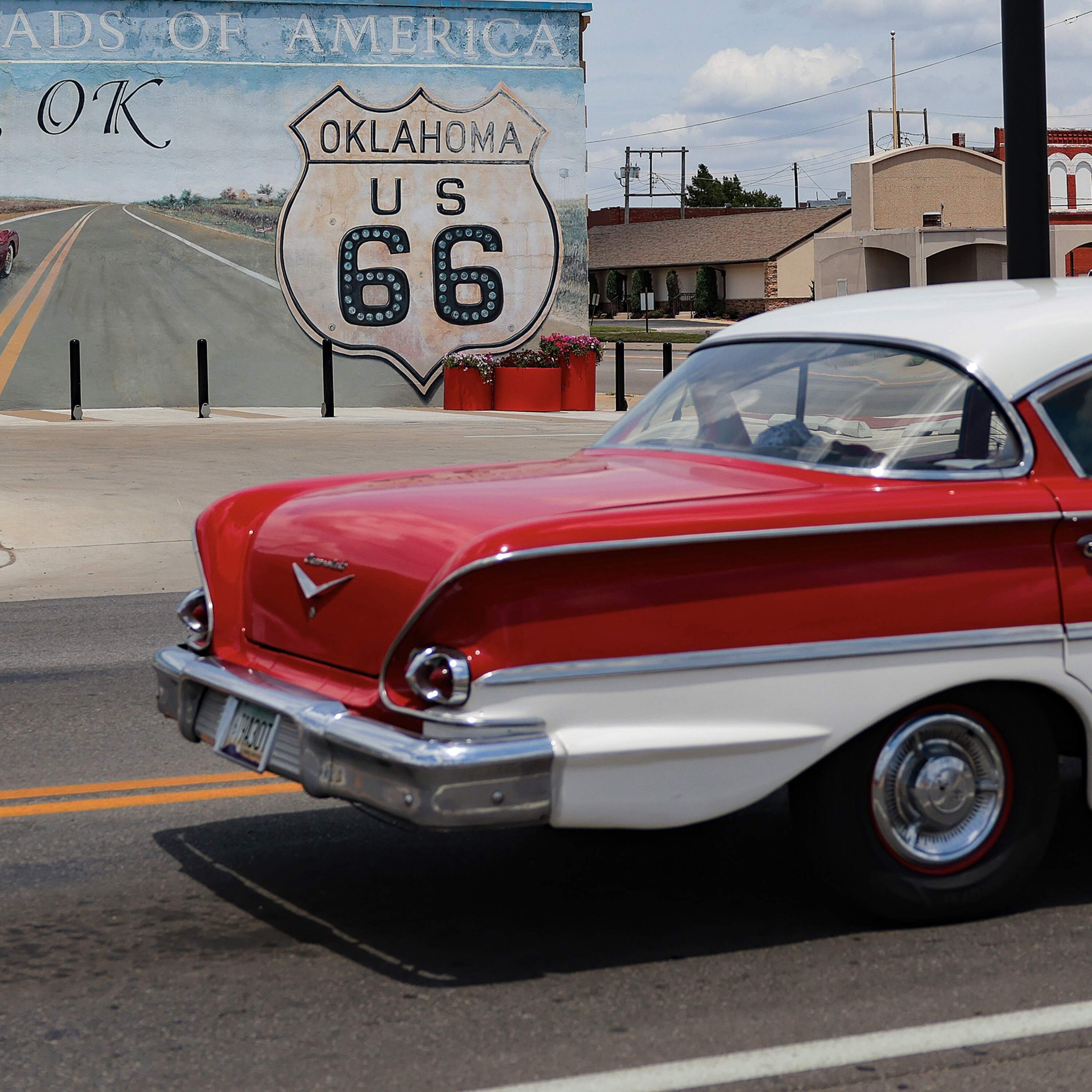
I'm Rendat Al Fattah and you're listening to throughline from NPR. This November, Route 66 turns 100. Today, the highway is largely defunct, broken up and bypassed, but in other places it's been restored to its old glory. America's most nostalgic road trip with wide open road, sunsets that fill the whole sky, dirt kissed Chevy trucks and revving motorcycles. But Route 66 started out as a muddy road to nowhere. And today on the show we'll meet a league of gilded Age bicyclists, a ragtag gang of cross country runners, and the very stubborn highway commissioner who turned it into the main street of America.
- [04:49]
Listener Callers
Hi, this is Jewel from Toledo, Ohio. You're listening to Throughline from npr. Thank you guys so much for all you do. I love listening to Throughline on my drive and on my rise and really anytime. So thank you guys for all you do.
- [05:13]
Sponsor Announcer
This message comes from NPR sponsor Shopify. No idea where to sell? Shopify puts you in control of every sales channel. It is the commerce platform revolutionizing millions of businesses worldwide. Whether you're a garage entrepreneur or IPO ready, Shopify is the only tool you need to start, run and grow your business without the struggle. Once you've reached your audience, Shopify has the Internet's best converting checkout to help you turn them from browsers to buyers. Go to Shopify.com NPR to take your business to the next level today.
- [05:42]
NPR Sponsor Announcer
This message comes from NPR sponsor Carvana. Carvana makes car buying easy. 100% online prices down to the penny delivered to your door. Why make car buying hard when it could be easy? Visit Carvana.com today. Terms may apply. This message comes from WISE. The Smart Way to manage your money around the world. With Wise, you can send, spend and receive Money in over 40 currencies at the mid market rate. Learn more at wise.com Ts and Cs.
- [06:11]
Sponsor Announcer
Apply support for this podcast and the following message come from Strawberry Me Be honest. Are you happy with your job? Are you stuck in a job you've outgrown or never wanted in the first place? Are your reasons for staying really just excuses for not leaving? Let a career coach from Strawberry Me help you get unstuck, discover the benefits of having a dedicated career coach in your Corner, and get 50% off your first coaching session at Strawberry. Me, NPR
- [06:43]
Ramtin Adablouei
Part 1 the Mighty Monarch Mud. I've never driven Route 66, but I can imagine it starting out in Chicago, driving past steaming sewer grates and concrete sidewalks, a lot of people honking at red lights, sirens blaring, and then leaving all that behind for winding roads down through Illinois, Missouri, Kansas, all the way across Oklahoma, Over rolling hills, open plains, and then we're into the southwest. Texas, New Mexico, Arizona, driving past gas stations and diners with neon signs until we hit the beach in Santa Monica, California. And all along the way, those two yellow lines take us through small towns where occasionally we might look out the window and see a little girl standing alongside the road, waving.
- [08:03]
Susan Croce Kelly
I grew up in Kirkwood, outside St. Louis, and when I was really a little girl, my mother would walk us down. My sister would be in a stroller, and we walked down to an old blacktop road where there was a little creek with fishes in it. And my mother would say, this is the most famous road in the world.
- [08:21]
Ramtin Adablouei
This is Susan Croce Kelly. She's written two books about Route 66, and as a kid in the 1950s, she lived just down the street from a bypass patch of the highway.
- [08:31]
Susan Croce Kelly
And Even at age 5, I remember looking at that road and thinking, nah, no way.
- [08:37]
Ramtin Adablouei
You were, like, underwhelmed by it.
- [08:38]
Susan Croce Kelly
It's just a little road, you know, as mothers are. My mother was right, you know, but it took a long time for me to know that.
- [08:47]
Ramtin Adablouei
When Susan grew up, she became a reporter for a local newspaper, and she spent a lot of her time driving around. And every once in a while, her work would take her down old Route 66.
- [08:58]
Susan Croce Kelly
And even back 50 years ago, when I was a reporter, you'd go down that highway, and it was like a time machine. There were the old motels and the old service stations and the old concrete pavement with the lip on the side, which was characteristic of the highway. And I thought, boy, somebody needs to write a book about this.
- [09:18]
Ramtin Adablouei
So she did, along with her colleague Quinta Scott. The two of them drove Route 66 together, knocking on doors, peering into shuttered businesses, grabbing a bite to eat at diners along the road.
- [09:30]
Susan Croce Kelly
And what people said was, cy avery invented Route 66. So then we had to find out about.
- [09:36]
Ramtin Adablouei
Cyrus. Avery was born in 1871 in a small town in Pennsylvania. He was named after his grandfathers, both of whom were also called Cyrus and Both of whom were farmers.
- [09:51]
Susan Croce Kelly
His dad was a livestock farmer, and Cy, among other things, delivered milk in the town with an ox.
- [10:00]
Ramtin Adablouei
By the time he was 12, Cy was growing up to be a curious and independent kid who knew his way not just around an ox cart, but the rutted dirt roads in Pennsylvania. And in 1884, after Cy's 13th birthday, he and his dad loaded up a heavy wagon and headed west in search of land for the family to settle on. Out on the frontier, his family says
- [10:22]
Susan Croce Kelly
he went in a covered wagon. My conjecture is that if you're on a covered wagon from Pennsylvania to southwest Missouri and then into what is now Oklahoma, that probably there were wagons that broke down, there was horses that got away, and if There was a 13 or 14 year old around, you would say, hey, come and help us pull this wagon out of the motor. So, as did many people in this country, Cy had a firsthand knowledge of how bad the roads were. This was not a theoretical deal.
- [10:53]
Ramtin Adablouei
Even during the colonial period, Americans were complaining to their government about bad roads. So in 1806, Congress and Thomas Jefferson approved plans for a national road that would funnel settlers from Maryland into the Northwest territory. But by the 1940s, the government had run out of money for the project. Then the civil War broke out, and by the time that was over, roads just weren't a priority anymore. We obviously don't have audio of Americans talking about this in the late 1800s, but the memory of abysmal roads still felt fresh in the 1940s. You can hear it in this promotional film for highways.
- [11:35]
Radio Announcer/Commercial Voice
But there are many among us who can recall when there wasn't an auto to be seen on the streets. Less than 50 years ago, this was still a predominantly rural country, with much of its life drearily affected by extremes of weather and roads that were impassable for weeks at a stretch.
- [11:52]
Ramtin Adablouei
So when Cy Avery and his dad were heading west, they would have run out of road somewhere around Illinois. And what they ran into was mud and lots of it. What does it entail to actually try to pull a wagon out of mud?
- [12:08]
Susan Croce Kelly
I can give you two stories, okay? One of them was obviously apocryphal, and probably from the era when Cy was that age. There were two farmers who lived across the road from each other, and they were friends, but the road was so terrible that they rarely actually crossed the road to be personally together. And one morning, they were yelling across the road to each other, and they noticed there was a hat in the middle of the road. And one of the farmers got A long pole, and he flipped up the edge of the hat, and lo and behold, there was a head under it. They said, my God, man, are you okay? The guy kind of shook his head and he said, yeah, I'm fine. But he said, I don't know about my horse. Does that help?
- [12:46]
Ramtin Adablouei
Yeah, yeah. I have an image in my head for sure now. And you have to understand, this was happening to people all the time.
- [12:55]
Radio Announcer/Commercial Voice
Life on the farm was particularly difficult before 1900, almost primitive compared to the present. Convenience was for millions, often only a word in the dictionary if you found time to look for it.
- [13:08]
Ramtin Adablouei
If you look at newspapers from the late 1800s, they make getting stuck in the mud sound like today's equivalent of sitting in traffic. So annoying and also so normal.
- [13:18]
Narrator/Poetic Voice
You have produce to sell, purchases to make, bills to collect, and obligations to meet. But all these must wait, because your only avenue of travel is taking its annual soak.
- [13:28]
Ramtin Adablouei
And you can tell people were mad because they got a little snarky about it.
- [13:32]
Narrator/Poetic Voice
The dirt roads of America are heavy drinkers. They lead a staggering and uncertain course from town to town. For four months of the year, they are unfit for the company of respectable people.
- [13:43]
Ramtin Adablouei
But the agent of change, the hero roads were waiting for wasn't who you might expect. It wasn't the doctors who couldn't get to their patients, or the farmers who couldn't get their goods to the market, or even the railroad magnates who thought roads would strengthen the shipping industry. No, the good roads movement came from a much more unified and powerful group.
- [14:05]
Susan Croce Kelly
Bicycles became a big deal in the United States. And as soon as people had bicycles, of course, beginning on the east coast, they said, we need better roads. We can't ride these bicycles in the mud. And that was the beginning of a push for good roads.
- [14:26]
Ramtin Adablouei
Bicyclists in the late 1800s were a pretty elite group. They tended to be wealthy because bicycles were expensive. And like other wealthy Americans at the time, they had power in politics and in business. By 1880, they'd created an advocacy group called the League of American wheelmen. And before long, that group went National. By 1890, its lobbying had steered Congress to spend thousands of dollars on road feasibility studies.
- [14:55]
Susan Croce Kelly
In 1893, at the Chicago world's fair, there was a big good roads convention, and a magazine came out. It was good roads magazine, and almost immediately, they had a million subscribers. I mean, this is how important this was to people. There were good roads men all over the country in their individual states getting elected because they said, I will bring better roads.
- [15:19]
Ramtin Adablouei
The cyclist Movement grew and grew. Soon they pulled in rural postal workers, doctors, and farmers in small towns who'd been complaining about mud for decades. They got the railroad magnates more involved, and they turned roads into a political issue. 1 Politicians ran campaigns on the way they might embrace climate or immigration as platforms today. And these were politicians whose names you might recognize when we wish to use
- [15:45]
Narrator/Poetic Voice
descriptive terms fit to characterize great empires and the men who made those empires great. Invariably, one of the terms used is to signify that that empire built good roads.
- [15:59]
Ramtin Adablouei
That's an excerpt from a speech by President Teddy Roosevelt hyping up roads in 1903. And here's another President, Calvin Coolidge, a couple decades later. No expenditure of public money contributes so much to the national wealth as for building good roads. Cy Avery grew up alongside the good roads movement. He went from being a kid who dug wagons out of knee deep mud to a young adult who relied on those same roads to move out of state and go to college. But by the 19 teens, he was done moving. Tulsa, Oklahoma was home. Saya was in his 40s, married with kids, and he was ready to step up and do something about these roads. Susan says he had a powerful presence.
- [16:47]
Susan Croce Kelly
He wasn't very big. I don't think he was six feet tall, but I think he might have been the kind of a guy that pretty soon you'd turn around if he walked into a room to see who that was.
- [16:56]
Ramtin Adablouei
Tsai was rapidly becoming a local leader in Tulsa. Farmers went to him for loans and the community voted for him to be on the board of county commissioners, even though he wasn't running in the election. Was he like, as far as we know, was he a good orator?
- [17:11]
Susan Croce Kelly
Yes. Golden tongued orator. He was a twinkly eyed guy. He would sit down and talk to anybody, and I don't think that he cared if people were barefooted or had servants with him. He was just a real universal kind of a guy and very smart and very committed to what he was doing.
- [17:32]
Ramtin Adablouei
What he was doing was building roads, and he found a way to do it without money from the federal government or the state of Oklahoma. In 1912, he raised $25,000 from private donors to build roads. And all the while, he was rubbing elbows with state senators to get laws passed that would make it easier for county officials to approve and break ground on roads in their communities without having to deal with red tape at the state level. We know Cy hated being four wheels deep in the mud as much as the next guy, but Susan says his obsession with roads was also about something bigger. He knew this issue would one day become existential for his community in that
- [18:12]
Susan Croce Kelly
part of the world. Because I guess in most of the world, even still today, it's all about money.
- [18:21]
Ramtin Adablouei
In the Midwest and on the frontier, a road could totally change a place, not just in the obvious ways, by building up an economy and making commerce easier for everyone, but by attracting new people, new settlers, and maybe for the first time, visitors, tourists. They saw it as like, this is the way we build the country. This is the way we expand.
- [18:45]
Susan Croce Kelly
Right, right. And after 1900, the push became even greater.
- [18:52]
Ramtin Adablouei
I don't need to be dramatic about what a big deal cars became at the time. That's what newsreels from the 1940s are for.
- [18:58]
Radio Announcer/Commercial Voice
first mistrusted, spoofed at, but gradually accepted as the open sesame to the new age, the automobile age, which was to have one of the greatest effects ever to rise from American mechanical G. That
- [19:11]
Ramtin Adablouei
mechanical genius was Ford's Model T, rolled out in 1908 and designed to be affordable and easy to operate.
- [19:19]
Susan Croce Kelly
After the Model T was introduced, that meant everybody could have a car. In 1909, up by Detroit, a bunch of engineers laid the first mile of concrete pavement. So that meant we could get hard roads, but concrete pavement was expensive.
- [19:36]
Ramtin Adablouei
In 1910, Oklahoma had a grand total of 23 miles of what were called hard surfaced roads. Tsai was pushing for more, but he realized quickly. Local taxes weren't going to cover the cost, and the federal government wasn't volunteering any funds.
- [19:53]
Susan Croce Kelly
And so people said, well, we'll do it ourselves if Congress won't do it.
- [19:56]
Ramtin Adablouei
County commissioners like Tsai and other good roadsmen organized a vigilante road bill building effort. They talk local groups into running road building seminars. They form new associations dedicated to roads left, right and center. The Tulsa Automobile Club, the Mid Continent highway association, the Tulsa Good Roads Association. You get the idea. And all of this was working. The federal government was expressing a greater interest in roads. It looked like money to build a highway system might be on the way.
- [20:27]
Susan Croce Kelly
1916, money was made available and the states began to pave their roads. By that time, every state had its own highway department, and they were at least working to improve the dirt and gravel roads. But then you had World War I and everything stopped.
- [20:43]
Ramtin Adablouei
Coming up. The war is over, and Cy Avery is hell bent on getting his highway
- [20:53]
Listener Callers
foreign. Hi, this is Kyle from Boys Town, Nebraska. You are listening to Throughline from npr.
- [21:10]
Sponsor Announcer
This message comes from NPR sponsor Shopify. No idea where to sell. Shopify puts you in control of every sales channel. It is the commerce platform revolutionizing millions of businesses worldwide. Whether you're a garage entrepreneur or IPO ready, Shopify is the only tool you need to start, run and grow your business without the struggle. Once you've reached your audience, Shopify has the Internet's best converting checkout to help you turn them from browsers to buyers. Go to Shopify.com NPR to take your business to the next level today. This message comes from BetterHelp. People talk about mental health more openly now, but asking for help can still feel hard. BetterHelp's 2026 State of Stigma report surveyed 2,000Americans and found that 85% believe getting support is wise, yet 74% say society discourages people from doing so. Don't let stigma stand in the way of support. Start therapy with BetterHelp. Visit betterhelp.com NPR
- [22:09]
Ramtin Adablouei
Part 2 Route 62. In April 1917, the United States declared war on Germany. And when it entered the war, road building efforts came to a screeching halt. Instead, states like Saya Avery's Oklahoma focused their resources on the war effort. They sent their oil mules, oxen and draft horses to the battlefront. When the US Military came home, it was newly motivated to invest in its own highway system. And that wasn't the only thing that had changed. Regular Americans had cars now around 6 million million of them. By 1929, that number would balloon to 23 million and very, very little pavement.
- [22:56]
Susan Croce Kelly
So as you can imagine driving 2,400 miles, mostly on a dirt road, people were pretty concerned about getting highway pavement. This was not just a weekend deal. This was serious business.
- [23:09]
Ramtin Adablouei
And while they waited to hear if and how the federal government might get involved, county commissioners like Cy Avery took matters into their own hands.
- [23:18]
Susan Croce Kelly
During those years, there became about 250 of these what I call do it yourself highways. Some of them went across the country. Some of them just went from one side of a state to another. But the idea was that all the towns along the way would ante up money and they would promise to keep the road in as good of shape as they could. And then the money would go to advertising.
- [23:39]
Ramtin Adablouei
Advertising because Americans were starting to travel in greater numbers. Previously, the American frontier had been a place you moved to, a place you never came back from. But now, as the country was expanding, roads were also making it feel smaller, more accessible.
- [23:56]
Susan Croce Kelly
I think it may be that you could say that the country's identity changed because of the roads. As people began to connect with each other. You know you don't send your daughter off to be married and go out west and never see her again. Physical communication became possible. And that was a huge change for this country.
- [24:14]
Ramtin Adablouei
Cars and roads were ushering in a modern era, and not just for the big cities on the coasts, but for suburban and rural communities, too. So this was the future in a nutshell like this, this road project that was the future of the country. Yeah, if you wanted to build that future, you needed to build the roads.
- [24:33]
Susan Croce Kelly
Right. So let's go back to Route 66, 1924.
- [24:40]
Ramtin Adablouei
Cy Avery had grown from a road evangelist to state highway commissioner for Oklahoma. He was on at least three different boards working with the federal government to make national highways a reality. But there's just one you need to keep track of.
- [24:54]
Susan Croce Kelly
The American association of State Highway Officials.
- [24:57]
Ramtin Adablouei
Lots of the guys in this association had roots going back to the good roadsman days of the late 1800s. They were people who'd been lobbying for roads and highways for decades. But by 1925, they'd amassed some real
- [25:10]
Susan Croce Kelly
authority, and they got together and asked the Secretary of Agriculture, who was the man ultimately in charge of rural roads, to appoint a committee to work together and figure out which ones of the major highways in each state would connect into a national highway system so that you could get in a car in Seattle or and drive to Florida and not get lost and not run into the mud.
- [25:34]
Ramtin Adablouei
They got the go ahead. Over the course of several months, Tsai and his fellow highway obsessives at the AASHO met around the country. They spread maps across tables, flagged roads that were already paved, and started debating where the new roads should go. The major highways connecting all these little
- [25:52]
Susan Croce Kelly
tributaries, they would be the most important roads. And people would know that if they got on one of those roads, they. That they would be able to go wherever they wanted to go. And our man Avery was really interested in making sure that a lot of roads went through Tulsa.
- [26:09]
Ramtin Adablouei
Did Cy Avery have a genuine passion for roads? Yes. But his real love was Tulsa, Oklahoma. And he had visions that went beyond car traffic. He wanted to put his city on the map. So even though the highways the association was plotting mostly went in a grid, north to south or east to west, Cy lobbied hard for his road. It was shaped like a hockey stick, because it didn't really matter to him where the road went after Tulsa. So it ran west to east from Los Angeles to Tulsa and then northeast to Chicago. Here's how he justified it to a reporter at the time.
- [26:46]
Cy Avery
This road of ours is the shortest to Southern California. There's already a tremendous traffic volume and it will increase rapidly. When the national highways are designated, there'll be no chance of getting lost. Naturally, it'll be the best road. It will get the business.
- [27:03]
Ramtin Adablouei
By October 1925, there was a map with 75,884 miles of highways traversing the United States. It was all very organized. You could tell whether a highway ran north, south or east west by its number. All the major roads ended in 0 or 1.
- [27:22]
Susan Croce Kelly
So that a driver who knew that they were on one of those roads would know that it would be a better road and that that's the best way to drive. Well, as you can imagine, the people in all those little towns all wanted to be on these main roads.
- [27:37]
Ramtin Adablouei
The highway Cy Avery had fought so hard for the one bridging Los Angeles and Chicago via Tulsa. It was a bit of an oddball, but SAI still wanted it to have a nice round number. So anyone opening up a roadmap would know it was a major Route 1. They should take Route 60. And that's the number size highway had when the map was sent around to the states for approval.
- [28:01]
Susan Croce Kelly
When the map got to the states, it was pretty much approved, except that the governor of Kentucky looked at the map and he said, wait a minute. There's no zero ending highway that goes through Kentucky. Kentucky is a proud member of the United States and has been for a very long time. And Kentucky has been ignored.
- [28:22]
Ramtin Adablouei
It also did not escape his notice that this new Route 60 would stop its eastward run just in time to skip over his home state and veer north to Chicago instead.
- [28:34]
Susan Croce Kelly
And he got very emotional about it.
- [28:36]
Narrator/Poetic Voice
Chicago influence is written all over the map. All east, east and west traffic is routed north of the Ohio.
- [28:44]
Radio Announcer/Commercial Voice
The East I am sure will join
- [28:47]
Narrator/Poetic Voice
in with me in my protest.
- [28:49]
Ramtin Adablouei
Likewise the South.
- [28:51]
Narrator/Poetic Voice
I will use every means in my power to fight this proposition of isolation
- [28:59]
Susan Croce Kelly
and Avery and would have none of
- [29:00]
Cy Avery
that if routes are to be changed this way without any notice to states or to the executive committee. You're making a joke of the interstate highway.
- [29:10]
Susan Croce Kelly
Well then the governor went to the executive committee of the state highway officials.
- [29:15]
Ramtin Adablouei
But you know who was on that committee? Cy Avery. And he was not sympathetic to the governor of Kentucky's cause.
- [29:22]
Cy Avery
I can think of nothing more unfair to the original marking committee or to the members of the executive committee.
- [29:29]
Susan Croce Kelly
Well, then the governor went to his congressman and complained about the highway. And you can imagine what happened next. We watch Congress all the time. If it's something not very important, they can get very riled up. And the highway number issue got to be not only the Kentucky congressman, but the Oklahoma congressman. And then automobile organizations began taking sides. Other states began taking sides about whether a highway that stopped in Chicago should have this exalted zero ending number. And as you can imagine, the people in Washington that were dealing with the highway system were getting more and more upset. And finally, one of them wrote to Avery and said, look, if you don't solve this problem, we're not going to have a national highway system. You've got to do something.
- [30:18]
Ramtin Adablouei
Cy Avery had a choice to make. He could die on the Route 60 hill and put his entire highway at risk, or hand the governor of Kentucky a win and accept a less flashy number for his own road, like Route 62 or 60 north. But both those numbers felt forgettable, even confusing. To Tsai, the problem was all the good numbers were already taken.
- [30:42]
Susan Croce Kelly
They had 24 numbers left over, and they said, what number is left over? One of them was 66. And they said, why don't we try that? And by afternoon, the decision was made, and they sent a telegram to Washington.
- [30:56]
Cy Avery
We are willing to agree to this change. We prefer 66 to 62.
- [31:03]
Ramtin Adablouei
There was something about that number 66, the way it rolls off the tongue, the visual impression of the matching sixes, a sort of edgy symbolism. In other words, Avery was on board
- [31:16]
Susan Croce Kelly
because he thought he could sell it. Ah, I think that's what it amounts to.
- [31:22]
Ramtin Adablouei
Yeah. Yeah. He was like, this number. This number has marketing power. On November 11, 1926, the states voted to accept the map for a new national highway system. Cy Avery had his highway. But at that moment, it was still just an idea, a line on a map, A disconnected jumble of corners, gravel roads, paved paths, and landscapes in need of a bushwhacking. And to make it more than that, to make it the thriving main street Cy Avery envisioned would take a miracle. That's after the break.
- [31:58]
Listener Callers
This is Rachel from San Diego, California. I love Throughline. As a history major in college, I feel like I get a refreshment every week, and I really appreciate it. You're listening to Throughline from npr.
- [32:17]
Sponsor Announcer
This message comes from NPR sponsor Shopify. No idea where to sell? Shopify puts you in control of every sales channel. It is the commerce platform, revolutionizing millions of businesses worldwide. Whether you're a garage entrepreneur or IPO ready, Shopify is the only tool you need to start, run, and grow your business without the struggle. Once you've reached your audience, Shopify has the Internet's best converting checkout to help you turn them from browsers to buyers, go to Shopify.com NPR to take your business to the next level today. This message comes from Leesa. Leesa mattresses are meticulously designed and assembled in the USA for exceptional quality and they back it all up with free shipping, easy returns and a 120 night sleep trial. Beautifully crafted mattresses tailored to how you sleep. Feel the difference from night one. Visit Lisa.com for 30% off today. Plus get an extra $50 off with promo code NPR. That's L-E-E-S A.com promo code NPR
- [33:18]
Listener Callers
part
- [33:18]
Ramtin Adablouei
three the main street of America.
- [33:23]
Susan Croce Kelly
My great uncle, my grandfather's brother, who was a very laconic Ozarker, he said, you know, when your grandparents got married, he said, I took them over to Joplin to take a train for their honeymoon. He drove them over there on old 66, which was new 66. And he said on the way over there, and I've since pinpointed the place, he said there was a paved section of highway because the states were also putting down test sections around the country. And he said there was about a mile of concrete. Said, I took him to the train and then I came back and I drove back and forth and back and forth and back and forth on that concrete because I'd never driven on anything that smooth or that fine. I just to think about this guy, you know, in an old Model T saying, I gotta go back and do that again, you know. That was so cool.
- [34:12]
Ramtin Adablouei
In 1926, when Route 66 was officially signed into existence along with the rest of the US's first interstate highway system. It didn't yet exist in real life, at least not as a connected, fully paved road. The highway engineers were working on it, but the road still felt sleepy. The small Oklahoma towns it ran through weren't seeing much more traffic than usual. Cy Avery wanted fanfare, and he knew it was going to take some good old fashioned showmanship.
- [34:41]
Susan Croce Kelly
Within weeks of coming up with the number and getting the quick approval from the other states to go ahead, Avery was invited back to Springfield by one of his buddies, another Good roads man named John Woodruff, who was one of the civic leaders in town. And Woodruff had built this huge, wonderful hotel on the edge of what would become Route 66. And he was having a celebration and he invited the governor and all kinds of state officials and he invited Avery and his wife and they drove over from Tulsa. And during the course of the two or three day celebration, Avery and Woodruff Went out to see where the paving was going on for what would become Route 66.
- [35:20]
Ramtin Adablouei
You can imagine the two of them standing there, the city behind them, the open land ahead of them, sky and distant hills, weeds and mud.
- [35:30]
Susan Croce Kelly
And Woodruff said, you know, we need a booster organization for this highway. And a few weeks later, they had a core group of people that got together and organized the US 66 Highway Association. And in the very first organizational papers, they said, we are going to make this the main road west and the most well known highway out there. So Avery's bet for promotionalism was front and center in. That's basically why Route 66 is. Route 66 is because of this guy.
- [36:03]
Ramtin Adablouei
Woodruff and Avery bought ads in magazines and put up billboards. They hired a PR guy and of course, had lots of. And lots of meetings which were more well attended than you might think.
- [36:14]
Susan Croce Kelly
They had over 100 people at this first meeting. And the minutes of that very first meeting talked about not only advertising the highway, which the Route 66 association did, and working to get the road paved, but they also sent a message to all the little towns and said, okay, you guys need to promote whatever is in your area that will bring people there. So this is going to be an event to go down Route 66 from the very get go.
- [36:46]
Ramtin Adablouei
And this committee came up with a pretty wild stunt, a stunt that you may never have heard of, but whose consequences rippled around the world.
- [36:55]
Susan Croce Kelly
The Bunyan Derby. I think this is the reason that Route 66 is known around the world right there.
- [37:02]
Ramtin Adablouei
It all started with the publicist Woodruff and Avery had hired to hype up Route 66, a guy named Lon Scott.
- [37:09]
Susan Croce Kelly
And while Avery and Woodruff were going around helping the states and the counties get money to pave the road, he was going around the chambers of commerce. And he talked about, you know, we're going to put ads in national magazines and we're going to do this and that. And somebody said, yeah, but what are you going to do to make the road famous? And somebody else said, have a foot race. Oh, and everybody guffawed.
- [37:30]
Ramtin Adablouei
A foot race on the highway?
- [37:32]
Susan Croce Kelly
Yes, yes. And after the luncheon, two or three reporters came up to him and said, you know, that's not a bad idea. There's a guy named Charlie Pyle who is a professional sports promoter, and you ought to get in touch with him.
- [37:47]
Ramtin Adablouei
Now, I don't claim to be any kind of sports aficionado, but even I have heard of some of the big sports stunts that were going on around this time. Charles Lindbergh flew nonstop over the Atlantic, the first time anyone had ever done that with the help of nine sponsors, when the American swimmer Gertrude Ederle swam the English Channel. Newspapers in both England and the US Had a field day. And Babe Ruth and his relentless home run streak was proving better than anyone, that amazing feats of athleticism, broken records, could capture attention. Expert promoters knew how to turn that attention to their advantage.
- [38:23]
Susan Croce Kelly
And Pyle was the sports promoter. So they got in touch with Charlie Pyle and the end result was the great international Transcontinental foot race. From Los Angeles to Chicago and then on to Madison Square Garden.
- [38:39]
Ramtin Adablouei
The race would be open to any runner who wanted to register from anywhere in the world. But Pyle also made a point of recruiting people he knew would make a good story.
- [38:50]
Susan Croce Kelly
In March of 1928, 199 men lined up and they included your typical American runners. A number of Olympic athletes. A black runner from Seattle, a guy that was in Bible movies who wore long biblical robes when he ran, a prize fighter from Arkansas who ran in red long underwear. At least for a while. I mean, it was just a motley crew. There were rich people whose families came along with a trainer and another car. There were poor people who didn't have anything else to do. They opened this up to everybody and then they promised $25,000 to the winner at that time. I mean, that was more money than anybody had, you know, and $1,000 to the top 10 finishers. And so this got worldwide attention. You can imagine
- [39:42]
Ramtin Adablouei
news reels covering the race don't have sound, but on the first screen, a quote flashes onto the screen in cursive. America calls it the Bunyan Derby. A throng of spectators bobs around the hood of a black car near the starting line.
- [40:01]
Susan Croce Kelly
On your marks.
- [40:02]
Narrator/Poetic Voice
And then get set.
- [40:04]
Ramtin Adablouei
The runners are off. They kick up a cloud of dust as they take off.
- [40:11]
Susan Croce Kelly
And the sports riders ate it up. Bunyan Derby underway.
- [40:15]
Ramtin Adablouei
Farmer Lee's Field in long. Bunyan Derby cross country.
- [40:20]
Radio Announcer/Commercial Voice
Bunyan marathon still numbers 96 tired runners.
- [40:25]
Ramtin Adablouei
And once it was well on its way down Route 66. That's when the Bunyan Derby really got weird. Heil's motley crew ran city to city through barren desert and small towns. They slept on the floors of an elf's lodge or a high school gym, or in motels if they had money. And Payle followed behind them with a parade of cars, a portable hospital, a radio truck and a 300 gallon coffee pot on wheels.
- [40:51]
Susan Croce Kelly
Pyle also had a carnival that went with him there was a two headed chicken, a tattoo lady. They also had the mummified body of a genuine Oklahoma Alpha outlaw.
- [41:04]
Ramtin Adablouei
I should say we weren't able to totally verify that last part. I just think this is remarkable, by the way, because this is decades before, like Mad Men era marketing. Like, this is the og.
- [41:16]
Susan Croce Kelly
Yes. And remember, the roads were muddy because
- [41:19]
Ramtin Adablouei
the road wasn't actually done yet, Right?
- [41:21]
Susan Croce Kelly
No. Illinois was paved all the way, and California had a lot of paved roads. But the rest of the country, you know, Missouri was paved in 1931. The whole way was paved in 1938. So in 1928, these guys had all kinds of issues. They ran into a snowstorm in Texas and in the Southwest, the black runners, as you might imagine, were not exactly welcome. So they had to find places to stay in the local black community if there was a local black community for them to stay in. And at one point, one of the runners was followed by a farmer with a shotgun who threatened that if he ever passed a white runner, that he'd get shot.
- [42:01]
Ramtin Adablouei
Sounds like a lot of people. You know, you're running across the country in 1928, you're gonna encounter the different dimensions of the country right at that moment in time.
- [42:13]
Susan Croce Kelly
And when we were interviewing people, I can remember two distinct times when somebody grabbed me by the shoulder and said, come here. And took me over to a window and said, I was sitting right there. When the Bunyan Derby came through, this was a huge deal for these little towns.
- [42:28]
Ramtin Adablouei
The runners plotted their way across the country from LA to Tulsa to Chicago and every small town in between, until finally 8th Avenue in Manhattan stretched ahead of them. Madison Square Garden growing closer with each step.
- [42:44]
Susan Croce Kelly
It took almost three full months, but 55 men made it all the way from Los Angeles to New York City.
- [42:52]
Ramtin Adablouei
55 made it the whole way. What happened to the rest of them? They just dropped off along the way somewhere.
- [42:56]
Susan Croce Kelly
They dropped off. Some of them got hit by cars. Some of them. I'm sorry, some of them just couldn't do it. I mean, you know, this is 50 miles a day for some days. The biblical actor got found in the trunk of a car and they of course, made him get out and eliminated him from the race.
- [43:13]
Ramtin Adablouei
I mean, it sounds like both hazardous and problematic in so many ways, but then also, like, weirdly, a celebration of the country of America at that moment.
- [43:23]
Susan Croce Kelly
Absolutely. I mean, this was the biggest thing, and I swear that's why Route 66 is known to people, because of the Bunyan Derby. I think the world knew about Route 66.
- [43:37]
Ramtin Adablouei
The Bunyan Derby, as zany and unconventional as it was, had served its purpose. Even when news coverage about the race had fizzled out, the idea of Route 66 persisted as an adventure, a romantic idea that, in Susan's words, connected humdrum middle America with golden and glowing Southern California. And even after the runners were gone, the cars kept coming, full of tourists who wanted to see Route 66.
- [44:08]
Susan Croce Kelly
My great grandfather had a farm on southwest Missouri that fronted on Route 66. And mom talked about seeing one time she saw a stilt walker going to come across the country circuses, because that was the era when circuses were traveling all over the place. And can you imagine being a kid and you're running down and seeing the elephants go by? I mean, wow. So this was a big deal. And from the very beginning, Route 66 was the best show in town. But mom also talked about something else. She talked about sitting on the porch with her grandfather and his cronies, and they'd watch the cars go past on the highway down at the end of the field. And she said, inevitably, one of those men would say, if I had a nickel, just a nickel for every car that goes past on this road. Route 66 was always, always savory or not. It was always about money getting people to drive in, get their car serviced, spend the night, eat in the cafes, and leave money behind because there was not much chance without the high.
- [45:08]
Ramtin Adablouei
In the early 1930s, Cy Avery stepped away from the highway making business. But his dream stayed alive. Route 66 kept growing, and by the end of the decade, the whole thing got paved. The first US highway paved all the way west. In the 40s and 50s, families now with paid time off set off on road trips.
- [45:32]
Radio Announcer/Commercial Voice
One of the best things about a trip to Southern California on U.S. 66 is that it starts in Chicago.
- [45:38]
Ramtin Adablouei
And promotional films like this one sold them on every stop along the way.
- [45:42]
Radio Announcer/Commercial Voice
I leave St. Louis and continue west. I'm having a very nice trip.
- [45:48]
Ramtin Adablouei
You can hear how over the course of these decades, Route 66 starts to take on a new identity.
- [45:53]
Radio Announcer/Commercial Voice
Route 66, called the Main street of
- [45:56]
Ramtin Adablouei
America, with ad copy that really channels John Steinbeck.
- [46:00]
Radio Announcer/Commercial Voice
Highway 66 leads across the arid, grass covered plains and plateaus that sweep toward the distant hills through a landscape of constantly changing colors, dotting the limitless panorama of earth and sky. Eyes on the street ahead and bent
- [46:15]
Ramtin Adablouei
to it again in the late 1950s, another literary giant, Jack Kerouac, left his own stamp on the great American road trip, giving words to the feeling so many others have tried to describe.
- [46:30]
Radio Announcer/Commercial Voice
So in America, when the sun goes down and I sense all that raw land that rolls in one unbelievable huge bulge over to the west coast, all that road going and all the people dreaming and the immensity of it, the evening star must be drooping and shedding her sparkler dims on the prairie, which is just before the coming of complete night that blesses the earth, darkens all the rivers, cups the peaks, folds the final shore in.
- [47:01]
Ramtin Adablouei
Susan says if cy Avery, the PR campaign, and the Bunyan Derby were what put Route 66 on the map, the people who drove down the road in the decades that followed were the ones who made it mean something.
- [47:14]
Susan Croce Kelly
In my mind, Route 66, it was first, a road to be able to drive your car and get somewhere. And then second, it became really personal. In the 30s and 40s, if you had left the Midwest and had to go to California with all your belongings on top of your car, you would remember that road. You might not remember it happily, but, boy, you wouldn't forget it. And that was two and a half million people. And then during the 40s, if you were sent to a military base or to the Pacific down that road, you didn't know if you were coming back.
- [47:51]
Ramtin Adablouei
It imprints on you when you go through something like that.
- [47:54]
Susan Croce Kelly
Yeah, it imprints on you. And then in the 50s, that was the first time that people in this country, the working people, got paid vacations. And so the ones who had been down Route 66 and seen the beaches in California came back, loaded their families in the car, and drove down Route 66 for an adventure.
- [48:14]
Radio Announcer/Commercial Voice
California, the golden land of orange groves and sunshine, trees and flowers, deserts and ocean shores, offers rich promise and exciting fulfillment to the holiday seeker.
- [48:25]
Susan Croce Kelly
So you had, you know, three decades of millions of Americans, they weren't just using the highway to get someplace place. It was personal.
- [48:37]
Ramtin Adablouei
At a time when the country was growing and US cities were changing, Route 66 allowed Americans to experience the vastness of their own country. And at the same time, it made that country feel smaller, quainter, simpler. Route 66 was the highway that taught Americans how to take a road trip. Before, that experience had been enshrined as a corporation core, part of this country's identity. Before, the open road and the opportunity and freedom it represented had been articulated as something truly American. But the road itself was not as enduring as the ideas it birthed. Over the course of decades, the federal government passed new highway legislation and built newer, bigger roads which bypassed and replaced the old Route 66.
- [49:23]
Susan Croce Kelly
After the interstate system came in. Route 66 was pretty much defunct. As the interstates came, they took the official signs down, and pretty soon there was not much there. Business just stopped.
- [49:38]
Ramtin Adablouei
In 1985, the highway was officially decommissioned. Today, in parts, Route 66 has been reduced to disconnected fragments of cracked asphalt, tumbleweeds, and dusty, out of date road signs. It's a road past the golden years of retirement, crisscrossed and paved over by newly poured highways of gray concrete. But something else happened, too. As car traffic dwindled and small towns along the road started to dry up, some local communities rallied around Route 66 with a Spirit Cy Avery would have been proud to see.
- [50:15]
Susan Croce Kelly
And so they started the first historic Route 66 association. Well, you know what's happened since then? The associations have grown, and 66 has become instead of a road, it has
- [50:27]
Ramtin Adablouei
become a tourist attraction, which was always Cy Avery's dream, wasn't it?
- [50:31]
Susan Croce Kelly
That's right. And, well, the very last thing in my book. In 1958, more than 40 years after he began building roads in Tulsa County, Cy received news that the county commission had changed the name of River Road to Avery Drive. When he heard the news, he observed To a friend, 40 years is a long time. But it only goes to show that anyone interested in roads should never quit.
- [50:54]
Ramtin Adablouei
You know, we're marking 100 years this year, and the country was undergoing this huge, dramatic transition at that moment. What does Route 66 kind of symbolize when it comes to the American story? What does it symbolize when it comes to the American road trip?
- [51:12]
Susan Croce Kelly
I think this has always been a do it yourself country. If somebody wanted to make something happen, they did or they could. It was possible. And I think it epitomizes the can do spirit of the United States. And I have heard so many stories about hitchhiking down Route 66. I've met a Finnish couple that was actually on their honeymoon down Route 66. And all of the little towns that have any kind of a tourism bureau will have a booklet that talks about people from all over the world who come in and there's that much of an interest in this old road. So it's the world's highway.
- [51:48]
Ramtin Adablouei
It's the world's highway. And what does it reflect about the
- [51:51]
Susan Croce Kelly
US I think it says welcome for one thing, and you can do this, you know, come and see who we are. I think a lot of people see this as the real America. You get down into the rural areas. You're not in New York City, you're not in Los Angeles, you're not in the dot com part of the world. This is real America. This is a way to get up close and personal to the United States.
- [52:17]
Ramtin Adablouei
Susan Croce Kelly is the author of the father of Route 66 the story of Cy Avery. And that's it for this week's show. I'm Randab Al Fattah. Throughline was created by me and Ramtin Adablouei. This episode was produced by me and Sarah Wyman, Julia Redpath, Casey Minor, Devin Kadayama, Kiana Mohadem, Amy Padula, Jasmine Romero,
- [52:50]
Susan Croce Kelly
Skyler Swenson, Liana Simstrom, Irene Moducci voiceover
- [52:54]
Ramtin Adablouei
work from Dan o', Neill, Ryland Barton, Steve Drummond, Mark Smith and Emily Seja. Fact checking for this episode was done by Kevin Voelkel. This episode was mixed by Jimmy Keeley. Thank you to Johannes Durgi, Cheyenne Butler, Matthew Pollack, Nadine Zylstra and Tommy Evans. Music for this episode was composed by Rantin and his band Drop Electric, which includes Naveed Marvi, Sho Fujiwara, Anya Mizani and finally, if you have an idea or like something you heard on the show, please write us@throughlinepr.org and if you're open to us giving you a call back, leave your number too. We might feature your idea in an upcoming episode. Also, make sure to follow us on Apple, Spotify or the NPR app. That way you'll never miss an episode. Thanks for listening.
- [53:57]
Sponsor Announcer
This message comes from NPR sponsor Shopify. No idea where to sell? Shopify puts you in control of every sales channel. It is the commerce platform revolutionizing millions of businesses worldwide. Whether you're a garage entrepreneur or IPO ready, Shopify is the only tool you need to start, run and grow your business without the struggle. Once you've reached your audience, Shopify has the Internet's best converting checkout to help you turn them from browsers to buyers. Go to Shopify.com NPR to take your business to the next level today. This message comes from NPR sponsor the NPR Wine Club, a place to find boutique wines from around the world and bottles inspired by popular NPR shows, as well as to explore the producers, regions and exciting stories that bring each selection to life. Whether you buy a few bottles or join the club, all purchases support NPR programming and help fund quality reporting. You can learn more@NPRWineClub.org podcast must be 21 or older to purchase.