← Wow in the World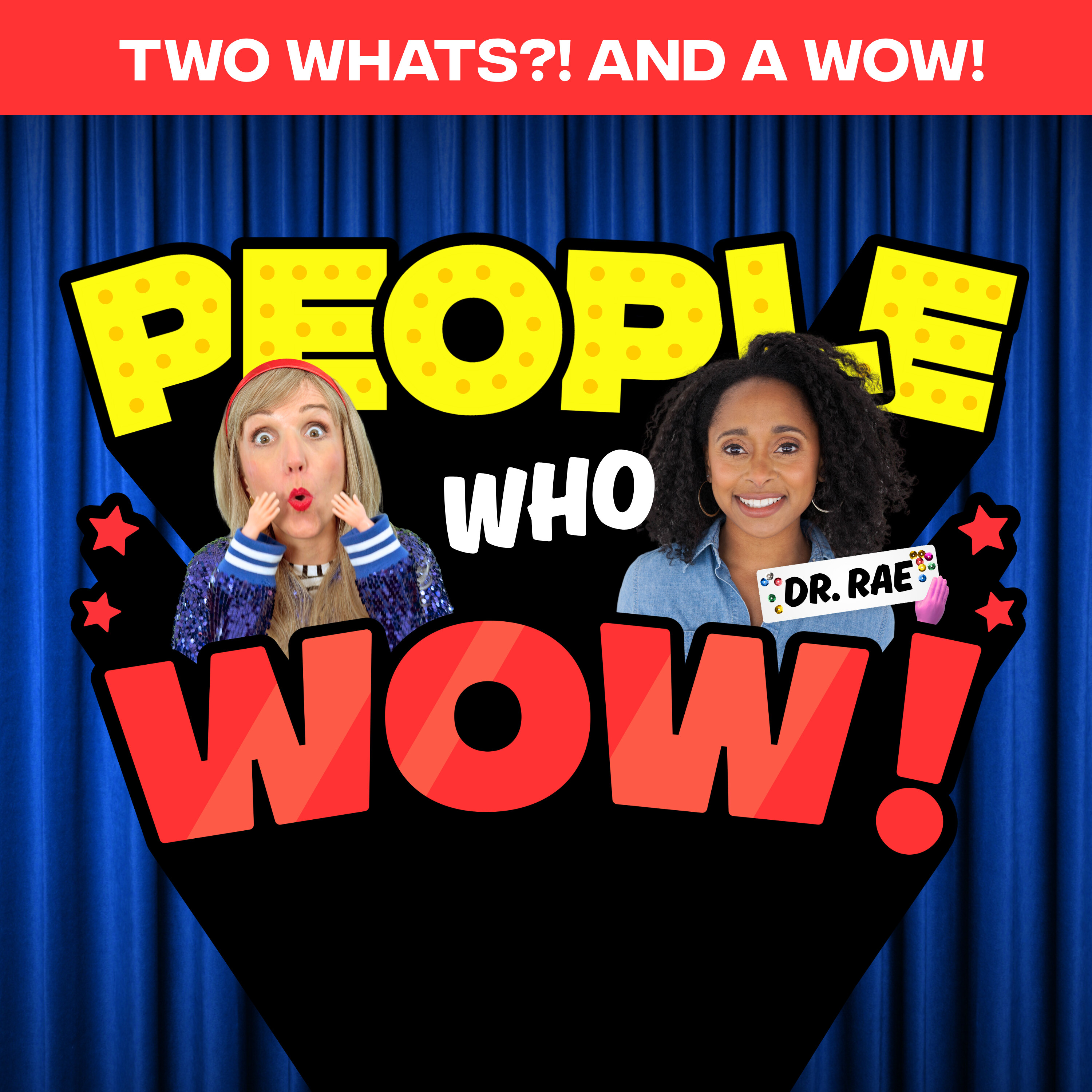
Wow in the World
Two Whats?! And A Wow! People Who Wow Edition – Dr. Rae Wynn-Grant – Guess the True Facts about this Wildlife Ecologist, TV Host, and Author!
00:23:14
Loading summary
Transcript103 lines
- [00:01]
A
Hey, Wowzer fams. Mindy here. And before we start the show, did you know that you can listen to your favorite songs from wow in the world all summer long? That's right, Reg. Whether you can't stop singing Oops, I slipped on a penguin or you can't stop dancing to the scientifically most danceable song in the world, you can now listen again and again and again on your favorite music player. Just search wow in the world in your music app. Oh, good point, Reg. And if you're looking for more, for more summer jams from your favorite Tinkercast podcasts, you can find songs from Flippin Mosey and Once Upon a Beat. Wherever you get your music, that's it. And now a quick ad break and then back to the show. Dk.
- [00:56]
B
In Donkey Kong Bonanza, you can smash through almost anything. Giant watermelon, easy. Solid rock. Say less. Explore the underground world by smashing to the planet's core as Donkey Kong and Pauline. Hold up. Are you hearing karts?
- [01:14]
C
All right.
- [01:15]
B
Race against your friends in Mario Kart World. Drive off walls.
- [01:19]
A
Woohoo.
- [01:21]
B
Off the road and over dinosaur.
- [01:25]
A
Sweet.
- [01:26]
B
You can power up your play on Nintendo Switch. Two additional accessories may be required for multiplayer mode, game system and some accessories sold separately. Games rated E to E10PL.
- [01:37]
A
You touch noses with a baby whale?
- [01:41]
C
Yeah. Lucky. A lot of people focus on the male lion because they're so big and beautiful and have that gorgeous mane. But they are not the hunters of the community. It is the female lions, the lioness that do all of the hunting for the pride.
- [01:56]
A
Have you worked with pigeons at all?
- [01:58]
C
No, not yet.
- [01:59]
A
They can be a little difficult. Welcome to two what's and a wow People who wow Edition with your host, Mindy. And featuring Today's special guest, Dr. Ray Two wow. Hello and welcome to Two what's in a People who Wow Edition. The getting to know you game show that separates the wows from the whats of some of the world's most interesting people. And our guest today is no exception. Says here she's a wildlife ecologist, a five time Emmy nominee for the show Mutual of Omaha's Wild Kingdom, Protecting the Planet. A podcast host, an author, and when she's not busy doing all that, she likes to make up music videos in her head. Please welcome Dr. Ray Win.
- [03:04]
B
Woo woo.
- [03:04]
C
I'm here. I'm so happy to be here. Thank you for having me.
- [03:07]
A
Dr. Ray. Welcome to two what's in a wow? People who wow. You are definitely a person who wows. Before we get started, first question, what Is a wildlife ecologist.
- [03:22]
C
Oh, well, I love this first question. I'll start with the second word. So an ecologist is a type of scientist that studies organisms and the environments that they interact with. And then wildlife are wild animals. So we're not talking about chickens and horses and cows, we're talking about whales and sharks and orangutans and tigers.
- [03:45]
A
Have you met all of those wild animals?
- [03:48]
C
Almost all. Not quite. I still have probably like half of the world's biodiversity left to meet. But I am making it my goal.
- [03:57]
A
There's a lot of them out there. So when you are on the job, when you're hosting your TV show, when you're, you know, going to work as a wildlife ecologist, are you out in the wild or is this something that you sit at a little desk and tap on your computer and just look up things on the interwebs?
- [04:15]
C
It is absolutely both. And so I'm so grateful that my job has always been going out into the deep wilderness, spending 2, 3, 4, 5, 6 weeks living out of a tent, finding wild animals and making observations, taking down data. But then I have to do something with that data. So probably about half of the year I am back in a cushy little office or a hotel room and I'm doing a lot of high level math and statistics to analyze patterns and understand what we can expect from these animals and then how we can provide what they need.
- [04:46]
A
Well, what we're doing today here is we are about to play a little game called 2 what's in a people who wow edition. Now, before we get started, Dr. Ray, I want to share with our listeners, our viewers, our contestants at home on how this game works. In our game today, Dr. Ray is going to give us three rounds of three weird, wild, unusual, maybe wow. Facts about herself. It's up to us to guess which one is the one true. Wow. In each round. Now, if we guess correctly, we get a point. If we guess incorrectly, I must do a redonkulous challenge. So go easy on me. Okay, Dr. Ray?
- [05:31]
C
You got it, girl.
- [05:32]
A
So for round one, we wanna go back to the basics. We wanna go back to little Ray when you were a child. Something that you remember from back in the day. Let's get started with round one. Three facts about yourself, about your childhood. And we're gonna guess which one is the one true. Wow.
- [05:53]
C
Which of these is a true fact about my childhood? Is it A, my favorite memories as a child were camp national parks with my family or is it B, I had strict parents who wanted me to do a traditional career. So I kept my love of nature and animals a secret until I got to college. Or is it C? I was not at all into risks as a kid. I was scared of loud noises and not at all outdoorsy.
- [06:25]
A
Wow. Okay, so A, you grew up camping at national parks with your family. That would be an early exposure to nature. Probably met a lot of raccoons that way. Maybe a snake or two bears. Strict parents who wanted you to do a traditional career when whereas you became a wildlife ecologist, television host, author, podcast host. That's a lot of things. And C, you were not into risks as a kid. Scared of loud noises and not very outdoorsy. Well, I'm going to say C, no way. I do not believe someone who became Dr. Ray Win Grant was scared of things as a kid, so I'm cutting that one out completely. Strict parents who wanted you to do a traditional career kept your love of nature and animals a secret until you got to college. I feel like there could be a kernel of truth there. And your favorite memory as a kid, camping in different national parks with your family. Too easy. I think the answer is B. Am I correct?
- [07:34]
C
I'm so sorry, Mindy. B is not the right answer. What?
- [07:40]
A
Okay, all right, all right, all right. Give me a second chance here. I'm going to guess. And the answer is A, that you grew up camping with your family in national parks.
- [07:53]
C
Wrong.
- [07:55]
A
What? All right, so the answer is C, the one that I crossed off immediately. That you were afraid of risks as a kid. You were scared of loud noises, not very outdoorsy. Dr. Ray, how did you become you?
- [08:13]
C
It's completely true. I grew up as a really urban kid. I did not go hiking or camping or visiting national parks or into the outdoors with my family or. Or my friends. And I lived an urban life. I was afraid of the noise of thunderstorms or, like balloons popping. I really liked to have kind of like this safe contained life. I had an amazing childhood, but there wasn't necessarily, like, evidence that I would live an adult life in the wilderness.
- [08:44]
A
Wow. Have you ever asked your parents what they thought you would have grown up to do for a living?
- [08:50]
C
Well, here's the kicker. When I was very, very little, I used to watch nature shows on tv and I would tell them, I want to be a nature show host. Like, I don't know what it's like out there, but a nature show host is going to make it look adventurous, cool, but not dangerous and definitely fascinating. So I knew I wanted to do tv. I knew I wanted to, like, present science on tv, But I wasn't necessarily the kid who had any experience doing anything like that.
- [09:19]
A
Well, I got that answer incorrect. So I must do a ridonkulous challenge. My pigeon Reggie is a giant pigeon. Have you worked with pigeons at all?
- [09:30]
C
No, not yet.
- [09:31]
A
That can be a little difficult. Reggie, Reggie, I need a challenge. Thank you.
- [09:39]
C
Thank you. Nope.
- [09:41]
B
Give it to me.
- [09:41]
A
Give it to me. Sorry. He has wings. He doesn't have thumbs. So. Thank you. Thank you, Reggie. Okay, I must perform a monologue as a misunderstood lioness. Have you ever worked with lions in the wild?
- [09:59]
C
Oh, I sure have. Yeah. For years. I lived in Tanzania and I studied lions.
- [10:05]
A
And is there anything about a lioness that you think might be misunderstood or about a lion that might be misunderstood?
- [10:14]
C
Oh, absolutely. Mindy. A lot of people focus on the male lion because they're so big and beautiful and have that gorgeous mane, but they are not the hunters of the community. It is the female lions, the lioness, that do all of the hunting for the pride.
- [10:29]
A
Got it. Okay, here we go. Hi. I'm a lioness, and I would like everyone to know. Does that food on your plate? Because I'm a lioness, and I serve food on plates. I hunted it. Everyone thinks it was my husband, but it was me. I'm the lioness. Sure, I don't have that big, beautiful mane that my husband has, but look at me. I found all of the food that you're eating. I am the real mvp. I am the queen of the animal kingdom. I am a lioness. Hear me roar.
- [11:12]
C
Awesome.
- [11:13]
A
Is that good? Is that good, girl? All right. Yeah. Lioness. They're doing all the work. They're doing all the work.
- [11:19]
C
They do all the work.
- [11:21]
A
Well, it's time to get on with round two. Round two is all about challenges. It hasn't always been easy. It's not smooth sailing through wildlife, through nature, through all of the schooling you had to do to become a wildlife ecologist. Give us three weird, weird, interesting, unusual statements about some challenges that you have faced in your life or career.
- [11:46]
C
Sure thing. Okay, get ready. So which of these is a true challenge that I still face to this day? Is it A, I'm afraid of heights, so I usually drive or take boats, but I rarely, rarely fly? Or is it B, I get really seasick, but I do need to be on boats, so I just have to deal with it, or is it sea? Being around wild animals so much has helped me to not feel fear, but that sometimes it makes it hard for me to relate to People who still do fear things.
- [12:23]
A
Okay, so let me think here. All right, so number one, afraid of height. So usually take boats everywhere.
- [12:30]
C
Or drive.
- [12:31]
A
Or drive. I just feel like that, like, take it. You do travel to other countries. Have you been on every continent? No, I can't ask follow up questions, but just that one. Have you been on every continent?
- [12:46]
C
Not yet. I'm missing one.
- [12:47]
A
Okay. All right. I wasn't supposed to ask follow up questions. Number B, you get seasick, need to be on boats, so you have to deal with it. Do you have to be on both so much? I guess you do. There's like orcas in the water. Being around wild animals has helped you to not feel fear. You were risk averse as a kid. But I think that. I think the answer is C. I think the answer is C, that you are, are not a fear. You don't have any fear anymore. And when people do feel fearful, you're just like, what are you afraid of? It's just a lion. It's just a bear. Why are you scared? I'm not scared. Is that you? No, I don't think that's you. I don't think that's you. I think you still get a little bit fear. A little bit of fear. I think the answer is B. I'm changing my answer. B.
- [13:48]
C
Ding, ding, ding, ding, ding, ding, ding. You got it, girl.
- [13:51]
B
Correct.
- [13:52]
C
Yes.
- [13:53]
A
I'm so glad I changed my answer and changed the rules of the game where I can change my answer at the same time. The answer is B, you get seasick.
- [14:01]
C
Oh, I get horribly seasick no matter what. Doesn't matter if I take medication for it. Doesn't matter if it's a very calm day on the water. I really struggle on the ocean. Yeah.
- [14:14]
A
Wow. So you barf on the job, but you also get to go spend time with these wild animals out in the ocean. Can you tell us, like, do you have a story of something amazing that you were there to witness that other people might not?
- [14:29]
C
Yes. Recently I was down in the San Ignacio Lagoon on the Pacific coast of Mexico and I was out filming gray whale moms and their newborn whale babies. And I got to like peer over the side of a boat to look for this baby whale. And I was looking, I was looking and right as my head was down there, it came up with its head and we touched. It was almost like we were kissing. We like touched noses and then it went back down and it was the most magical moment.
- [15:05]
A
You touch noses with a baby whale?
- [15:09]
C
Yeah.
- [15:10]
A
Lucky. What do baby whales look Like. Like, how big, how little are they? Do they make little sounds? Do they have a little pacifier? Do they, like, have diapers? Like, what do baby whales look like in the wild?
- [15:22]
C
They look just like their moms. So they look like mini versions of their moms. But even mini means that they are thousands and thousands of pounds. So they're longer than our boat. They have these huge heads. They come up to breathe and spout air, and they look like maybe like a slightly smoother version of mom. So, big gray giant head. Absolutely perfect.
- [15:45]
A
So, Dr. Ray, if C is not the correct answer, that means that you do get afraid of some things. You do get a little scared sometimes when you're in nature. Tell us more about that.
- [15:56]
C
Yeah, I mean, wild animals are unpredictable, and there's all kinds of things that can surprise me or happen incorrectly, and I just have to experience fear. The thing that I really care about is making sure I recognize fear versus danger. Danger is real and danger is important. But being afraid because something surprises me or there is an insect that I'm scared of, I mean, that doesn't necessarily signify danger. And that's a really good life lesson, identifying what's fear and what's danger. And if it's just fear moving through it, if it's danger getting out of there.
- [16:35]
A
Two what's in a while. We'll be right back after this ad break. Hey, grown ups. Mindy here. And it should come as no surprise that I love talking to people. I do it every Friday on two. What's in a People who Wow edition? And I've got to tell you about something else designed to bring the joy of conversation back to kids. It's called Pinwheel Home, and it's a modern take on the landline phone. The Pinwheel Home is just like the phones you remember, except it connects using your wifi and plugs into a regular wall outlet. Plus, adults approve all contacts so you don't get strangers or spam calls. And calls to other Pinwheel Homes are free, so you can talk to all your friends. Pinwheel Home lets kids safely connect with their friends and family. Plus it builds conversation skills and promotes independence. Visit pinwheel.com wow. To learn more. That's P-I N W H E-E-L.com wow. To learn more. That's it. Now back to the show. All right, Dr. Ray, it is time for round three. Round three is a round that we're gonna just call the Top of the Mountain round. This is a round where you talk about something that you have not done yet, but still hope to someday. So give us three weird, wild, unusual statements about things that you still hope to accomplish, you know, when you grow up.
- [18:12]
C
All right, you all, so get ready. Which of these mind is my top of the mountain goal? Something that I would still love to accomplish. And mind you, I've got time. Is it A, I would love to see and study a tiger in the wild? Is it B, I would love to one day learn to play a classical instrument? You know, I love music. Or is it C, I would really love to compete in a reality show like Dancing with the stars.
- [18:45]
A
Oh, you made this tough.
- [18:47]
C
Oh. Cause they're all good.
- [18:48]
A
Okay, so number one, you would like to study and see a tiger in the wild. I don't even know that you haven't done that yet. So you would love to one day learn how to play a classical instrument. I don't even know how you'd have time to think about that, much less learn it. So I'm going to cross that one out. Compete in a reality show like Dancing with the stars. You do like to make up music videos in your head. I think you love music. I think that the answer is. I'm gonna guess that the answer is A, that you still would love to see and work with a tiger in the wild and also touch noses with it and also hug it and maybe even ride it if it's big enough. Am I corre. Is the correct answer a Ding, ding, ding, ding, ding.
- [19:45]
C
You got it, girl.
- [19:47]
A
Yes.
- [19:48]
C
Yes.
- [19:48]
A
Okay, so the correct answer is A. You have not worked with a tiger yet.
- [19:54]
C
No, it's true. I have traveled around the world. I have done deep, important research with African lions and North American bears and primates across the world, But I have never actually traveled to the parts of Asia where tigers live. And I've never seen a tiger in its natural habitat. Tigers at the zoo I have seen and just absolutely fallen in love with. But. But the wild tigers, it hasn't happened yet, and I really, really hope I get the chance.
- [20:19]
A
Well, Dr. Ray, that does it for our three rounds today. But I wanted to end on a quick little lightning round where we kind of test your knowledge quickly on some animals that you've met in nature. So I'm going to give you an adjective, and I want you to tell me the first animal that comes to mind that fits this adjective.
- [20:40]
C
Okay, I'm ready.
- [20:41]
A
An adjective meaning a word used to describe something. Okay, Here we go. 30 seconds on the clock. Thank you very much.
- [20:48]
C
Brave indigo snake. Ooh.
- [20:52]
A
Very specific. Loud.
- [20:54]
C
Ooh. Spider monkey.
- [20:55]
A
Smart.
- [20:56]
C
Blue whale.
- [20:58]
A
Misunderstood polar bear.
- [21:02]
C
Fast Fred. Tail hawk. Slow Galapagos tortoise. Cute. Oh, everything. Mexican gray wolf. Puppy.
- [21:15]
A
Oh, I gotta look that one up. So ugly. It's cute.
- [21:19]
C
The aye aye.
- [21:20]
A
The answer is slow loris. Oh, the aye aye.
- [21:23]
C
Yes, the aye aye is uglier than the slow loris.
- [21:26]
A
Oh, you're right. But also so cute. Big.
- [21:30]
C
They dress smart. Dung beetle.
- [21:35]
A
Dung beetle. Ah, friendly.
- [21:38]
C
A box turtle.
- [21:39]
A
There we go. And full of surprises.
- [21:42]
C
Octopus.
- [21:44]
A
Octopus. All right, this is. I could talk to you about these all day long. Well, that is our show for today, but before we go, it is time to wow. This is where we flip the script and give you a chance to go make someone else wow. So with our time to wow challenge, Dr. Ray, take it away.
- [22:04]
C
It is your turn to be a wildlife ecologist. Go outside or look out your window and just count how much biodiversity there is around you. Look for birds or insects or plants, I don't know, roly polys, flowers, you name it. Pay attention to the sights, sounds and smells and count how many there are of everything you see or hear. And if you really want a challenge, come back a week later and count again. Did that number go up? Did it go down? Did anything else change? Write down what you learned and you are doing the job of a wildlife ecologist.
- [22:36]
A
Amazing. Dr. Ray, thank you so much for joining us today. If you are watching, if you are viewing, if you're listening and you would like to learn more about Dr. Ray, you can find her on Mutual of Omaha's Wild Kingdom. Protecting the Planet Grown ups. Check out her book, check out her Instagram. Your Instagram is
- [23:01]
C
Grant.
- [23:02]
A
Therehere we go. Dr. Raewyn Grant. Thank you so much for joining us today. Thank you all for watching, listening, and playing along. Until next time, keep on wowing. Want more wow? So don't be shy, give us a like and subscribe to our WowTube channel. This helps us to spread more wows to you and it also helps other curious kids and their grown ups find us too. Hey, thanks for listening to our show. And did you know that you can watch it now too? Yeah. Just visit Tinkercast.com YouTube, YouTube and click subscribe. There you'll find full video episodes of two what's in a People who Wow Edition podcast, episodes of wow in the World Science Experiments in my laboratory of Bad ideas and more. And to keep the WOW rolling, visit us@tinkercast.com There you can become a member of the world organization of wowzers and get year round mailings weekly activities Shop our Wow. Shop, get tickets for upcoming live events, find our best selling books and learn all about all of the other amazing podcasts that we have here at Tinkercast Grown Ups. You can follow us on Facebook and Instagram owintheworld and our email address is hellotinkercast.com to what's in a People who Wow. Edition was created by Meredith Halpern, Ranzer, Guy Raz and me, Mindy Thomas and his Executive producer by Steph Sosa. Video editing is by Thomas Van Kalken with sound, production and design by Jed Anderson, Tyler Thol and Henry Moskal. Special thanks to more people who wow, including Anna Zagorski, Marianne Fernstler, Kristin Yang, Thuy Mak Ali Paxsima, Linda Rothenberg and all of the other tinkerers at Tinkercast HQ. Our theme song was written and composed by the pop up. You can find them at thepopups.com thanks again for listening, watching and just playing along. Meet us back here every Friday for more episodes of two what's in a People who Wow. Edition Saturday and Sunday for wewow, on the Weekend with Dennis and Mondays for more wow in the World. It's all right here on the wow. In the World podcast feed. Until then, keep on wowing.
- [25:42]
B
Wow.
- [25:42]
A
In the World was made by Tinkercast.